
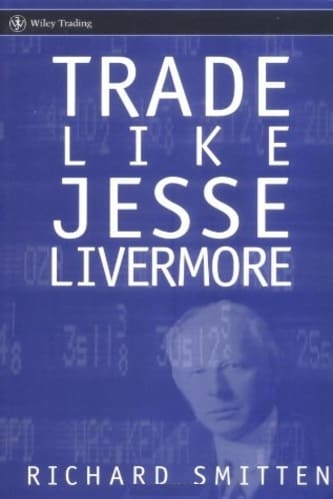
Trade Like Jesse Livermore
$19.23
Trade Like Jesse Livermore presents Richard Smitten’s reconstruction of the trading methods developed by Jesse Livermore during his long career as a stock and commodity speculator. Rather than functioning primarily as a biography, the book concentrates on the structure of Livermore’s trading system and organizes it around three interconnected disciplines: market timing, money management, and emotional control.
The technical component focuses on determining the market’s direction, which Livermore described as the Line of Least Resistance, and waiting for price action to confirm a trade before committing capital. The methodology includes Pivotal Points, Continuation Pivotal Points, one- and three-day reversal signals, breakouts to new highs, volume confirmation, tandem trading, industry-group behavior, leading stocks, and top-down market analysis. A recurring principle is that traders should follow demonstrated price behavior rather than anticipate what a market ought to do.
Risk control forms a second major component of the system. The book explains Livermore’s use of probing positions, predefined loss limits, cash reserves, staged commitments, rules against averaging losses, and procedures for protecting substantial trading profits. Profitable positions are treated differently from losing ones: losses are controlled quickly, while positions behaving correctly are given room to develop until market action provides a valid reason to exit.
The third component examines psychology and trading discipline. Livermore regarded fear, greed, hope, impatience, outside opinions, and failure to follow established rules as persistent threats to trading performance. Smitten therefore integrates preparation, record keeping, independent judgment, concentration, post-trade analysis, and adherence to rules into the broader Livermore framework. The book ultimately presents trading as a coordinated process in which timing, capital preservation, and emotional control must operate together.
✅ What You’ll Learn
- Determine the market’s prevailing direction through Livermore’s concept of the Line of Least Resistance.
- Understand how Pivotal Points and Continuation Pivotal Points are used to confirm potential entries.
- Recognize one-day and three-day reversal behavior within the Livermore framework.
- Evaluate breakouts, new highs, trading volume, leading stocks, and industry-group action before initiating positions.
- Apply tandem trading and top-down analysis to strengthen individual stock decisions.
- Use probing positions and staged commitments rather than committing full trading capital immediately.
- Apply Livermore’s loss-control principles, including avoiding averaging down and restricting individual trade losses.
- Understand when profitable positions should be retained rather than closed simply because a gain exists.
- Identify how fear, greed, hope, impatience, tips, and outside opinions can interfere with disciplined execution.
- Incorporate preparation, trading records, review, and rule-based decision-making into a repeatable trading process.
💡 Key Benefits
- Organizes the Livermore methodology into a coherent framework covering timing, money management, and emotional control.
- Connects price and volume behavior with specific confirmation principles rather than relying on unsupported market predictions.
- Provides defined capital-preservation rules for controlling losses and maintaining the ability to participate in future opportunities.
- Shows how market direction, sector behavior, individual stock action, and trade timing can be evaluated together.
- Treats trader psychology as an operational component of the trading system rather than as a separate motivational subject.
- Provides a structured reference to Livermore’s trading rules, observations, and market principles.
👤 Who This Book Is For
- Beginner to Intermediate traders seeking a structured introduction to Jesse Livermore’s approach to speculation and market timing.
- Stock traders interested in price action, breakout confirmation, volume analysis, trend direction, and pivotal-point techniques.
- Active traders seeking clearer rules for position management, loss control, and preserving trading capital.
- Traders studying the psychological discipline required to follow a defined methodology without relying on tips or outside opinions.
📚 Table of Contents
- Meet Jesse Livermore
- Timing is Everything
- Livermore Trading Discoveries
- Livermore Pattern Recognition Timing Keys: Pivotal Point Trading
- Perfecting Money Management
- Emotional Control
- How Livermore Prepared for His Day
- General Livermore Issues
- Livermore Quotes—Trading Truths
- Summary of Livermore Trading Rules
- Livermore Secret Market Key
Trade Like Jesse Livermore By Richard Smitten
| Author(s) | |
|---|---|
| Product Type | Ebook |
| Format | |
| Skill Level | Beginner to Intermediate |
| Pages | 234 |
| Publication Year | 2004 |
| Delivery | Instant Download |
5 reviews for Trade Like Jesse Livermore
Only logged in customers who have purchased this product may leave a review.
Related products





Journey McLean (verified owner) –
I have read all of richard smittens books about jesse livermore. they are all very much the same. they have identical passages in different order. the trade like jesse livermore i reckon is the best or 2nd best after how to trade in stocks – due to the flow/order. i reckon first read reminiscences of a stock operator and then one of richards smittens books. richards smittens books is also about 60% repititive to reminiscences of a stock operator which i think is okay
Jeremias Luna (verified owner) –
If you thought you would learn the actual methods of how Jesse Livermore traded, you are WRONG.
Gives a quick outline of how Livermore traded, like ‘pivotal points’ but teaches you NOTHING about how to apply them.
Illustrations are very poor, just a few trend lines which any newbie could have drawn straight out from stockcharts.com
The only moderatesly useful point may have been the emphasis of the ‘time stop’ where Livermore states that if the stock doesn’t react in a few days, get out.
The “Livermore Secret Market Key” was a total scam, once again showing and teaching you NOTHING.
Repeats about 1/4 of the book in the summary by directly cutting and pasting.
If you would like to learn more of Livermore’s methods, go read Reminescences of a Stock Operator.
I’d rather have read that one more time than waste my time and money on this book. Huge buyer’s remorse!
Dayton Wilcox (verified owner) –
Not sure why all the negative comments. Maybe as traders we are all accustomed to complex strategies that make J.L.’s seem simplistic. But that’s the beauty of it. I like this book. And the charts in it. If somebody needs an explanation of what the pivot points are on the charts, well, then you shouldn’t be trading. Because it’s so obvious. I have read all 3 J.L. books (“Reminiscences” J.L.’s original “How to trade stocks” and this one and yes, there is some repetition. But that’s a good way to learn. Don’t be put off. Read this. It’s a good solid, proven strategy…And about the writing…? it ain’t literature!
Amelia Hansen (verified owner) –
If you read Reminiscences of a Stock Operator, then you know Livermore’s rules. As for the secret trading method (Smitten calls Pivotal Point Trading)…. it boils down to trendlines. That is it. The book is so similar to the books of William ONeill I was expecting an IBD subscription card to fall out: 1. Watch the top industry groups for market signals. 2. Watch the top two stocks in each market group. 3. Cut losses at 10% (IBD is 8%). 4. Watch for volume to be up at least 50%. 5. Do not average down. 6. Buy on breakouts to new highs. etc, etc, etc.
Charlie Whitaker (verified owner) –
Smitten uses Livermore’s own words from his book “How to Trade in Stocks”in the first part of the book, but then offers detailed analysis. I have read both books and both are excellent trading books for new traders and intermediates. The only weakness is there is considerable overlap between Smitten’s book and Livermore’s.