
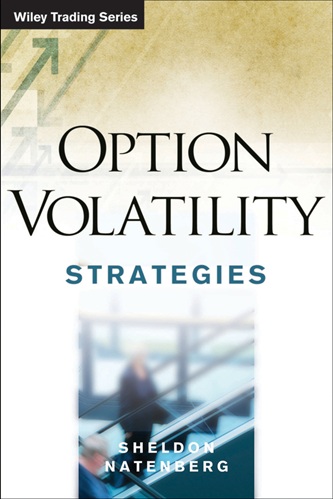
Option Volatility Trading Strategies
$21.66
Option Volatility Trading Strategies provides a structured introduction to the role volatility plays in option valuation, pricing, and strategy selection. Sheldon Natenberg explains why volatility is the least directly observable input in an option-pricing model and demonstrates how errors in estimating it can materially affect theoretical option values.
The book develops its framework through probability-based pricing principles, beginning with the Black-Scholes model and the fundamental inputs used to calculate theoretical value. It examines normal and lognormal distributions, standard deviation, annualized volatility, and the conversion of volatility measurements across different time periods.
A central part of the methodology is the distinction between future, historical, forecast, and implied volatility. Natenberg shows how traders compare implied volatility, representing market price, with an estimate of future volatility, representing theoretical value. This price-versus-value comparison forms the basis of the book’s volatility-trading framework.
The practical sections address delta-neutral positioning, dynamic rehedging, covered and uncovered option exposure, volatility cones, forecasting characteristics, and the limitations of theoretical models in real markets. Supporting appendices provide additional guidance on option fundamentals, Black-Scholes, calendar spreads, valuation Greeks, and essential terminology.
✅ What You’ll Learn
- Identify the principal inputs used in theoretical option-pricing models.
- Understand how probability distributions influence option values.
- Interpret standard deviation as a practical measure of market volatility.
- Convert annual volatility into daily and other time-period measurements.
- Distinguish future, historical, forecast, and implied volatility.
- Compare an option’s market price with its estimated theoretical value.
- Recognize when market behavior conflicts with model assumptions.
- Structure and maintain delta-neutral volatility positions.
- Evaluate volatility cones, mean reversion, and serial correlation.
- Account for hedging risk, model risk, commissions, and margin requirements.
💡 Key Benefits
- Establishes a disciplined framework for evaluating whether options are relatively expensive or inexpensive.
- Connects statistical concepts to practical option-pricing decisions without relying on extensive mathematics.
- Clarifies the limitations of Black-Scholes and similar theoretical models.
- Improves awareness of the risks associated with uncovered options and imperfect hedging.
- Provides a foundation for interpreting professional volatility forecasts and model outputs.
- Integrates core theory with self-tests, examples, appendices, and reference material.
👤 Who This Book Is For
- Beginner to intermediate options traders seeking a structured understanding of volatility.
- Equity, index, futures, or commodity traders who use exchange-traded options.
- Investors who want to evaluate option prices through theoretical value rather than directional opinion alone.
- Market participants interested in volatility trading, hedging, spreads, and professional pricing methods.
📚 Table of Contents
- Chapter 1: The Most Important Tool for Any Options Trader
- Chapter 2: Probability and Its Role in Valuing Options
- Chapter 3: Using Standard Deviation to Assess Levels of Volatility
- Chapter 4: Making Your Pricing Model More Accurate
- Chapter 5: The Four Types of Volatility and How to Evaluate Them
- Chapter 6: Volatility Trading Strategies
- Chapter 7: Theoretical Models vs. the Real World
Option Volatility Trading Strategies By Sheldon Natenberg
| Author(s) | |
|---|---|
| Product Type | Ebook |
| Format | |
| Skill Level | Beginner to Intermediate |
| Pages | 173 |
| Publication Year | 2007 |
| Delivery | Instant Download |
7 reviews for Option Volatility Trading Strategies
Only logged in customers who have purchased this product may leave a review.
Mila Lawson (verified owner) –
Although I am a great fan of Shelly (Sheldon Natenberg) I want to say that the website mentioned doesn’t work ,we can’t get the answers of questions or recorded videos of Shelly there. It has become long time since this book is updated. The person who pays such a price for about 150 pages book should get the answers and lastly the book needs to be updated as soon as possible.
Haylee Ellis (verified owner) –
Nattenberg is a Master on Options, but this book is just an introduction to price & Volatility. Do not expect strategies nor anything easilly useful
Jacoby Oliver (verified owner) –
Compared to his first book, this one is a joke and makes you wonder whether Natenberg did write it himself. It was way to basic and brief for a serious vol trader and too involved for a beginner. I went through the book in 30 minutes and was extremely disappointed. The book has less than 100 pages of real content, not to mention large font size and double space. A good chunk was spent on talking about very basic concept of expected value and normal distribution. I hope anyone who is interested in trading option would know such things by heart. And the book ends very abruptly. In short, the technical content of the book is thin, not worth $21.
Muhammad David (verified owner) –
I approached this book with great expectations having read other books of natenburg, this book fell short. Very basic information even dummies series will have more information. There is nothing that you can take from this book and call as strategy. Perhaps basic fundamental of option volatility would be a good title and 50 pages would be enough
Cadence Curtis (verified owner) –
Great discussion of volatility and explained well for the “not so mathematically inclined”. Not deep enough to actually learn trading.
Marilyn Ruiz (verified owner) –
No one has ever questioned that Natenberg literally wrote the book on option volatility and pricing, but I don’t think anyone will argue it is not a light read. This new work is immensely more accessible and actually reads light a chat with the author. The professional or highly experienced trader might find it a good refresher at best, but for the newbie or average trader this book is a trove of answers and solid explanations. I haven’t tried the tests at the end of the chapters (you can go to Traders’ Library to take the online) but it looks like a good idea. The way I see it is this book is like the friend you had who read the instructions for the game Risk so you didn’t have to. A great book to have on your shelf.
Camille Rowland (verified owner) –
I did this backward I got his first book “option volatility & pricing” first it took me a couple months to really understand it but if I would have started with this one it would have been a quicker study.
Sheldon is a master and explains how the retail investor can succeed even if he doesn’t actually say it.
Both his books are a must, you will find new things out each time you read them, I find myself always going back to them over and over.
Watch tastytrade along the way and you will be successful.