
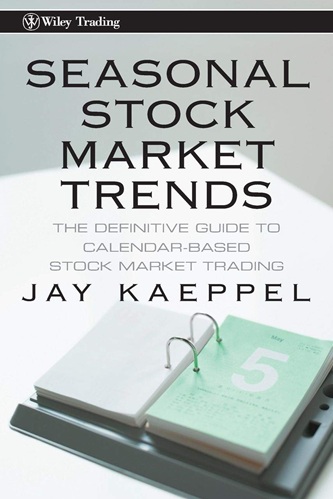
Seasonal Stock Market Trends: The Definitive Guide to Calendar-Based Stock Market Trading
$23.50
Seasonal Stock Market Trends by Jay Kaeppel is the most comprehensive and statistically grounded guide ever written on calendar-based trading strategies. Spanning decades of market data, Kaeppel reveals how recurring patterns—driven by investor psychology, institutional behavior, liquidity cycles, and macroeconomic seasonality—create reliable tendencies in the stock market.
The book contains exceptionally detailed research, including the “Election Cycle Heatmap” on page 52, the S&P 500 Presidential Cycle chart on page 58, the Monthly Market Strength tables on pages 80–91, and the Power Zone composites on pages 142–155. These visuals allow traders to see precisely how certain months, weeks, and even days tend to behave across history, delivering a statistical foundation for repeatable seasonal trading systems.
Kaeppel presents dozens of robust strategies such as:
- The “Best Six Months” strategy
- The Santa Claus Rally
- The Presidential Cycle
- First Trading Day / Last Trading Day effects
- Sector-specific seasonal edges
- Holidays, end-of-quarter flows, and turn-of-month strength
- Momentum filters applied to seasonal patterns
Rather than promoting prediction, Kaeppel teaches traders how to exploit historically consistent tendencies while combining them with risk filters, trend confirmation, and disciplined execution. Each strategy is supported by quantified performance results, making the book a data-driven manual rather than a theoretical overview.
This is the authoritative reference for traders who want to integrate seasonality into a professional trading system.
✅ What You’ll Learn:
- How seasonal and calendar cycles influence stock market behavior
- Which months, weeks, and days have the strongest historical performance
- The mechanics of the Presidential Cycle and election-year tendencies
- High-probability seasonal strategies using historical market bias
- Turn-of-the-month, holiday, and quarterly flows that repeat reliably
- Sector-specific seasonal opportunities (technology, gold, energy, etc.)
- How to backtest seasonal strategies correctly
- How to combine seasonal edges with trend filters and risk controls
- How to identify “Power Zones” of maximum market tendency
- How to build a seasonal trading portfolio with rules and discipline
💡 Key Benefits:
- A fully quantified, evidence-based approach to seasonal trading
- Reduces noise by focusing on statistically proven market behaviors
- Helps time entries and exits using decades of historical tendencies
- Works across indices, ETFs, and industry groups
- Enables traders to build simple, robust rules for recurring patterns
- Enhances strategy diversification with non-correlated seasonal edges
👤 Who This Book Is For:
This book is ideal for:
- Intermediate traders seeking systematic, data-driven strategies
- Swing and position traders who want timing advantages
- Investors looking to integrate seasonality into long-term portfolios
- Quantitative traders testing calendar-based patterns
- ETF and index traders seeking reliable historical edges
- Anyone wanting a rules-based approach built on multi-decade data
📚 Table of Contents:
- Introduction to Seasonality in the Stock Market
- The Month of January
- Holiday Seasonal Trends
- Monthly Seasonal Trends
- Yearly Seasonal Trends
- Repetitive Time Cycles of Note
- Election Cycle Investing
- Sell in May and Go Away
- Putting It All Together
Seasonal Stock Market Trends By Jay Kaeppel
| Author(s) | |
|---|---|
| Product Type | Ebook |
| Format | |
| Skill Level | Intermediate to Advanced |
| Pages | 312 |
| Publication Year | 2009 |
| Delivery | Instant Download |
15 reviews for Seasonal Stock Market Trends: The Definitive Guide to Calendar-Based Stock Market Trading
Only logged in customers who have purchased this product may leave a review.
Related products

Estella Patrick (verified owner) –
This was an interesting book and easy to read, but ultimately unsatisfactory. The first issue was that there was no accounting of transaction costs – which is completely unrealistic. The second issue is that the data used to confirm his ideas was the same data that were used to generate the idea – a very serious problem.
In any event, I was interested enough to test his ideas.
As the book was written some time ago the data from 2007 to 2019 were out of sample. This gave 3271 data points. I used the KTI as described in Chapter 9. There were 693 times where the strategy called for a change (transaction out & in, so 1384 transaction costs – that’s not cheap). The overall gain using KTI (ignoring transaction costs) was 95%. A simple buy and hold strategy yielded 128% gain (and would have avoided the transaction costs).
It may be possible that implementing parts of the strategy might yield superior results but, to some extent, that is also poisoning the data and should be approached cautiously, if at all.
Still, some interesting ideas and a completely approachable book. Just be cautious implementing the ideas.
Navy Rice (verified owner) –
Kaeppel outlines from the start that the strategies presented are to be used in conjunction with your current strategies, in order to enhance performance by investing during optimal times. The book is direct, easy to understand and every statement is backed up using historical data.
Maggie Hayden (verified owner) –
The book was well written and informative. I had heard of a lot of the trends in the past, but there were several that were new to me as well.
I recently subscribed to […] The site researches stocks to uncover historical trends based on calendar as well as company earnings releases. I have found that using their research along with some simple technical analysis produces very good results.
Izabella Skinner (verified owner) –
I coded the main system (KTI) presented in the last chapter into Tradestation. The results are spectacular as the author claimed for years 1934 through 2007. “Incidentally”, the worst drawdown is for the only year the author didn’t have the data for (which is 2008). This is because he didn’t separate the available data into test and train subsets which is quite standard technique. Of course, if one tests the results on the same data they used to derive the system rules the outcome will be excellent.
Take this review as a warning.
Veronica O’Donnell (verified owner) –
This is a well written book about a very useful topic for Traders. I have used the Seasonal Stock Trading technique for many years now and have been quite profitable doing so.
HOWEVER, to really get good results out of Seasonal Stock Trading .. you need to have a service like Blashing.com to get Seasonal data and graphs for every stock or ETF. They also have a Seasonal Stock Scanner which finds the best stocks to buy and sell for every period of the year.
So, using the Seasonal Stock Trading technique learned from this good book along with having access to good, reliable Seasonal data and graphs is a very profitable method to Trade Stocks.
Aniya Blackwell (verified owner) –
“Seasonal Stock Market Trends” by Jay Kaeppel is a detailed guide to trading in the stock market based on seasonal patterns. The book covers the concepts of seasonality and its impact on stock prices.
The author’s writing style is straightforward, with clear explanations of technical concepts. The book is divided into four parts, covering the basics of seasonal trading, the different seasonal trends in the stock market, strategies for trading based on seasonal trends, and case studies of seasonal trading.
Kaeppel discusses several key concepts in the book, including the Santa Claus rally, the January effect, and the summer rally. He also covers strategies for trading based on these patterns, including how to identify potential trades, set stop losses, and execute trades.
The book is highly effective in teaching the subject matter, with detailed explanations and real-world examples to illustrate the concepts. Kaeppel provides unique insights into seasonal trading, including how to use seasonal trends to identify potential trades and the importance of risk management in seasonal trading.
The examples and explanations in the book are helpful, making complex concepts easy to understand. The author provides clear charts and tables to help readers visualize the data, making it easier to identify trends and potential trades.
The book could be improved by including more updated data and examples, as the book was published in 2009. Some of the strategies may also be too technical for beginners, making it challenging for them to follow along.
Overall, “Seasonal Stock Market Trends” is an essential guide for traders who want to capitalize on seasonal patterns in the stock market. It’s suitable for intermediate to advanced traders who are already familiar with technical analysis and want to explore new strategies.
Naomi Miles (verified owner) –
All was as expected
Nadia Neal (verified owner) –
Perfect introduction to seasonal trading.
Kane Dawson (verified owner) –
This book is an interesting read and Jay shares some extremely powerful seasonal patterns that are simple to incorporate into your existing trading models.
Graham Padilla (verified owner) –
Good book, got me thinking about seasonal trends to go along with my trading approach
Lian Phillips (verified owner) –
Good eye opening book on seasonals. I like how he keeps iterating with more discretion and using leverage instead of adding more rules. It needs a 2nd edition soon, the data stops around 2007-2008 so you have to run your own backtest using recent data. Jay seems down to earth, theory is definatley worth considering.
Autumn Castillo (verified owner) –
Too early to tell.
Ridge Mack (verified owner) –
The is a trading book that I’ll come back to again and again. Jay is pretty rigorous in his testing, and some of The seasonal patterns he’s found defy belief…and yet there they are, as plain as day.
The book was written a few years ago, but that’s actually a good thing, as you can then research for yourself the “out of sample” data of the subsequent time period, and see for yourself if the patterns are still holding up.
My one quibble, which is minor, is that the longer-term patterns (4- Or 10-Year patterns for example) simply haven’t had enough data points in the last 120 yrs or so to be truly meaningful. But the astute reader can decide for him/herself whether there’s signal in the noise.
Jay also has a great and humorous writing style, and you’ll be hard-pressed to find a book on historical trading patterns that is this light and amusing. A must-read.
Marcellus Sutton (verified owner) –
This is the kind of book that can get you thinking, questioning your belief system, and forces you to accept facts. I guaranty you that there is no way you can read this book and not get out a calendar and start making notes. For everyone of us who has thought “the trend is your friend” was a trite expression and then immediately started thinking we were smarter than the market and then started picking tops, this book is a slap on the back of the head. Well written and presented. Highly recommended.
Jared Yu (verified owner) –
The book should actually be called “Calendar Investing”, because it conserns itself with how the market performs on a calendar, not Winter, Spring, Summer, Fall.
That being said, the book stays on topic and makes its points clearly. The book goes into broader details and also micro details, but always on topic.
A minor drawback is that each chapter has useless introductions and conclusions. We were taught (badly) in school that we are supposed to indiscriminately pad our writing with such filler. A much better way to present technical material is the DRY approach (Don’t Repeat Yourself). Besides the introductions/conclusions, the author also sometimes repeats himself in-chapter (“as we discussed earlier…”). Personally, I want to read high quality information, and only high quality information, exactly once. But these writing inefficiencies are not enough to take a star away. So I still give the book five stars.