
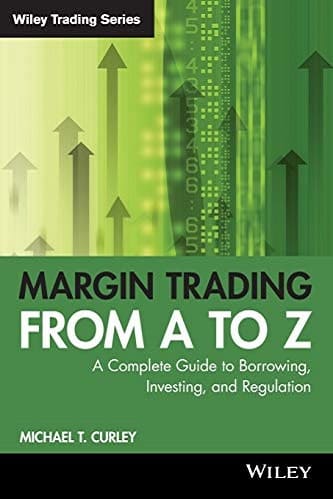
Margin Trading from A to Z: A Complete Guide to Borrowing, Investing and Regulation
$16.43
Margin Trading from A to Z offers a step-by-step explanation of the mechanics of the margin account. Filled with in-depth insights and expert advice, this book uses a hands-on approach to show how a Regulation T Margin Call is arrived at; how it may be answered; and how an account looks once a call is issued and after the call is met. Other items covered by this detailed guide include minimum maintenance requirements, short selling, memorandum accounts, options, hedge funds, and portfolio margining. The book includes quiz questions and a comprehensive exam.
Author’s Introduction:
Trading on margin has taken an unfair and unwarranted amount of abuse. Purchasing securities on margin is nothing more than purchasing securities on credit. Credit is not evil or bad and, if properly used, can be an extremely profitable means of investing. If I told you that I had just purchased a house and paid for it in full, I am sure you would be surprised, because this is not the normal procedure for purchasing a house. Most people react to this statement by saying that (1) a house is a huge purchase requiring financing (true) and (2) there is no risk—real estate always increases in value (false).
I would be negligent not to tell you that any credit purchase of stocks, bonds, real estate, furniture, fixtures, and so on involves a degree of risk. However, a cash purchase in full of the same items involves the same degree of risk. The value of items purchased, whether financed or paid for in full, can decline, giving you a loss. Real estate prices have dropped substantially in certain geographical areas, areas that have experienced a decline in jobs and increased unemployment; a decline in real estate value usually accompanies it. The real estate decline affected houses being financed with a mortgage as well as those that were fully paid.
The first false notion one must discard is the idea that debt is bad. It is not. Borrowed funds used properly can result in considerable profits. The term leveraged buyout is very popular right now on Wall Street. It is nothing more than one company taking over another company with borrowed funds. Our economy and our standard of living as we know it today would not exist without credit. The obvious fact in purchasing securities on credit, with the current requirements at 50 percent, is that one can purchase twice as much in a margin account as in a cash account.
Consequently, if one purchases $10,000 worth of securities in a cash account and that security doubles in value, one has a profit of $10,000. The same $10,000 in a margin account enables one to purchase $20,000 in securities. Should these securities double in value, the profit is $20,000. That, in essence, is the principle behind margin trading. Often, the complaint is voiced that an additional expense is involved in margin trading, because the broker charges interest on the money he or she is financing. And that is absolutely true. However, since one can purchase twice as many securities, twice as many dividends are available to offset a good portion of the interest charged.
A margin account can also be used to obtain financing for purposes other than buying and selling securities. Assume a customer has $60,000 in market value of listed securities and wants to buy a new car with a total sticker price of $27,000. Depositing these securities into a margin account, the broker is permitted to finance 50 percent, or $30,000. In this case, the customer has purchased his or her car and still maintained ownership of the securities. Interest charged by the broker is approximately the same as that charged by a bank for an auto loan. The advantage of the margin account is that the client does not have to make monthly payments to pay off the loan. The loan may be paid off at any time or can stay open indefinitely, provided the collateral is sufficient to meet the minimum maintenance requirement (this is discussed in detail in the text). In addition, the bank loan requires the automobile as collateral. The bank can thus dictate what kind of insurance must be purchased, whether alarms must be installed, and so on. However, with the margin account the loan is tied to the securities deposited and has nothing to do with the car.
Contents:
- Cash Accounts
- Initial Federal Margin Requirements
- Initial and Minimum Maintenance Requirements
- The Special Memorandum Account
- Short Sales
- Bonds
- Miscellaneous Categories
- Options
- Portfolio Margining
Margin Trading from A to Z: A Complete Guide to Borrowing, Investing and Regulation By Michael T. Curley pdf
| Author(s) | |
|---|---|
| Format | |
| Pages | 206 |
| Publication Year | 2008 |
1 review for Margin Trading from A to Z: A Complete Guide to Borrowing, Investing and Regulation
Only logged in customers who have purchased this product may leave a review.
Related products






Manuel Holmes (verified owner) –
The author does a good job in this book of showing how margin works. He does this with specific scenarios showing what your account looks like after taking a stock position on margin. The book breaks down what your equity market value is after a purchase and what your debit and equity balance looks like. You will also see how these change with the fluctuation of the market value of your equity. The book shows what the minimum equity requirement is to maintain a position on margin before you get a margin call. The book explains the anatomy of how a short sale works in a margin account. He discusses the minimum cash requirement for pattern day trading ($25,000) and how you can use the maximum amount of margin to day trade by always getting out of your positions on the same day you purchase an equity. The book has an outstanding chapter on options, really explaining how they work along with their margin requirements for trading them. There is also a chapter on what is called a portfolio margin account, which allows for much more leverage than the traditional 50% margin account requirement. This type of account adjusts margin based on risk, you can hedge your positions by holding put or call options that insure your holdings and minimize your risk. Doing this inside a portfolio margin account allows you to 10 times leverage of more due to the low risk position. (However this type of account has large capital requirements of $100,000 or more). This book is for beginners, and I would recommend reading it if you want a better understanding of how margin works. If you plan on being a day trader you will need a margin account to be able to trade enough size to profit daily.