
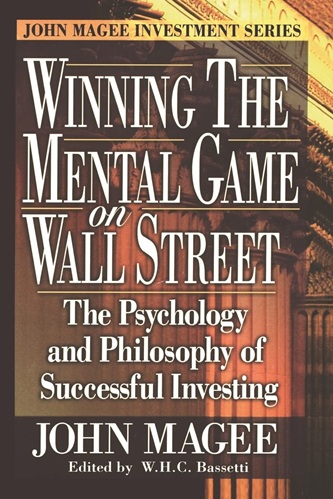
Winning the Mental Game on Wall Street: The Psychology and Philosophy of Successful Investing
$26.86
Winning the Mental Game on Wall Street is a classic work on the psychological foundations of successful investing. John Magee—best known as a pioneer of technical market analysis—turns his attention inward, examining the mental habits, emotional pressures, and philosophical attitudes that separate consistent investors from those who repeatedly sabotage their own results. The book argues that markets do not defeat most participants; rather, investors defeat themselves through fear, impatience, overconfidence, and lack of discipline.
Magee frames investing as a decision-making profession where emotional control and self-awareness are as critical as analytical skill. He explores how hope and fear distort judgment, how ego interferes with risk management, and why the inability to accept losses often leads to far greater damage than being wrong on a trade. Throughout the book, mistakes are treated not as failures of intelligence, but as predictable psychological traps that can be anticipated and managed.
A defining strength of the book is its emphasis on philosophy. Magee does not offer quick fixes or motivational slogans. Instead, he encourages readers to adopt a professional mindset—one that respects uncertainty, embraces probability, and accepts losses as a normal cost of participation. Discipline, consistency, and humility are presented as learned behaviors, not innate traits.
Rather than being tied to any specific market or method, Winning the Mental Game on Wall Street applies to all forms of investing and trading. Its lessons are timeless because they address human behavior, which remains constant across market cycles. For serious market participants, the book serves as both a mirror and a guide—helping readers recognize destructive patterns and replace them with constructive mental frameworks.
✅ What You’ll Learn:
- Why emotional discipline is more important than analytical brilliance
- How fear, hope, and ego distort investment decisions
- How to develop a professional mindset toward losses and uncertainty
- Why consistency depends on behavior, not prediction
- How to align philosophy, psychology, and execution
💡 Key Benefits:
- Improves decision quality by addressing the root causes of poor performance
- Helps investors build emotional resilience during drawdowns
- Encourages disciplined, probability-based thinking
- Applicable to all markets, strategies, and timeframes
👤 Who This Book Is For:
- Traders and investors struggling with emotional consistency
- Market participants seeking psychological edge rather than new strategies
- Readers interested in the philosophy of investing success
- Not suitable for readers looking for technical indicators or trading systems
📚 Table of Contents:
- THE BIG GAME
- OUT OF THE DARKNESS
- THE PRIMARY RECEPTORS
- A STARTING POINT
- DATING THE MAP
- THE 26 LEAD SOLDIERS
- THE PIGEONHOLES
- BEYOND THE WORLD OF THINGS
- THE MEANINGS WE ATTACH TO MAPS
- THE VAGUENESS OF THE HIGH ABSTRACTIONS
- THREE-VALUED ORIENTATION
- MULTI-VALUED SYSTEMS
- INFINITE-VALUED SYSTEMS
- PROFITS CAN BE PAINFUL, TOO
- PREDICTING THE FUTURE
- THE METHOD OF PREDICTION
- PUT THEM AWAY IN THE BOX AND FORGET THEM
- POLITICS AND ECONOMICS
Winning the Mental Game on Wall Street: The Psychology and Philosophy of Successful Investing By John Magee
| Author(s) | |
|---|---|
| Product Type | Ebook |
| Format | |
| Skill Level | Beginner to Intermediate |
| Pages | 456 |
| Publication Year | 2000 |
| Delivery | Instant Download |
5 reviews for Winning the Mental Game on Wall Street: The Psychology and Philosophy of Successful Investing
Only logged in customers who have purchased this product may leave a review.
Related products

Jade Ferguson (verified owner) –
The answer to all those traders that constantly loose money in the market.
Lyanna Colon (verified owner) –
Of all the books available on the markets, this is the one I’d recommend to a beginner as a starting point. I’m not surprised that an amateur would be disappointed (or even dissapoined) in it since it doesn’t provide quick-start recipes for guaranteed success in the financial arena. What it does do is explain what the markets are all about. It dispels the myths that lead to inevitable losses and eventual ruin, preparing one for the reality of the market rather than perpetuating the illusions that enable all those advisory services, newsletters, and gurus to flourish.
You won’t learn the “best” MACD settings here. What you will learn is the reality of the markets, a necessary first step toward creating a trading style.
Oddly enough, Amazon has paired the book with The Nature of Risk, above, at least temporarily, which is the second book I’d recommend to anyone interested in learning how to approach the financial markets.
Miguel Short (verified owner) –
great book
Frankie Roach (verified owner) –
This is one that I wish I had read when I first started trading. It took me over 3 years to even come across this book. I had no idea it existed. I can’t be sure if it would have the same effect then as it does now. However, I honestly feel that it is essential no matter what stage you are in. One would probably benefit to read this book every 3 to 6 months. I have a pretty solid suspicion that the material is this book will take on different meanings during different stages of a trader’s progression.
If you are open to change in your life, this will be one of the most influential books you will come across. There is many a paradigm shift in the text. It is often difficult for people to accept change since our perceptions are ingrained from such an early age. However, it is possible to change these habits and preconceptions once one “learns how to see”. Magee’s book will put you on the right path to “seeing” how Wall Street really is.
This isn’t a “how to” book on trading. It is meant as a companion piece to Magee’s other work, TA of Stock Trends. And when one considers that these books were written a few generations ago, it lays credence to the adage that the more things change the more they stay the same. The same game is played on Wall Street today as it was 100 years ago and will continue 100 years into the future.
When you are ready to learn (and I mean open your eyes to a new way of thinking) this book will be there for you.
Bruce Long (verified owner) –
This book is a gem. After reading this book, I will no longer be seeking a fast, easy, get rich method. Since, there isn’t one in our ever changing world.
This book is a must read for anyone entering the markets because it sets up the outlook for an investor in the market which involves gains and losses.