
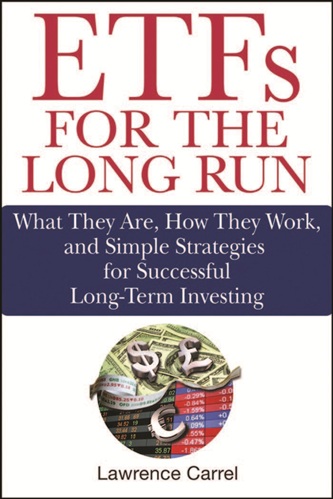
ETFs for the Long Run: What They Are, How They Work, and Simple Strategies for Successful Long-Term Investing
$19.53
ETFs for the Long Run by Lawrence Carrel is a structured, practical examination of exchange-traded funds as long-term investment vehicles. Rather than treating ETFs as short-term trading instruments, Carrel positions them within the broader framework of disciplined portfolio construction, cost control, and tax efficiency. The book was written during a formative period in ETF industry growth, and it provides both historical context and structural insight into how these instruments evolved and why they matter.
The core philosophy of the book is grounded in efficiency and transparency. Carrel explains how ETFs differ from mutual funds in structure, pricing mechanics, and operational design—particularly the creation and redemption process that allows ETFs to minimize costs and maintain tight tracking to underlying indexes. By clarifying how ETFs are built and traded, the book removes the ambiguity that often surrounds investment products marketed as “simple.”
Beyond structural mechanics, the text emphasizes long-term allocation discipline. It discusses index construction, fee structures, diversification principles, and the importance of asset allocation in building durable portfolios. Carrel also addresses actively managed ETFs, exchange-traded notes (ETNs), and related instruments, providing analytical clarity around risks that are often overlooked.
The final chapters transition from theory to application, guiding readers through the process of constructing an ETF-based portfolio aligned with long-term wealth accumulation. The result is a comprehensive manual for investors who want to understand not just what ETFs are, but how they function within a coherent, cost-conscious investment strategy.
✅ What You’ll Learn:
- How ETFs are structured, created, and redeemed in the primary market
- The operational differences between ETFs and traditional mutual funds
- Why index construction and tracking methodology matter
- How fees, expense ratios, and hidden costs impact long-term returns
- The tax efficiency mechanisms unique to ETFs
- The distinctions between ETFs, ETNs, and other exchange-traded products
- How to evaluate actively managed versus passive ETF strategies
- A framework for building a diversified ETF-based portfolio
💡 Key Benefits:
- Greater clarity in selecting cost-efficient investment vehicles
- Improved long-term allocation decisions through structural understanding
- Reduced risk of hidden fee erosion
- Enhanced confidence in constructing diversified portfolios
- Better evaluation of marketing claims surrounding ETF products
- Stronger alignment between investment strategy and long-term wealth goals
👤 Who This Book Is For:
- Beginner to intermediate investors building long-term portfolios
- Self-directed investors transitioning from mutual funds to ETFs
- Retirement-focused investors emphasizing cost control
- Financial professionals seeking structural ETF knowledge
- Investors prioritizing diversification and tax efficiency
📚 Table of Contents:
- Chapter 1: ETFs—The Newfangled Mutual Funds
- Chapter 2: ETF History Lesson: How a New Type of Fund Was Born
- Chapter 3: The Evolution of the ETF
- Chapter 4: Index Fund-amentals
- Chapter 5: Fee Bitten
- Chapter 6: The Better Mousetrap: How Can ETFs Charge So Little?
- Chapter 7: The New Indexers
- Chapter 8: The ETFs That Aren’t ETFs: ETPs, ETVs, and Related Products
- Chapter 9: Putting the “Trade” in Exchange-Traded Funds
- Chapter 10: Building Your Own ETF Portfolio
ETFs for the Long Run: What They Are, How They Work, and Simple Strategies for Successful Long-Term Investing by Lawrence Carrel
| Author(s) | |
|---|---|
| Product Type | Ebook |
| Format | |
| Skill Level | Beginner to Intermediate |
| Pages | 323 |
| Publication Year | 2008 |
| Delivery | Instant Download |
8 reviews for ETFs for the Long Run: What They Are, How They Work, and Simple Strategies for Successful Long-Term Investing
Only logged in customers who have purchased this product may leave a review.
Related products
Braylon Moyer (verified owner) –
Book in excellent condition. Very interesting content for newbies to the subject and for those who know a little more about it.
Makenzie Yates (verified owner) –
Having the interest to invest long term in a product which can have a low cost and high return I wanted to educate myself further on the do’s and don’ts of trading ETFs. Easy reading and not too technical.
Killian Callahan (verified owner) –
An introductory text on ETFs. Good coverage. A bit dated, by the time of writing. Looks at ETFs through an American lens rather a British one. If you don’t know anything about ETFs and want to, this could be a good starting point, but I don’t know if it’s the best, especially for a UK reader.
Lola Clark (verified owner) –
Best ETF book ever. Anything you need to know about ETFs is in this book. Lawrence explains why they are better than mutual funds, shares the history of ETFs and explains all the tax ramifications of alternative ETFs. This book is definitely the authority on ETFs.
Kimber Greer (verified owner) –
Excellent book. Thoroughly describes the history, pro’s and con’s of ETF’s. Provides application strategies to consider and offers allocation suggestions. This book will give most investors all that is needed to decided whether to use ETF’S exclusively or mix them with standard mutual fund offerings.
Zola Cohen (verified owner) –
The issuance of ETFs, or to be more accurate, ETPs, has exploded over the last ten years. As with most new, successful financial inventions, there are good reasons to invest in them, but many of us do it without really understanding how they work. The common wisdom is that they are mutual funds that trade like stocks, which is true. But as with anything investors want to put their life savings into, they need to make an effort to know what exactly they are.
ETFs for the Long Run is a good start, but not a great one. You will read, many times, about how ETFs have a much lower management costs than mutual funds. How they are more transparent — they release a list of their of their holdings essentially in real time instead of the six-month rear view mirror that mutual funds do. And how they are more tax-efficient – you won’t be taxed on profits they make that you don’t get as happens with mutual funds.
But this book will only give you a limited glimpse at how these securities work. For example, it’s only stated once, very briefly, that the Authorized Participants who deal in ETF units make money by arbitraging the value of the ETFs with those of their underlying investments. They do this very often. It’s why ETFs hew toward their NAVs. And why APs do it. It’s a money-making machine for them, and an essential part of how they work.
Worse, the author often touts ETPs that trade dangerously thinly. For example, he recommends BWV, an ETN based on selling covered calls. Today, that ETN traded only 114 shares. It rarely trades more than few thousand. It’s essentially illiquid, which is something retail investors should avoid. PBP, a similar ETN, trades over 100,000 shares consistently and would be more appropriate. To be fair, PBP came to market after this book was written. But it’s still disturbing that BWV got such a good review.
Finally, this book is very repetitious and typos abound. One gets the sense that it’s a compilation of quickly produced articles thrown somewhat carelessly together to form a book. Perhaps the author was in a hurry to be one of the first to get a book about ETPs to market. And he did. But read it with some skepticism. He ran too fast to get all the details and recommendations right. But he did get most of the basics in, which are repeated continually.
Koda Hicks (verified owner) –
If you like history this book is interesting. Unfortunately the world of 2007 and today is not comparable in many ways. Of course some concepts are timeless. That said if you want, like I did, a current plan for investing in ETF’s then this is probably not the book for you. The mere fact that in 2007 trading fees created a vastly different environment than in 2021 where trading fees are more or less gone speaks volumes.
John Shelton (verified owner) –
I felt this book did a great job explaining the topic and giving a basic introduction into ETFs. After reading this yesterday I felt that the author could delve more into building a successful trading strategy. It’s good to know the history and how ETFs came into existence but it’s not very useful to me as an investor. The section on building portfolios was probably the most useful section of the book but I felt it could have been expanded.