
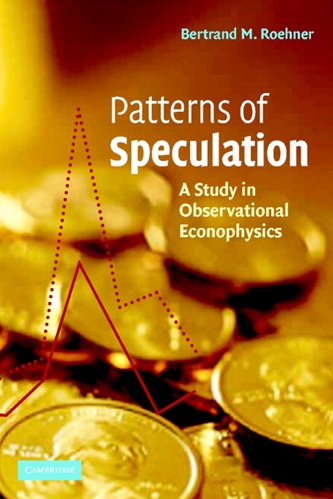
Patterns of Speculation: A Study in Observational Econophysics
$24.49
“Patterns of Speculation: A Study in Observational Econophysics” by Bertrand M. Roehner is a deeply analytical examination of speculative behavior in financial markets through the lens of empirical observation and physical science methodology. Rather than relying on economic theory or abstract modeling, Roehner approaches markets as observable systems whose speculative phases—booms, bubbles, and crashes—exhibit recurring structural patterns across time, geography, and asset classes.
The book introduces readers to econophysics, a discipline that applies methods from statistical physics to economic and financial phenomena. Roehner systematically studies historical episodes of speculation, including stock market manias, real estate bubbles, and commodity price surges, demonstrating that speculative dynamics often follow remarkably similar trajectories regardless of the underlying asset. These trajectories include characteristic acceleration phases, peak formation, instability zones, and collapse patterns.
A central contribution of the book is its emphasis on pattern recognition over prediction. Roehner argues that while exact forecasting is unrealistic, recognizing recurring speculative signatures allows analysts and traders to better assess risk, identify late-stage bubbles, and understand market fragility. The work challenges traditional efficient-market assumptions and highlights the collective behavior of investors as a dominant force shaping price dynamics.
Written in a precise, research-driven style, this book is not a trading manual but a conceptual framework for understanding how speculation evolves and why markets repeatedly generate extreme events. It is particularly valuable for traders, analysts, and researchers who want to deepen their understanding of market cycles, crowd behavior, and the structural anatomy of bubbles and crashes.
✅ What You’ll Learn:
- What econophysics is and how it applies to financial market analysis.
- How speculative bubbles and crashes develop through identifiable stages.
- Empirical patterns shared across historical episodes of speculation.
- Why crowd behavior and imitation dominate market extremes.
- How acceleration, instability, and collapse phases manifest in price data.
- The limitations of classical economic models in explaining speculative events.
- How observational analysis can improve risk awareness during late-cycle markets.
💡 Key Benefits:
- Develop a deeper, structural understanding of market speculation and extremes.
- Learn to recognize warning signs of bubbles without relying on forecasts.
- Gain an interdisciplinary perspective combining physics, history, and finance.
- Strengthen market-cycle awareness beyond indicators and price patterns.
- Improve strategic thinking during periods of exuberance and panic.
👤 Who This Book Is For:
- Intermediate to advanced traders seeking a conceptual edge in market-cycle analysis.
- Analysts and researchers interested in bubbles, crashes, and systemic risk.
- Market participants who want to understand crowd psychology at extremes.
- Readers interested in econophysics, complexity, and financial systems.
- Long-term investors focused on capital preservation during speculative phases.
📚 Table of Contents:
- WHY ECONOPHYSICS?
- THE BEGINNINGS OF ECONOPHYSICS
- SOCIAL MAN VERSUS HOMO ECONOMICUS
- ORGANIZATION OF SPECULATIVE MARKETS
- COLLECTIVE BEHAVIOR OF INVESTORS
- SPECULATIVE PEAKS: STATISTICAL REGULARITIES
- TWO CLASSES OF SPECULATIVE PEAKS
- DYNAMICS OF SPECULATIVE PEAKS: THEORETICAL FRAMEWORK
- THEORETICAL FRAMEWORK: IMPLICATIONS
Patterns of Speculation: A Study in Observational Econophysics By Bertrand M. Roehner
| Author(s) | |
|---|---|
| Product Type | Ebook |
| Format | |
| Skill Level | Intermediate to Advanced |
| Pages | 246 |
| Publication Year | 2002 |
| Delivery | Instant Download |
3 reviews for Patterns of Speculation: A Study in Observational Econophysics
Only logged in customers who have purchased this product may leave a review.
Related products


Adrian Padilla (verified owner) –
“The author presents an excellent description…. It is a very pleasant read…. the book is worth reading to anyone interested in these matters.
Aliyah Dyer (verified owner) –
Econophysics a relative, new and exciting field often (and justifiably?) suffers from bad press, as this definition taken from […] points out:
“It is the application of the principles of mathematical physics to the study of financial markets. Experts are beginning to discover that the world economy behaves like a collection of electrons or a group of water molecules that interact with each other. With new tools of statistical analysis, like the recent breakthroughs in understanding chaotic systems, it is beginning to be possible to make sense of these hugely complicated systems (one year of the world’s financial markets produces about 24 CD-ROMs’ worth of data, so there’s no shortage of material to number-crunch). As a result, specialists are addressing a variety of questions that are difficult or impossible to understand using conventional economic principles: Is the market random, or is there any underlying order? In particular, are there any long-term trends that can be foretold? Are financial crashes inevitable? Someone who is an expert in this arcane field is an econophysicist.”
Here in lies its weakness, eoconphysics is percieved not only as mathematically, but also as conceptually non intutive and difficult for anyone but the the seasoned physicsist or mathematician who has had years of prior experience in statistics and mathematical physics in order to grasp both the qualitative and quantative flavor of the burgeoning filed!
Perhaps this was true until the advent of books like this, it is simple, straightforward approach not only captures the essence of the field but also provides useful history on the evolution of the field as a new sub discipline.
The text is remarkably readable and is accessible not only to graduate and undergraduate students in Physics and Economics but perhaps even to a good high school student with a working knowledge of statistics and calculus, with its focus on comparative empirical studies and the construction of models that reflect data as opposed to theory.
Each chapter presents plenty of data and the author at each step explains not only economically but also physically what is occurring as he builds his models and explains his methods of analysis.
This is an excellent self contained book and a joy to read.
Maggie Salgado (verified owner) –
This book is very technical and has good information, but it is not up to date as it was written in 2002.