
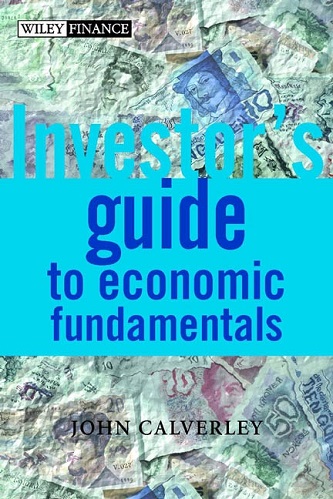
The Investor’s Guide to Economic Fundamentals
$24.81
The Investor’s Guide to Economic Fundamentals can be read from beginning to end of course, but it is also designed to allow the reader to dip into any chapter as desired. For example, the reader interested in the fundamentals of stock markets can go straight to Chapter 13. Or if the immediate interest is in understanding monetary policy, the reader can go directly to Chapter 5. Also, in the glossary the reader will find most of the jargon that is commonly used in the markets, from arbitrage investing to yield curve. A section on websites lists some of the most useful resources, noting especially sites with good links.
Introduction:
The book is structured as follows. Part I (Chapters 1–10) looks at economic fundamentals for investors, to explain how economic forces combine with monetary and fiscal policy to determine interest rates, economic growth and inflation. The chapters start with economic growth and the cycle, moving through inflation, deflation and unemployment to monetary and fiscal policy. In Chapter 4 an assessment of the socalled ‘new economy’ is made. Chapter 7 discusses the feedback from asset prices to the economy and policy, an increasing area of interest to policymakers and the markets. Chapters 8–10 look at international aspects including the exchange rate, trade and globalisation and emerging markets.
Part II (Chapters 11–17) then takes each of the major asset classes in turn and explains how they are assessed using fundamental techniques. Individual chapters cover money markets, bonds, stocks, currencies, property, emerging markets and commodities. Part III concludes with three chapters. Chapter 18 provides a summary of the main body of the book with a table showing the typical response of each asset class to economic events. Chapter 19 looks at different approaches to investment, from market timing to hedge funds and discusses how economic fundamentals are used in each case. Chapter 20 looks at how the fundamentals have changed over the last 10 years and hazards some guesses about future developments.
Although it is very much the author’s contention that the fundamentals are just that, fundamental, in practice there are substantial shifts over time, sometimes caused by changing policy approaches and sometimes due to changes in the economy. Over the last 10 years the most significant changes have been the widespread adoption of inflation targeting, the emergence of deflation, the collapse of the ‘Asian miracle’ and the emergence of historically high stock market valuations. Throughout the book the reader will find sections focusing on a market over a specific period, for example a profile of the last US business cycle or an explanation of the Asia crisis, explaining what happened and why. Naturally, considerable attention is paid to the US economy, but the reader will also find detailed discussions of Japan, Euroland, the UK and emerging economies.
Contents:
- Why Economic Growth Matters
- Business Cycle Fundamentals
- Is Inflation Dead?
- The New Economy: Myth or Reality
- Understanding Central Banks
- Fiscal Policy
- Asset Prices and the Economy
- Globalisation and Capital Flows
- International Linkages
- Emerging Economies
- Money Markets
- Bond Markets
- Stock Markets
- Currency Markets
- Property Markets
- Emerging Markets Investments
- Commodity Markets
- Summary: Economic Fundamentals and Market Performance
- Economic Fundamentals and the Investment Process
- Ten Years of Changing Fundamentals
The Investor's Guide to Economic Fundamentals By John P. Calverley pdf
| Author(s) | |
|---|---|
| Format | |
| Pages | 263 |
| Publication Year | 2003 |
2 reviews for The Investor’s Guide to Economic Fundamentals
Only logged in customers who have purchased this product may leave a review.
Related products




Ivan Carlson (verified owner) –
This book is excellent, as it delivers exactly what its title suggests. The book is expensive, as it is priced as a textbook. However, after reading it I feel it provides an excellent value. And, I will keep it in my personal library of quantitative books. Although the book is short, it is so hard packed with information that it takes a while to digest. Confirming the intensity of the information conveyed Amazon stats discloses that its Fog Index is 14.7 (years of formal education suggested to understand the book) and its Flesch-Kincaid Index is 11.5 (corresponding to the reading grade level). Those metrics are relatively high. However, the book is very rewarding if you want to learn the subject and manage your own capital in a better informed manner.
The book is divided into two main sections. The first section comprised of 10 chapters makes for an excellent foundation in macroeconomics, international economics, monetary and fiscal policies. The author always makes the topic relevant from an investor’s standpoint. Thus, he presents the material in a practical way. Some of the subsections are particularly interesting including explanation of the implication of different yield curve shapes, the sustainability of current account deficits and fiscal budget deficits, the differentiation between the cyclical and structural components of the U.S. budget deficit, the detailed analysis of various emerging markets crisis (Asia, Russia, Brazil, and Argentina) during the nineties. In each cases, the author demonstrates an outstanding knowledge of the historical events and the underlying economic factors.
The second section includes 7 chapters covering each a specific investment (stocks, bonds, real estate, etc…). He explains how an investment is valued, what are the main drivers affecting its value, and how economic indicators and factors affect the value and attractiveness of that given investment. The author does a very good job of disaggregating the different components of economic return associated with each investment. By reading this section, you will learn in great detail how to value stocks, bonds, real estate and other assets.
The author also wrote a short third section that serves as a summary, synthesis, and conclusion. Within this section, he compares how all the different asset classes respond to various economic events. He also builds a rational expectation of real returns for stocks, bonds, and real estate going forward. He also outlines the many different investment styles of the investment pros and the challenges that each investment style faces. Overall, I strongly recommend the book.
Kali Zuniga (verified owner) –
a useful primer in economics for the beginner in financial markets