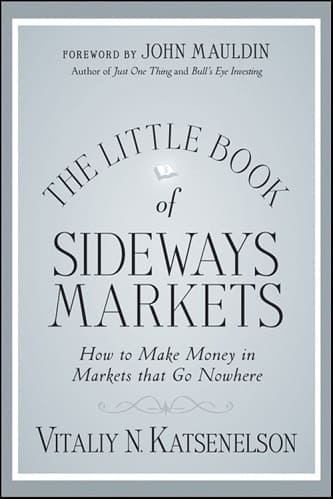
The Little Book of Sideways Markets: How to Make Money in Markets That Go Nowhere by Vitaliy N. Katsenelson
$12.25
In The Little Book of Sideways Markets, Katsenelson gives a lucid explanation of today’s markets with sound advice about how to make money while avoiding the traps that the market sets for exuberant bulls and frightened bears alike. This book convincingly reinforces the timeless advice of contrarian value investing. Vitaliy Katsenelson concisely articulates how an investor may better weather the potentially difficult markets that lie ahead.
Introduction:
It is common among market analysts to talk of secular (long-term) bull and bear markets, but back in the late 1990s I began to notice that markets didn’t necessarily march to a neat and tidy bull or bear tune. In my book, Bull’s Eye Investing, I explained that investors should focus on valuation instead of price, particularly when markets seem to tread water (lots of action, no prolonged movement up or down) for an extended period of time. In other words, there was a third type of secular market: the trendless market.
A few years later, Vitaliy Katsenelson came along and started talking about sideways (Cowardly Lion) markets. What a clever way to describe these trendless, whipsaw markets that are terribly maddening to investors. This book is a helpful and easy-to-understand guide to navigating these frustrating periods. You need this guidance here and now, because markets are going to go nowhere for some time. What is a secular sideways market and why do I say it will continue? To see tomorrow, let’s take a look back in time. In doing so we’ll be able to readily see how valuable this book will be for your portfolio.
Markets go from long periods of appreciation to long periods of stagnation. These cycles last on average 17 years. If you bought an index in the United States in 1966, it was 1982 before you saw a new high—that was the last secular sideways market in the United States (until the current one). Investing in that market was difficult, to say the least. But buying in the beginning of the next secular bull market in 1982 and holding until 1999 saw an almost 13 times return. Investing was simple and the rising markets made geniuses out of many investors and investment professionals. Since early 2000, markets in much of the developed world have basically been down to flat. Once again, we are in a difficult period. Genius is in short supply.
“But why?” I am often asked. Why don’t markets just continue to go up as so many pundits say that “over the long term” they do? I agree that over the very long term, markets do go up. And therein is the problem: Most people are not in the market for that long—40 to 90 years. Maybe it’s the human desire to live forever that has many focused on that super long-term market performance that looks so good. Or perhaps it is the habit people have of taking their most recent experience and projecting it into the future. As the previous century closed, a good many investors queried in surveys indicated that they thought they would make a compound 15 percent a year from their investments in the stock market. And that expectation was still there a few years later even after a brutal bear market. Research shows that it takes at least three negative events to persuade people that things have changed. This is usually just about the time that things are indeed getting ready to change for the better!
History, as Mark Twain said, does not repeat, but it does rhyme. In the 1930s and 1940s we had the Great Depression, a series of policy mistakes, and a war. Stock returns ended up in single digits as the second half of the century dawned. Then we had the boom of the 1950s and on into the 1960s, then a war, a series of policy mistakes, and the tumultuous 1970s with inflation and high interest rates. Then Paul Volcker wrenched the economy into two recessions, bringing stock market returns back to single digits (!). The next 18 years saw a perfect environment for a bull market: falling interest rates and inflation, new technologies, and a demo-graphic bulge designed to create bull markets and foster optimism—even if punctuated by a recession and several market crashes. As positive year after positive year passed, many assumed that things would be even better the next year. Trees really would grow to the sky.
Then came the bursting of the bubble and the Tech Wreck, a recession, and a vicious short-term bear market in stock prices, especially in the beloved tech sector. But things soon got rolling again and the pundits were proclaiming the return of the bull market. Artificially low rates from the Federal Reserve, tax cuts, and what we now know was a bubble in housing jet-fueled an economic rise around the world. Indeed, a study (co-authored by Alan Greenspan) showed that better than 2 percent (and sometimes almost 3 percent!) of gross domestic product (GDP) growth per year from 2002 to 2006 was basically from people taking out credit against their houses. Without this line of credit, the recession would have lasted over two full years and the next two would have seen GDP growth in the range of a puny 1 percent.
And that brings us to the current environment. Households in the United States and throughout the developing world are beginning to cut back on debt, paying down old bills and taking out less in new debt. But governments in many countries are borrowing ever more money to fund their deficits.
Contents:
- Fasten Your Seat Belt
- A Sideways View of the World
- Don’t Shoot the Messenger
- Tevye Was a Rich Man
- What We Can Learn from Gamblers
- Brought to You by the Letter “Q” (for Quality)
- Brought to You by the Letter “G” (for Growth)
- Brought to You by the Letter “V” (for Valuation)
- Add It Up
- Nip/Tuck
- The Born-Again Value Investor
- Applying Darwinism to the Sales Process
- You Are Not As Dumb—or Smart—As You Think
- On a Scavenger Hunt for Stocks
- Farewell, Blissful Ignorance
- Think Different
- I Could Be Wrong, but I Doubt It
The Little Book of Sideways Markets: How to Make Money in Markets that Go Nowhere By Vitaliy N. Katsenelson pdf
| Author(s) | |
|---|---|
| Format | |
| Pages | 258 |
| Publication Year | 2011 |
Related products