
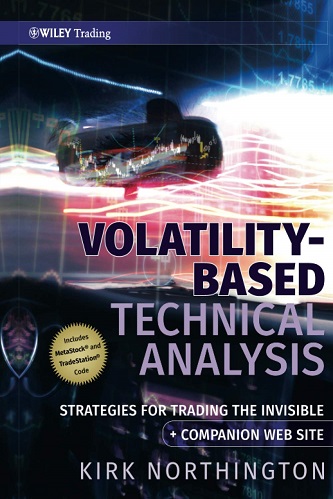
Volatility-Based Technical Analysis: Strategies for Trading the Invisible by Kirk Northington
$22.37
Volatility-Based Technical Analysis presents a methodology for incorporating volatility measurement into technical indicators, trade setups, and trading-system development. Kirk Northington examines how volatility-sensitive calculations can reveal price relationships that conventional chart interpretation may overlook, with applications centered on swing and position trading.
The book progresses from foundational trading concepts to custom indicator construction using standard deviation, average true range, and other mathematical tools. It introduces Projected Implied Volatility (PIV), the author’s approach to identifying volatility-based support and resistance, and explores ways to integrate volatility measurement into traditional technical-analysis methods.
A central organizing method, the Framework, structures cross-verification among trading components. Subsequent chapters apply these concepts to market-direction analysis, Adeo reversal setups, the 1-2-3 trend method, hidden momentum, and exit design. Market-breadth analysis supports the Correction and Surge methodology for evaluating changing broad-market conditions.
The book also addresses component testing and trading-system design, supported by chart examples, statistical studies, MetaStock formulas, and TradeStation EasyLanguage code. An options appendix examines PIV applications to butterflies, condors, strangles, and straddles. Published in 2009, the book’s software examples and market studies reflect its original development period; its instructional indicators are presented as starting points for further refinement.
✅ What You’ll Learn
- Construct volatility-sensitive indicators using standard deviation and average true range.
- Integrate volatility measurement into existing technical-analysis calculations.
- Interpret the author’s Projected Implied Volatility approach to support and resistance.
- Organize trading components within a structured cross-verification framework.
- Evaluate short-term and intermediate-term market direction using volatility and market breadth.
- Analyze Adeo reversal setups, 1-2-3 trend setups, and Adeo High Slope momentum conditions.
- Design exits around volatility levels, trade duration, and changing indicator behavior.
- Examine Correction and Surge signals when assessing broad-market conditions.
- Test individual trading components before combining them into a broader system.
- Study coded implementations in MetaStock and TradeStation EasyLanguage.
💡 Key Benefits
- A development-oriented approach: Explains how to build and adapt analytical tools rather than simply apply preset indicators.
- Integrated trade analysis: Connects market context, entry conditions, momentum, and exit decisions.
- Transparent implementation: Provides formulas and code that make the calculations available for inspection and modification.
- Structured decision support: Uses component cross-verification to organize evidence within a trading method.
- Applied learning material: Combines chart studies, construction exercises, and testing examples.
- Accessible mathematics: Develops technically demanding concepts through arithmetic and high-school mathematics without calculus.
👤 Who This Book Is For
- Intermediate to advanced technical traders seeking to incorporate volatility measurement into established methods.
- Swing and position traders studying structured reversal, trend, momentum, and exit setups.
- Trading-system developers and quantitative-minded analysts interested in custom indicators, programmable rules, and component testing.
- Experienced options traders exploring the book’s PIV-based analysis of underlying price levels and spread opportunities.
📚 Table of Contents
Part One — Are You Prepared?
- The Challenges
- The Opportunities
- The Foundation: Preparations for Exploring Volatility-Based Technical Analysis
Part Two — Seeing the Invisible
- New Volatility Indicator Design
- Integrated Volatility Indicator Design
- The Framework: A Structural Approach for Cross-Verification
- Traditional Technical Analysis: What Works, What Doesn’t, and Why
Part Three — Trading the Invisible
- Bull Bear Phase Prediction: The Intermediate- and Short-Term Market Swing
- Trading the Short-Term Reversal with Volatility-Based Technical Analysis—The Adeo
- Trading the Trend with the 1-2-3
- Hidden Momentum with Adeo High Slope
- Designing the Exit
- Correction and Surge: An Early Warning System
- Trading System Design: Detecting the Invisible
Appendices
- Appendix A: TradeStation Examples and EasyLanguage Code
- Appendix B: The PIV Options Advantage: Using Projected Implied Volatility to Trade the Butterfly, Condor, Strangle, and Straddle
- Appendix C: About the Companion Web Site
Volatility-Based Technical Analysis: Strategies for Trading the Invisible By Kirk Northington
| Author(s) | |
|---|---|
| Product Type | Ebook |
| Format | |
| Skill Level | Intermediate to Advanced |
| Pages | 483 |
| Publication Year | 2009 |
| Delivery | Instant Download |
10 reviews for Volatility-Based Technical Analysis: Strategies for Trading the Invisible by Kirk Northington
Only logged in customers who have purchased this product may leave a review.
Related products




Jennifer Jacobs (verified owner) –
Just as the title promises, the author addresses volume-based action with the help of EL. Personally, I am fascinated by the use of the volume and the Indi’s of Whiley. Nice code examples.
Presley Ruiz (verified owner) –
This book is a hot recommendation for trading with technical analysis. It does not repeat the “old stuff” of fibonacci and systems which do not work anymore in mordern markets.
It explains a system which can be successfull in real life trading. The book is hard to read and you should have a sound knowledge to be able to fully understand. Some of the Tradestation programming is very hard to understand because it reference some functions with generic names and can not be understood without futher investigation. Not all indicators mentioned in the book come with open code and it is not possible to easy re-program or find the missing code.
Northington helps you to develop your own indicators and gives some interesting up to date insights. The book will help you if you are an analytical trader and if you design systems. I increased my knowledge with this book.
Northington promotes his commercial “MetaSwing” system in this book. The commercial system is not included in the book and you will not be able to develop something compareable usefull yourself.
If you just look for commercial indicators I recommend to directly lease his indicators (130 US $ a month for Tradestation) because the manual has enough knowledge to fully understand his systems. If you like to learn in general I recommend this book.
Bryan Evans (verified owner) –
good read
Kaylani Tyler (verified owner) –
This book in fact tells nothing
They just tell you this indicator is important, that indicator is significant. But no where can I find the definition or how to calculate it.
For example, the very first component introduced in this book, the N Bands. There is a long paragraph talking about it, saying it is related to volatility, saying it is different from other price bands, and giving example it provide support and resistance clues to price movements. But you can never find how to calculate it out from the book nor you can find it from the Internet.
For other indicators, you can find similar situations. Maybe it is the company’s secret how this indicators are worked out. If it is the case, pls state it clearly in the book! Don’t waste our time.
Seven Delacruz (verified owner) –
There are a lot of books on technical analysis but this book is different. The author does not waste the readers time repeating Technical Analysis 101 but explains some interesting concepts on how to build indicators based on volatility that I haven’t read elsewhere. There are enough interesting ideas in here for technical traders. — “Momentum hides in the movement of implied volatility” (page 284)
Austin Manning (verified owner) –
Disappointed. I do not use TradeStation or MetaStock. The book needs a Big notice on the front cover advising you need to be a user of those software packages. I purchased the book thinking it would further my knowledge of adding volatility to my TA. I trade straight volatility or trade options on ETFs of indexes using Volatility as a leading indicator for swings. My expectation was to gain something I didn’t know already that I could use. What was generic I already knew and what I didn’t know was of no use because I don’t use the required software packages.
Bronson Reilly (verified owner) –
Even apart from the meticulously-prepared technical content, this book has a very enjoyable style and use of language and an interesting theme regarding how non-quant readers can still plausibly gain an advantage using Metastock or Tradestation or a similar package if they are prepared to roll up their sleeves and develop some code.
With so many financial trading books these days being little more than reprints of computer programs and charts, it is enjoyable to read one that propounds a novel general thesis – that you need to develop an orthogonal view of the markets that is based on your own indicators that are different from those used by everyone else. This book looks for volatility-based indicators but other types could be used too.
I suspect that anyone who really learns and heeds that lesson has excellent prospects for success.
Kirk’s discipline, precision, and sense of purpose also shine through and are worth emulating.
For those themes alone, this book is valuable.
Whether or not the detailed models that are provided by the book, with code, would work well, I myself cannot tell, but they do at least serve as an interesting example of the overall kind of framework you would need for your own system.
Della Michael (verified owner) –
I liked the book. I learned quite a lot. I give it 3 stars only because near the second half of the book, it didn’t really apply to what I was looking for. Was it worth the money I paid? More than most books you can find on trading. What I really liked about the book, is the honesty, and the fact that it was written by a trader and a quant. In a world of snake oil salesman, Northington is a breathe of fresh air. I was pleased, you will be too.
Celine Michael (verified owner) –
this is a pretentious product that purports to “predict” price movement on the basis of volatility. No formulas are provided for the graphic lines and alerts that populate confusing graphs. Even more interesting still is the LACK of use of implied option volatility for front and back months to graph these lines. No references about or discussion of probability of profit using the indicators is made. This book tries to support a BLACK BOX trading method that is an expensive add on for Metastock. There are several problems with this add on. The most important being Metastock CANNOT graph Ichimoku Kinko Hyo(IKH)
indicators which would make it highly unlikely that it could graph “forward looking bands” that are even more complex than IKH.
A bigger red flag is the lack of discussion of historical volatility and the many ways it can be calculated. Historical volatility is apparently the only thing this program can calculate, since Metastock does not query option chains.
IN SHORT: THE BOOK IS AN EXPENSIVE ADVERTISEMENT FOR A BLACK BOX ‘VOLATILITY’ INDICATOR SYSTEM OF TRADING WHICH IS EVEN MORE EXPENSIVE, THAT WILL REQUIRE CLASSES WHICH ARE EVEN MORE EXPENSIVE.
MY ADVISE IS TO EXAMINE THE AUDITED TRADING ACCOUNTS OF THE AUTHOR OVER THE LAST 3 YEARS TO SEE HOW MUCH HE MADE USING THE SYSTEM. ALSO HAS HE PUBLISHED ANY ARTICLES IN WILMOTT’S OR PEER REVIEWED ARTICLES IN THE JOURNAL OF POLITICAL ECONOMY
Tori Townsend (verified owner) –
After reading this book and previous reviews, I felt compelled to write my very first review on Sacred Traders. I have read over 20+ technical analysis books (from Wilder to Mcmillan to Elder to Van Tharp etc). This book is very much different than your typical traditional indicators (in fact there is a great chapter on why traditional indicators do not work in today’s environment). The basis for the “new” indicators defined in this book are based on volatility algorithms which the author has developed over time. The book absolutely provides the formulas for these new indicators AND provides a web page to download them (password in book). Obviouusly the indicators need to be applied to either Metastock or TradeStation, so an additional investment is required (if you currently don’t own any of the above). The book is an easy read and the author gives plenty of analogies to help the novice reader along.