
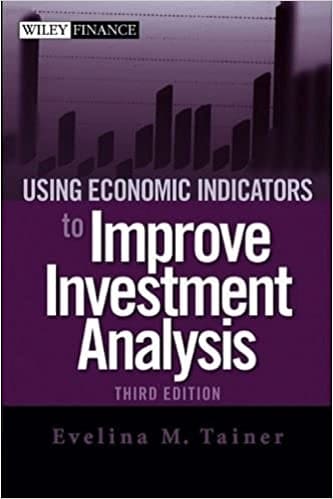
Using Economic Indicators to Improve Investment Analysis
$18.20
Using Economic Indicators to Improve Investment Analysis is an indispensable resource for anyone that wants a practical understanding of the economy and how it is measured. The information is clear, concise, and will help investors at all levels leverage the vast amount of economic data available.
Introduction:
Financial market participants, who anticipate fiscal and monetary policy changes that ultimately affect interest rates, stock prices, and the dollar exchange rate, need to know how to dissect the indicators and search for anomalies. If these economic indicators are misinterpreted, then their market reaction will be wrong and their best guess on future Federal Reserve policy will also be incorrect. For example, perceiving a strong economy, because nonfarm payroll employment posted a large gain, would lead to rising interest rates.
This, however, would actually hurt the economy if activity were anemic and the rise in payrolls was due to one or more special factors such as auto workers returning to work after a protracted labor dispute. Policymakers could also misinterpret the economic figures if they did not pay attention to the occasional quirks in the data and policy decisions would be based on incorrect information about the current and future state of the economy. For instance, a healthy employment scenario might cause the Federal Reserve to worry about inflationary pressures and induce unwarranted tightening measures. Rest assured that policymakers and economists at the Federal Reserve do closely scrutinize each economic indicator and are aware of the potential quirks.
Government policymakers in Congress as well as bureaucrats at federal agencies, and state and local government agencies should also have a healthy understanding of current economic conditions. They, too, can misinterpret economic figures when they do not pay attention to quirks in the data that, in turn, lead to bad decision making. State and local government leaders need to understand the interest rate environment because municipalities need to borrow money and issue tax-exempt securities.
The proper interpretation of economic news is not just limited to the players in the financial market and policymakers. Business students who study economics still do not see the connection between economic theory and the real world from their courses. Journalists, too, need to understand economic information before imparting it to the general public (who often only rely on the media for the information that they use to make their economic decisions).
This book serves three functions for its audience. It describes economic indicators and the nuances associated with them and it explains market reactions to those consumers, investors, government officials, and the like who are not directly participating in the financial markets. It also shows individual investors that they can use economic indicators to their advantage in making long-term strategic investment decisions.
Each chapter explains the economic indicator, the different market reactions to it whether the fixed income, foreign exchange, and stock markets, and key points to look for in the particular series. Economic indicators are divided by sectors of the economy such as consumer, investment, and inflation. If you are a sophisticated financial market participant, the “Market Reaction” sections may seem simplistic. However, even sophisticated market players will find useful information in the specific indicator section. The “Watch Out!” sections are crucial, too, for pointing out common and uncommon quirks along with potential special factors.
Contents:
- Cycles, Markets, and Participants
- National Income and Product Accounts
- The Consumer Sector
- Investment Spending
- The Foreign Sector
- The Government Sector
- Inflation
- The Labor Market
- Other Measures of Production
- The Federal Reserve System
- The Treasury
- Making Strategic Investment Decisions
Using Economic Indicators to Improve Investment Analysis By Evelina M. Tainer pdf
| Author(s) | |
|---|---|
| Format | |
| Pages | 354 |
| Publication Year | 2006 |
9 reviews for Using Economic Indicators to Improve Investment Analysis
Only logged in customers who have purchased this product may leave a review.
Related products

Raylan Montgomery (verified owner) –
This book is an indispensable resource for anyone that wants a practical understanding of the economy and how it is measured. The information is clear, concise, and will help investors at all levels leverage the vast amount of economic data available.
Francis Coleman (verified owner) –
A virtual bible of how economic indicators are constructed and used. Important tidbits of history are mixed with present-day nuances to explain why we should care about all the economic indicators.
Ayla Wilkinson (verified owner) –
From my point of view, this book consists of three parts. Part one, that is, Chapters 1-6, devoted to national accounts and their indicators. Part two, that is, Chapters 7-9, devoted to inflation and inflation related labor and production indicators, and finally part three, Chapters 10-11, is devoted to the central bank and treasury systems. The investment analysis part of this book seems to be the market reaction parts mentioned at the end of each section. Yet they seem to me a little too simplistic for the real world. In the real world, we mostly observe growth cycles rather than business cycles. In other words, business cycle recessions rather than growth cycle recessions are depicted in market reaction parts in this book. Nevertheless this is a good streetwise ECON 101 book. As a final note; although not updated, its second edition seems to me better.
Bentley Bell (verified owner) –
This is not only an excellent reference source, but also a very interesting book. People who are not experts in the fields of economics or finance will have no problem grasping the concepts. I keep it in the office for reference and from time to time pick it up to read up on different topics. I’ve been impressed with Tainer’s ability to make these concepts so easy to understand. Her “Did you know? and Market Reaction” sections are also very interesting and provide an inside view as to how government policymakers and financial marketmakers shape the economy in ways that are very relevant to the average consumer. I recommend this book to anyone who is looking for a good reference book or wants to complement his studies in this field. I think that college students can benefit a great deal from it. For those of you who watch CNBC or CNNfn constantly, you stand to benefit the most from a book like this as it will not only teach you the cause and effect of important economic indicators that are put on the screen on a daily basis, but what’s more important, the reasons why they impact the economy and the markets the way they do.
Julia Neal (verified owner) –
If you are used to read more technical and professional books, this book will be a disappointment. The writting style is too sloppy. The author has an annoying habit of citing so-on-so said this and that – it’s not the standard way of making references in a typical academic manner. There is also too much repetition. The author basically says that whenever an economic indicator suggests a stronger economy, it’d be negative for the bond market and positive for the equity market, which is fine, but she keeps repeating the same thing over and over again. There isn’t much insight in it.
Evangeline Fernandez (verified owner) –
This is a good book on how the different sectors of the economy affect the overal economy and how they move relative to the business cycle. The book explains how these sectors affect the business cycle and how they can be used to assess the state of the economy and forcast the different stages of the business cycle.
The book can be a very good complement for a textbook on macroeconomics or business cycles. It is much more practical than most macroeconomics books.
The book describes many important economic indicators and how markets react to each one of them.
However, the book does not put these economic indicators (and the dynamics of the different sectors) into a framework or a plan that the investor can use to make investment decisions. The last chapter of the book makes an attempt at doing that, but, in my opinion, it is not enough.
I also recommend “The Investor’s Guide to Active Asset Allocation” by Martin Pring which does a great job in explaining the business cycle and how to factor it into your investment decisions.
Melody Nicholson (verified owner) –
Yes! Good book, it’s a dry read, not enough examples to really understand but provides good exposure to economic indicators.
Kane Woods (verified owner) –
This book might be a good compliment to an existing library, but I didn’t find it very useful myself. I thought the comment of an earlier review’s title, ‘A Perfect Complement to an academic finance text!’ fairly accurate. If you want to know what the talking heads on the financial news are touting, this is an excellent guide.
In other words, if you have bought into the conventional econometrics of the day, whatever that is, this is your guidebook. It ought to help get through a class, but outside the ivory tower, I’m not sure it will be much help.
Personally, the author didn’t help me connect the dots. What do these indicators imply for the GNP 2, 3 or 4 years down the road? What connections do foreign indicators have with domestic ones?
These questions are not answered. It’s just a dictionary. You get the nominal description, the publishing authority, a bit about why the authority thinks their indicator useful and maybe a few sample numbers. That is it. If you like academic economics or ever have to make a presentation to some government officials, this is probably an exceptional service, though.
Claire Hammond (verified owner) –
This was the required text for my MBA level class on investments. The book is very well organized and extremely lucid. The book covers a very wide gamut of concepts related to investments. Most MBA classes focus of financial markets whereas traditional economics programts are very theoretical. MBA classes typically do not cover the working of the Fed and the factors that go into interest rate determination; even the class on Money and Banking mostly focusses on the administrative and theoretical aspects of money. This book is unique as it covers not only how the FOMC makes decisions, but also explains the various indices that typical MBA programs fail to cover. A very rigorous book at a great price. I learnt a lot from this book.