
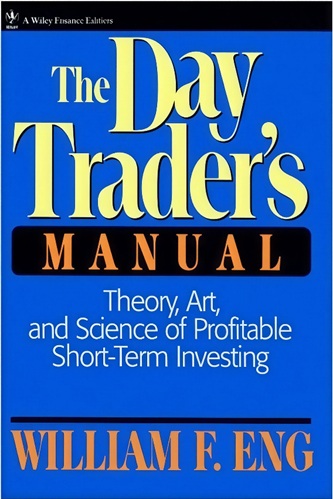
The Day Trader’s Manual: Theory, Art, and Science of Profitable Short-Term Investing
$17.97
The Day Trader’s Manual is a structured, discipline-first guide to short-term trading that treats day trading as a professional craft rather than a collection of ad-hoc tactics. William F. Eng frames profitable intraday trading at the intersection of theory (market structure and behavior), art (judgment and timing), and science (rules, statistics, and risk control). The book’s core message is that consistency emerges from preparation, repeatable processes, and strict risk governance—not from prediction.
Eng begins by establishing a realistic view of intraday markets: liquidity flows, volatility bursts, and the constraints imposed by time. He emphasizes preparation routines, trade selection filters, and the necessity of aligning tactics with the day’s market condition. Rather than promoting constant activity, the book encourages selectivity—waiting for conditions that justify risk and standing aside when they do not.
A defining strength of the manual is its treatment of execution and management. Entries are discussed in the context of confirmation and structure; exits are framed as decisions that protect expectancy. Stops, position sizing, and loss containment are integral to every setup. Eng repeatedly reinforces that small, controlled losses are the cost of staying in business, while unmanaged risk is the fastest path to failure.
Finally, the book addresses the mental demands of day trading. Discipline, routine, and post-trade review are presented as non-negotiables. By integrating mindset with mechanics, The Day Trader’s Manual offers a coherent framework for traders who want to professionalize their intraday approach and build durability across market regimes.
✅ What You’ll Learn:
- How to structure a professional intraday trading process from preparation to review
- How to align tactics with market condition, volatility, and time constraints
- Practical entry and exit logic focused on expectancy and protection
- How to size positions and define risk before every trade
- How discipline and routine support consistency in short-term trading
💡 Key Benefits:
- Promotes a rules-based, repeatable approach to day trading
- Emphasizes risk control and loss containment over prediction
- Integrates execution, management, and psychology into one framework
- Encourages selectivity and patience to reduce overtrading
👤 Who This Book Is For:
- Traders with basic market knowledge seeking a professional intraday framework
- Short-term traders aiming to improve consistency and discipline
- Market participants who value process over indicators
- Not suitable for readers looking for guaranteed signals or automated systems
📚 Table of Contents:
- Time, Price, and the Day Trader
- Strategies for Profitable Day Trading
- Day Trading Approaches Defined by Market Action
- Chaos Theory and the Day Trader
- Tape-Reading Techniques
- Spread Trading
- Trading Market Profile
- Using Chart Patterns
- Mathematical Approaches to Day Trading
- Sequential Patterns in Day Trading
- Elliott Wave Theory and Day Trading
The Day Trader's Manual: Theory, Art, and Science of Profitable Short-Term Investing By William F. Eng
| Author(s) | |
|---|---|
| Product Type | Ebook |
| Format | |
| Skill Level | Intermediate to Advanced |
| Pages | 355 |
| Publication Year | 1993 |
| Delivery | Instant Download |
3 reviews for The Day Trader’s Manual: Theory, Art, and Science of Profitable Short-Term Investing
Only logged in customers who have purchased this product may leave a review.
Related products





Harrison Gomez (verified owner) –
I had rated the author’s first book “Trading rules: Strategies for success” with 5 stars. I never expected such a frustration with this book.
Perhaps the trader did try to make this book as a day trader’s manual by including everything he deemed fit into a 322 page book: trading psychology, rules drawn from his own experience, chaos theory and in particular many TA tools like Market Profile, Elliot Wave, Gann Fan, RSI, Stochastics and so on. He then used nearly 40% of the book in 14 cases to elaborate those tools. The problem is, though I believe it’s the intent of the author to make the book as concise as possible, it’s simply impossible for most, even some professionals, to grasp the usage of the aforesaid TA tools. Even worse, the cases just did not help at all.
In a word, a big disappointment for this one and I suggest those who would like to give the author a try to bet on his first book “Trading Rules: Strategies for success”.
Natalie Joseph (verified owner) –
Interesting information.
Kyle Collier (verified owner) –
The book is written using the most complicated phrasing and is hard to read. I have to go back several times to get it. This in not a philosophical topic and has to be delivered in a comprehensive way in my opinion.