
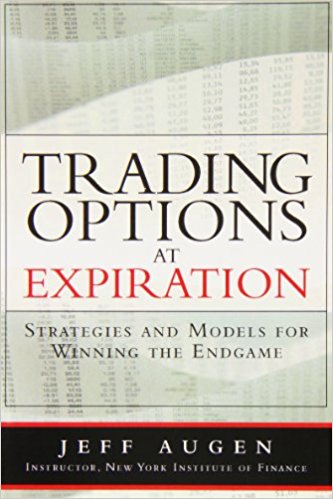
Trading Options at Expiration: Strategies and Models for Winning the Endgame
$15.87
Trading Options at Expiration explores the unique pricing dynamics and trading opportunities that emerge during the final days and hours before options expiration. Jeff Augen focuses specifically on expiration-week anomalies, including implied volatility collapse, strike price pinning, accelerated time decay, and short-term pricing distortions that traditional option pricing models fail to capture effectively.
Rather than presenting conventional directional option strategies, the book develops a framework centered on statistical behavior, minute-by-minute market analysis, and short-duration trade structures. Augen demonstrates how expiration trading differs fundamentally from longer-term speculation by emphasizing timing precision, volatility behavior, and mathematical edge rather than market prediction. The discussion integrates real trading examples, probability analysis, and institutional market mechanics.
A major strength of the book is its quantitative orientation. The author explains how to work with minute-by-minute data, construct statistical models, analyze strike price crossing frequencies, and identify recurring expiration-day patterns using spreadsheets, databases, and custom analytics. The material bridges discretionary trading concepts with data-driven execution methodologies.
The book also provides practical guidance on structuring expiration trades using straddles, ratio spreads, calendars, and volatility-based positions. Real market examples involving stocks such as Google, Goldman Sachs, Apple, and Research in Motion are used to illustrate how traders can exploit volatility collapse and strike-price behavior during expiration week. Overall, the book is positioned for active traders seeking short-duration, event-driven options strategies grounded in quantitative market behavior rather than directional forecasting.
✅ What You’ll Learn:
- How implied volatility collapses during expiration week
- The mechanics of strike price pinning and strike-cross behavior
- How to structure expiration-day ratio spreads and volatility trades
- Techniques for analyzing minute-by-minute options data
- How to build statistical models for expiration trading
- Methods for identifying option pricing distortions near expiration
- How time decay accelerates during the final trading hours
- Practical use of Excel and databases for options research
- Risk management principles for short-duration options trading
- How institutional positioning impacts expiration pricing dynamics
💡 Key Benefits:
- Provides a specialized framework for expiration-week options trading
- Combines quantitative analysis with practical trading execution
- Explains complex volatility behavior using real market examples
- Focuses on short-duration strategies with limited market exposure
- Helps traders understand structural inefficiencies in options pricing
- Bridges discretionary trading concepts with data-driven methodology
👤 Who This Book Is For:
- Intermediate to advanced options traders
- Active traders focused on short-term volatility opportunities
- Quantitatively inclined traders using statistical market analysis
- Day traders seeking expiration-week trading strategies
📚 Table of Contents:
- Expiration Pricing Dynamics
- Working with Statistical Models
- Day Trading Strategies
Trading Options at Expiration: Strategies and Models for Winning the Endgame By Jeff Augen
| Author(s) | |
|---|---|
| Product Type | Ebook |
| Format | |
| Skill Level | Intermediate to Advanced |
| Pages | 172 |
| Publication Year | 2009 |
| Delivery | Instant Download |
8 reviews for Trading Options at Expiration: Strategies and Models for Winning the Endgame
Only logged in customers who have purchased this product may leave a review.
Harmony Madden (verified owner) –
Well written and very interesting strategies.
Amelie Rosario (verified owner) –
I have read bad books about options but this ….
What a waste of good money it was.
Basically, the author takes 5 stocks, uses historical data and tells you : “you should have done this this and that and boom 500% returns, nice hu?”
Absolutely pointless.
Claire Jenkins (verified owner) –
This was a good book in providing valuable information for trading near expiration options. It discusses the pitfalls of trading near expiration options and provides information on how to use these pitfalls to your advantage.
Jedidiah Cruz (verified owner) –
This book is very dense and thorough. Although weekly expiry choices are now available the same principles that Augen speaks. The author gathered some very granular data about intraday option prints which is hard to come by historically and really applied it in application for this book. Yes the book does have actionable strategies that experienced option users can apply. This book is not for beginners or even mid level users of options as the comprehension of concepts requires a thorough understanding of many dynamics ranging from extrinsic value compression/expansion, implied volatility crush and general theta decay and being able to loop all these concepts together in sync instead of understanding in singular form is vital to get the value from the book.
Declan Casey (verified owner) –
This book provides interesting data and examples of how option prices behave at the time of expiration and gives some example trade ideas and setups you can look for trading intaday. This is one of the few books I have seen that actually discuss intraday option trading so it was a good read and worth the price.
*The downside is that it was written 10 years ago with data from 2007 and 2008. The markets were structurally different back then with companies such as AAPL having strikes every $5 and monthly expiration cycles. Today AAPL has $2.5 wide strikes and weekly expirations. This dramatically impacts some of the trade ideas the author presents in the book so one would have to apply the same concepts but using today’s market structure.
Everest Kent (verified owner) –
Very good book on the price movements late in option expiration cycles. Would highly recommend.
Jazmine Kelley (verified owner) –
Excellent options book for 0DTE options. It was a bonus for me to learn that Jeff Augen is an instructor at my alma mater, The New York Institute of Finance.
Eric Gentry (verified owner) –
This is a great book for providing the details on how implied volatility collapses on option expiration day. I found the studies to be of great help in understanding pricing dynamics applied to 0 DTE options.
However, the author illustrates most of his examples using 1:3 call ratio back spreads ( long 1 OTM call, short 3 further OTM calls). This constitutes a debit spread plus two naked calls for a net credit. Not for the faint hearted unless you’re watching it like a hawk!
I would like to see a sequel to this book that illustrates trading near expiration options with balanced credit spreads, debit spreads, or straight long options.