
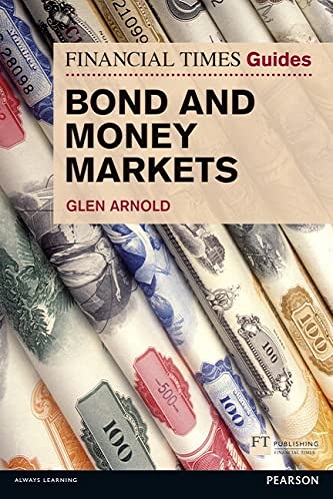
Financial Times Guide to Bond & Money Markets
$24.87
The Financial Times Guide to Bond and Money Markets explains how debt markets operate, how their instruments are structured and how investors assess their value. Glen Arnold begins with the functions of bond and money markets before examining the securities used by governments, corporations and financial institutions to raise finance and manage liquidity.
The book follows a five-part structure covering market foundations, bond markets, money markets, valuation and selected broader applications. Its bond coverage includes government securities, corporate debt, credit ratings, high-yield and hybrid bonds, and international issues. The money-market chapters explain interbank lending, Eurocurrency markets, Treasury bills, commercial paper, repurchase agreements, certificates of deposit, bills of exchange and banker’s acceptances.
The quantitative material develops from financial concepts and mathematics into practical valuation. Worked examples explain discounting, bond prices, yields, interest-rate sensitivity, duration, convexity and the term structure of interest rates. Separate treatment of money-market valuation highlights the importance of distinguishing discount rates from investment returns and understanding day-count conventions.
The concluding chapters examine securitisation and central-bank influence on interest rates. Financial Times articles, tables and examples connect the explanations to market events and institutional practice. Published in 2015, the book provides an accessible foundation for investors, students and professionals, with market data, benchmark references and institutional examples reflecting that period.
✅ What You’ll Learn
- Distinguish bond markets from money markets and explain their financing and liquidity functions.
- Compare government, corporate, international, high-yield and hybrid bonds.
- Interpret credit ratings and examine the risks associated with different debt securities.
- Explain how interbank lending, Eurocurrency markets and short-term funding instruments operate.
- Understand the mechanics of repos, certificates of deposit, bills of exchange and banker’s acceptances.
- Apply compounding and discounting concepts to financial cash flows.
- Calculate bond values and yields, and examine price sensitivity through duration and convexity.
- Compare money-market discount yields and investment returns using relevant day-count conventions.
- Explain securitisation structures and the channels through which central banks influence interest rates.
💡 Key Benefits
- A coherent market foundation: Connects issuers, investors, intermediaries and instruments within the wider financial system.
- A gradual quantitative progression: Introduces essential mathematics after establishing the underlying financial concepts.
- More informed security comparisons: Explains how credit quality, maturity, contractual features and liquidity affect debt investments.
- Practical valuation context: Uses worked examples to connect cash flows and interest rates with security prices.
- Institutional perspective: Relates individual instruments to bank funding, securitisation and monetary policy.
👤 Who This Book Is For
- Beginning fixed-income investors seeking a structured introduction to bonds and money-market instruments.
- Finance students who need detailed explanations of debt markets and foundational valuation methods.
- Banking, accounting, legal and insurance professionals developing a working knowledge of financial-market terminology and structures.
- Intermediate investors and market practitioners reviewing credit assessment, yield calculations and interest-rate sensitivity.
📚 Table of Contents
- Introduction to bond and money markets
- Government bonds
- Government bonds around the world
- Corporate bonds
- Credit ratings for bonds
- High-yield and hybrid bonds
- International bonds
- Interbank and Eurocurrency
- Treasury bills and commercial paper
- Repurchase agreements and certificates of deposit
- Bills of exchange and banker’s acceptances
- Financial concepts and mathematics
- Bond valuation
- Money market securities valuation
- Securitisation
- Central banking influence on interest rates
FT Guide to Bond & Money Markets By Glen Arnold
| Author(s) | |
|---|---|
| Product Type | Ebook |
| Format | |
| Skill Level | Beginner to Intermediate |
| Pages | 489 |
| Publication Year | 2015 |
| Delivery | Instant Download |
2 reviews for Financial Times Guide to Bond & Money Markets
Only logged in customers who have purchased this product may leave a review.
Related products







Douglas Cardenas (verified owner) –
Useful guide to investing in bonds and other debt securities. This book is from an Investor perspective not a guide for issuers so if your are looking for information on the documentation and procedures for issuing debt securities this isn’t it but if you are thinking of investing in these securities then this is a comprehensive but accessible introduction and well priced.
Rylie Huerta (verified owner) –
The product was worth the money and quality was good.