
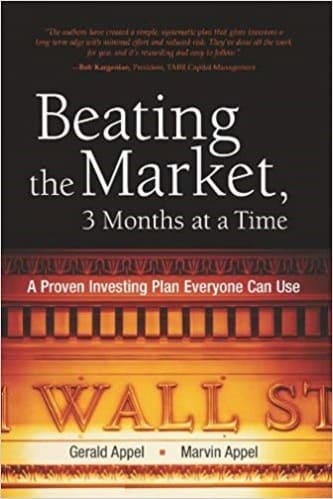
Beating the Market, 3 Months at a Time: A Proven Investing Plan Everyone Can Use
$11.18
Beating the Market, 3 Months at a Time presents a structured investment methodology focused on portfolio construction, sector rotation, momentum investing, diversification, and risk management. Written by veteran market analysts Gerald Appel and Marvin Appel, the book combines long-term wealth-building principles with practical tactical allocation systems designed for individual investors.
The book emphasizes disciplined investing through quarterly portfolio review processes, ETF and mutual fund selection models, and risk-adjusted asset allocation strategies. Rather than relying on speculative forecasting, the authors focus on evidence-based approaches to portfolio management using historical performance analysis, trend strength evaluation, and diversification across domestic and international markets.
A major component of the framework involves balancing growth-oriented equity exposure with bond allocation, defensive positioning, and systematic rebalancing procedures. The authors also explore inflation-sensitive investments, international equity rotation, high-yield bond opportunities, and strategies for reducing drawdowns during unfavorable market conditions.
In addition to tactical investment models, the book addresses broader financial planning considerations, including retirement preparation, capital preservation, compounding, and long-term wealth accumulation. The result is a comprehensive investment guide that integrates technical market behavior, asset allocation discipline, and practical portfolio management into a repeatable investing process.
✅ What You’ll Learn:
- How to build diversified investment portfolios using ETFs and mutual funds
- Momentum-based sector rotation strategies using quarterly evaluation periods
- Methods for reducing portfolio drawdowns through asset allocation
- Practical portfolio rebalancing techniques for long-term stability
- How to evaluate risk using historical drawdown analysis
- International market allocation and currency-related investment considerations
- Bond market strategies including laddering, TIPS, and high-yield bond management
- How inflation and commodity cycles impact equities and fixed income markets
- Risk-adjusted approaches to long-term wealth accumulation
- Techniques for combining income investments with growth-oriented assets
💡 Key Benefits:
- Provides a systematic framework for self-directed investing
- Combines long-term portfolio management with tactical market timing concepts
- Emphasizes risk reduction alongside return optimization
- Introduces practical ETF and mutual fund allocation models
- Helps investors understand market cycles and sector leadership behavior
- Offers actionable strategies that require limited ongoing management time
👤 Who This Book Is For:
- Intermediate investors seeking structured portfolio management methods
- ETF and mutual fund investors interested in momentum-based allocation systems
- Long-term investors focused on balancing growth with risk control
- Individuals seeking practical frameworks for retirement and wealth planning
📚 Table of Contents:
- Putting Together a Winning Investment Portfolio
- Advanced Diversification and Risk Management
- Prelude to Long-Term Wealth— Introduction to the Stock Market
- Nothing Succeeds Like Success
- Worldwide Opportunity
- Bonds—An Investment for All Seasons
- Special Bond Market Investment Opportunities
- Treasure in the Junkyard—How to Tame High Yield Bonds
- The Definitive Portfolio—The Whole Is Greater Than the Sum of Its Parts
- Don’t Let Them Blow You Off the Planet!
- Maybe the Politicians Can’t Do It, but You Can—Planning and Carrying Through a Long-Term Financial Program
Beating the Market, 3 Months at a Time: A Proven Investing Plan Everyone Can Use By Gerald Appel
| Author(s) | |
|---|---|
| Product Type | Ebook |
| Format | |
| Skill Level | Intermediate to Advanced |
| Pages | 236 |
| Publication Year | 2008 |
| Delivery | Instant Download |
10 reviews for Beating the Market, 3 Months at a Time: A Proven Investing Plan Everyone Can Use
Only logged in customers who have purchased this product may leave a review.
Related products

Terry Walls (verified owner) –
Great book
Ryker O’Donnell (verified owner) –
Cramer may be more entertaining, but Dr. Appel’s book is a must read for any investor, whether novice or expert! I highly recommend this book for prudent, responsible investing advice!
Elijah Bennett (verified owner) –
This book suffers from two problems. First, it seems like a slimmed-down version of author Gerald Appel’s “Opportunity Investing,” which also discussed the use of a momentum-rotation strategy to improve absolute returns and reduce portfolio drawdown. The big difference here is that the Appels emphasize the use of ETFs for implementing their strategy.
Second, there is a lot of basic material whose purpose is to persuade the reader that they need to invest in equity markets. You see this too often in books on investing, where the authors assume that the reader need first be persuaded to invest and then to invest according to the author’s strategy. I would wager that most people who pick up books on investing need no such convincing: it’s preaching to the choir.
That said, the momentum-rotation strategy is an interesting concept, elegant and, in its ETF incarnation, easy to use. It is worth bearing in mind, though, that trading in and out of ETFs as might be necessary under this strategy would incur a significant tax and cost liability that the strategy would have to hurdle if it was to outperform as simple buy-and-hold plan. Alas, transaction costs and taxes do not factor into the Appels’ analysis.
Annalise Cano (verified owner) –
I got a couple of useful ideas from this book, but overall I was disappointed. The most useful ideas are (1) market sectors that outperform over one three-month period are more likely to outperform over the next three-month period, and (2) how to use ETFs to implement a timing-rotation strategy based on the first idea. The disappointments: (1) This is a thin book: 230 pages. Take away the notes and index and it’s 196 pages. (2) There seemed to be some internal conflict in just how to use allocations to create proper portfolios. After a while, I was not sure just what was being recommended. If I got it right, four different investment strategies ended up being recommended, and then blends of those were discussed. I got confused. Partly this may be the result of the book having two authors, and they apparently wrote different chapters independently. I’m not sure everything got reconciled. (3) The end of the book wandered into retirement topics, healthcare costs, social security…in other words, non-investing topics. This was unnecessary, annoying, and one wonders whether it was done because they needed more pages.
Arianna Simon (verified owner) –
This book describes how to set up your portfolio and how to diversify it. I also gives you specific suggestions of ETFs and how to pick the best ones. It also tells you how to rate them every 3 months and move into the better ones. The last section in chapter 9 gives you specific suggestions.
Dawson Hale (verified owner) –
A word before I start: I’m averaging two book review requests a month at present. I tell the PR people that I don’t guarantee a review (though I have reviewed them all so far), or even a favorable review. They send the books anyway.
Included in every book is a 2-6 page summary of what a reviewer would want to know, so he can easily write a review. Catchy bits, crunchy quotes, outlines…
I don’t read those. I read or skim the book. If I skim the book, I note that in my review. Typically, I only skim a book when it is a topic that I know cold. Otherwise I read, and give you my unvarnished opinion. I’m not in the book selling business… I’m here to help investors.
If I can keep you from buying a bad book, then I’ve done something useful for you. I have more than enough good books for readers to buy. Plus, I review older books that no one will push. I hope eventually to get all of my favorites written up for readers.
Enough about my review process; on with the review:
When the PR guy sent me the title of the book, I thought, “Oh, no. Another investing formula book. I probably won’t like it.” Well, I liked it, but with some reservations.
The authors are a father and son — Gerard Appel and Marvin Appel, Ph. D. They manage over $300 million of assets together. The father has written a bunch of books on technical analysis, and the son has written a book on ETFs.
Well, it is an investing formula book… it has a simple method for raising returns and reducing risks that has worked in the past. The ideas are simple enough that an investor could apply them in one hour or so every three months. I won’t give you the whole formula, because it wouldn’t be fair to the authors. The ideas, if spun down to their core, would fill up one long blog post of mine. But you would lose a lot of the explanations and graphs which are helpful to less experienced readers. The book is well-written, and I found it a breezy read at ~200 pages.
I will summarize the approach, though. They use a positive momentum strategy on three asset classes — domestic equities, international equities, and high yield bonds, and a buy-and-hold strategy on investment grade bonds. They apply these strategies to open- and closed-end mutual funds and ETFs. They then give you a weighting for the four asset classes to create a balanced portfolio that is close to what I would consider a reasonable allocation for a middle aged person.
Their backtests show that their balanced portfolio earned more than the S&P 500 from 1979-2007, with less risk, measured by maximum drawdown. Okay, so the formula works in reverse. What do we have to commend/discredit the formula from what I know tend to happen when formulas get applied to real markets?
Commend
* Momentum effects do tend to persist across equity styles.
* Momentum effects do tend to persist across international regional equity returns.
* Momentum effects do tend to persist on high yield returns in the short run.
* The investment grade buy-and-hold bond strategy is a reasonable one, if a bit quirky.
* Keeps investment expenses low.
* Gives you some more advanced strategies as well as simple ones.
* The last two chapters are there to motivate you to save, because they suggest the US Government won’t have the money they promised to pay you when you are old. (At least not in terms of current purchasing power…)
Discredit
* The time period of the backtest was unique 3/31/1979-3/31/2007. There are unique factors to that era: The beginning of that period had high interest rates, and low equity valuations. Interest rates fell over the period, and equity valuations rose. International investing was particularly profitable over the same period… no telling whether that will persist into the future.
* I could not tie back the numbers from their domestic equity and international equity strategies in the asset allocation portfolio to their individual component strategies.
* I suspect that might be because though the indexes existed over their test period, tradeable index funds may not have existed, so in the individual strategy components they might be done over shorter time horizons, and then used indexes for the backtest. This is just a hypothesis of mine, and it doesn’t destroy their overall thesis — just the degree that it outperforms in the past.
* They occasionally recommend fund managers, most of whom I think are good, but funds change over time, so I would be careful about being married to a fund just because it did well in the past.
* If style factors or international regional return factors get choppy, this would underperform. I don’t think that is likely, investors chase past performance, so momentum works in the short run.
* Though you only act four times a year, that’s enough to generate a lot of taxable events if you are not doing this in a tax-sheltered account.
* It looks like they reorganized the book at the end, because the one footnote for Chapter 9 references Chapter 10, when it really means chapter 8.
The Verdict
I think their strategy works, given what I know about momentum strategies. I don’t think it will work as relatively well in the future as in the past for 3 reasons:
* There is more momentum money in the market now than in the past… momentum strategies should still work but not to the same degree.
* International investing is more common than in the past… the payoff from it should be less. There aren’t that many more areas of the world to go capitalist remaining, and who knows? We could hit a new era of socialism abroad, or even in the US.
* Interest rates are low today, and equity valuations are not low.
Who might this book be good for? Someone who only invests in mutual funds, and wants to try to get a little more juice out of them. The rules on managing the portfolio are simple enough that they could be done in an hour or two once every three months. Just do it in a tax-sheltered account, and be aware that if too many people adopt momentum strategies (not likely), this could underperform.
Zayne Bauer (verified owner) –
This book contains valuable market timing strategies that anyone willing to spend the time and energy can implement. I like the presentation of the more active and less active (mutual fund) approach, and the fact that either strategy can be implemented without a great deal of time. How many times has an investor, myself included, made decisions based upon yesterday’s winners, only to get in near the top of the market before a fall? I think this book offers practical strategies to make decisions based on valid indicators.
Josephine Vargas (verified owner) –
The authors have put together a fine basic plan to do precisely what the book title indicates. Most of the strategies,tips, ideas are things most investors should already be aware of. This tutorial very well reinforces the basics. It points out how the sellers of many mutual funds can be highly motivated by commissions. It is suggested that investors seriously consider etf’s. In my view, most investors would benefit from this quick read.
Brinley Brown (verified owner) –
Gerald Appel is a pioneer of chart based market timing. He also has a commendable track record. He has been ranked very highly for long term performance multiple times by the Hulbert market advisory rating service.
Mr. Appel, and his talented son Marvin, could have written a complex tome for market heads. This book, though, seems aimed at the vast majority of investors who do not want to take up economics, markets, and finance as an avocation. It aims to improve safety, and possibly returns, for retirement savers while keeping it as simple as possible. I think it succeeds in this mission.
The Appels’ method of making minor quarterly adjustments within a portfolio of low cost exchange traded funds using tested techniques of market timing, asset allocation, and diversification does seem to add value for those willing to spend half an hour to an hour every three months. I imagine buy-and-hold investors spend more time than that worrying when markets go down sharply.
It’s worth remembering that improving performance by, on average, a few percentage points a year, means you will retire with strikingly more money. Doing it by reducing losses along the way also makes it easier to stick to your plan, and it makes life more enjoyable!
I would have liked to have seen an appendix documenting the back tests in detail.
Most of the portfolio he recommends is constantly exposed to stock market risk (and, to be fair, stock market returns). He times domestic equities by switching between broad market sectors. I would have enjoyed a discussion of overlaying this approach with a simple market timing filter that gets one out altogether when risk is high.
Highly recommended, especially for non-market junkies who want to look out less for the interests of their mutual fund companies and more for their own.
Haley Dunn (verified owner) –
Most of this book I thought was very basic & a review of what I’ve read in many other places. What set this book apart was thier idea of momenum play with broad stock market ETF’s. They spell out thier idea in easy to understand language. I am in the process of evaluating the tax consequences of trying this but it seems more efficient & easier than most other investment methods I’ve tried.