
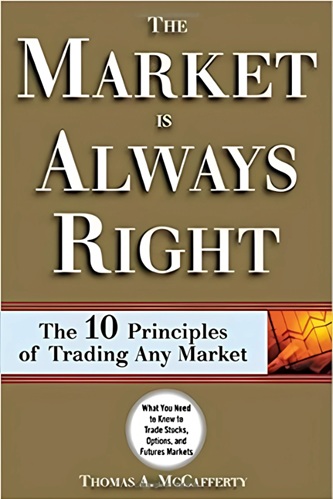
The Market Is Always Right: 10 Principles of Trading Any Market
$15.03
The Market Is Always Right is a disciplined, principle-driven guide to trading that strips away prediction, opinion, and narrative bias in favor of objective market behavior. Thomas McCafferty’s central thesis is uncompromising: price is the final authority. Traders who argue with the market, rationalize losses, or impose beliefs onto price action eventually pay for it. Those who learn to listen, adapt, and execute with discipline survive and grow.
The book is structured around ten core principles that apply across all markets and timeframes—stocks, futures, commodities, or currencies. These principles are not strategies in the narrow sense; they are behavioral and structural rules that govern how successful traders think, prepare, and act. McCafferty emphasizes alignment with trend, acceptance of uncertainty, and the necessity of risk control as non-negotiable foundations of trading longevity.
Rather than focusing on indicators or proprietary setups, the author concentrates on decision-making under pressure. Topics such as position sizing, loss acceptance, emotional neutrality, and consistency are treated as skills that must be trained deliberately. The market does not reward intelligence or conviction—it rewards discipline and adaptability. This mindset runs through every chapter.
Importantly, the book addresses one of the most common failure points among traders: the need to be right. McCafferty reframes trading as a probabilistic business where survival and capital preservation matter more than ego. By internalizing these principles, traders develop the ability to follow price objectively, manage risk calmly, and operate without emotional attachment to outcomes.
This is not a book about quick profits or mechanical systems. It is a professional framework for traders who want to build a durable process—one that holds up across changing market regimes and volatile conditions.
✅ What You’ll Learn:
- Why price action, not opinion or prediction, must be the final decision driver
- How to trade in harmony with market structure and dominant trends
- The role of risk control and position sizing in long-term survival
- How to detach emotionally from wins, losses, and the need to be “right”
- Core behavioral principles that separate consistent traders from chronic losers
💡 Key Benefits:
- Builds a durable trading mindset applicable to any market or timeframe
- Helps eliminate emotional and cognitive errors that sabotage performance
- Reinforces discipline, patience, and consistency over short-term excitement
- Complements any technical or price-based trading methodology
👤 Who This Book Is For:
- Traders who already understand basic market mechanics and want consistency
- Technical or price-action traders seeking stronger behavioral discipline
- Traders struggling with overtrading, revenge trading, or emotional decisions
- Not suitable for readers looking for step-by-step indicators or mechanical systems
📚 Table of Contents:
- The Market Is Always Right
- It’s All in Your Head
- You Can’t Prepare Enough
- Supply and Demand Rule the Markets
- Commit Your Thoughts to Paper
- Developing and Perfecting Your Trading Shtick
- Enhancing Your Shtick
- Dealing with One of the Toughest Parts of the Game: Discipline
- Staying the Course
- On Becoming the Ideal Trader
The Market Is Always Right: 10 Principles of Trading Any Market By Thomas McCafferty
| Author(s) | |
|---|---|
| Product Type | Ebook |
| Format | |
| Skill Level | Intermediate to Advanced |
| Pages | 249 |
| Publication Year | 2003 |
| Delivery | Instant Download |
4 reviews for The Market Is Always Right: 10 Principles of Trading Any Market
Only logged in customers who have purchased this product may leave a review.
Related products


Savannah Daugherty (verified owner) –
I have read other books by Mr. McCafferty and have found this one to be the most valuable, not to mention entertaining. It seems as though most of the newer books out there are just a rehashing of commonly known techniques and offer little valuable insight into how the market actually operates, that is not the case with this fine book. Mr McCafferty seems to understand the way the markets operate and the players in the trading community. He mentions several successful traders and their methods and explains them very well, probably better than those traders could themselves, which is a true testament to his ability as a writer. I learned specific strategies that have changed the way I trade and have been surprised by how well the simple things Tom mentions (and many of us overlook) have worked for me. I can say that I am a more profitable trader because of what I read in this book and for the [$$] it cost me, that is an unbelievable deal. Thank you for unselfishly sharing your trading experiences with us Tom, my life has been enriched because or your words.
Jamie Gutierrez (verified owner) –
This is a 100% trading psychology book. No FA, no TA, but ten chapters or the author’s so called principles on trading psychology, which are
1. The market is always right.
2. It’s all in your head.
3. You cant prepare enough.
4. Supply and demand rule the markets
5. Commit your thoughts to paper
6. Developing and perfecting your trading shtick
7. Enhancing your shtick
8. Discipline
9. Staying the course
10. On becoming the ideal trader
Though the above can be commonly found in most trading books, the author had done it relatively well by drawing many uncommon analogies, stories, idiomatic phrases that put life into the book. In particular I like his description of successful traders as captains in the oceans, mice in the laboratories and actuaries in insurance companies.
In short, if you wanna read a good trading psychology book, this is it. If you want TA or FA knowledge, look somewhere else.
p.s. The seven cardinal sins of trading in the last chaper is a favorite of mine. They are:-
1. Pride, which challenges the first rule of trading: The market is always right.
2. Greed, holding onto trades hoping for more and more profits while all TA signals are telling you the party is over.
3. Envy, drains positive energy from their psyche, leaving them mean spirited and weak.
4. Anger, that when Greek gods decided to destroy a human, they got him angry and let him destroy himself.
5. Lust, equates to ignoring key defensive rules or self control. The unbridled gambler is the epitome of lust, doubling up after every loss.
6. Gluttony, a lack of focus. Trading becomes obsession They eat and sleep trading.
7. Sloth, that a lazy successful trader is an oxymoron. He or she just doesnt exist.
Bjorn Eaton (verified owner) –
not so useful
Malaya McKee (verified owner) –
People contrary to the bad reviews this book recieved I will beg to differ. I have read both of his books.. The market is always right and All about options. In the market is always right the author discusses “principles” for dealing with the market, your own behavior and the behavior of the stock, option or future you are trading. This isn’t a book about the fundamentals of stocks, options or futures. Just based on the way the author writes he assumes you already understand the fundamentals. He addresses the problem that most traders face. Why are you not making money or why are winning trades end up becoming loosers. Regardless of what you buy :stocks, options, futures, bonds and ect at the end of the day you are trying to make money. You either make money or loose money. The author does a very good job of explaining the “principles” of what will help you make money in any market. People I have been on both sides of the fence and know first hand that anytime you try to “impose your will on the market you court disasters”…that’s a quote from the book. Chapter 1 and 5 alone are worth “gold”. In chapter one he stresses the first principle and to me the most important one. The market is always right. From my experience in trading there are to many factors that affect the market that you are thousands of individuals have no control over. For example News, foreign markets, economic data, political turmoil, earnings, breaking news, technicals, sector analysis and ect all can contribute to the rise and fall of a stock, option, future or commodity you are trading and I have seen instances in my own trading where it was one factor…technicals that affected the market and cases in which is was a combination of factors like earnings, technicals, economic data and ect. The author stresses the importance of trading with your eyes and not with your heart.. basically take emotions out the game. He stresses taking your cue from the market and the market only.. Regardless of what is going on around you what is the market doing. He stresses a trading plan and writing your commitments down on paper b/c there are so many things that you have to think about and trying to do all that in your head is lying to yourself. Also writing stimulates thought and helps you see what the blind man never saw at all. If you are looking for a book to teach you the fundamentals or advanced trading strategies you will be disappointed, but if you are looking for a system that will teach you specific rules for making money (rules you don’t violate), making wise trades, knowing when and how to get in and out of a trade, psychological barries that you and other traders encounter and how to deal with them I highly recommend you read this book. Even in his other book called All about options.. he touches on the basics of options and some strategies on how to make money but the author’s primary goal is to teach you principles that will help you make money and cut your losses short. Like I said before and I will say again. On my trading plan the last line says this “my primary objective is to make a 5, 10 or 20 % profit off each trade. Did I accomplish my main “objective”? Remember an objective can easily be phrased as a question and answered with yes or no. At the end of the day people you are either making money or loosing it. The more you can look at your trading or investing in terms of black and white the less likely you will decieve yourself.