
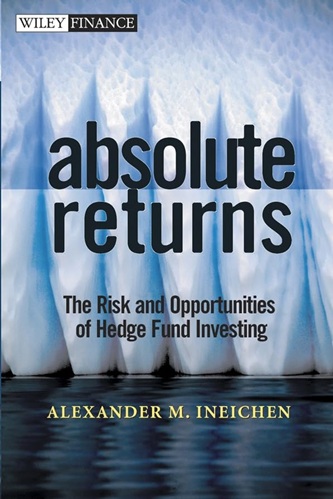
Absolute Returns: The Risk and Opportunities of Hedge Fund Investing
$18.06
Absolute Returns: The Risk and Opportunities of Hedge Fund Investing is a rigorous, research-driven examination of hedge funds as an asset class, written for investors who want to understand how hedge funds generate returns rather than simply chasing performance figures. Alexander M. Ineichen approaches hedge fund investing from an analytical and institutional perspective, focusing on return drivers, risk structures, and the economic rationale behind alternative investment strategies.
Rather than promoting hedge funds as a monolithic solution, the book dissects their diversity. Ineichen explains the fundamental differences between traditional long-only investing and absolute-return strategies, emphasizing why hedge funds seek to decouple performance from broad market direction. Key concepts such as alpha generation, leverage, short selling, and dynamic risk exposure are explored with clarity, allowing readers to evaluate hedge funds on structural merit rather than marketing narratives.
A significant portion of the book is dedicated to risk. Ineichen challenges conventional volatility-based risk measures and introduces more appropriate frameworks for assessing downside risk, drawdowns, skewness, and tail exposure. He explains why many standard portfolio metrics fail when applied to hedge funds and how investors should adjust their evaluation tools accordingly. This makes the book especially valuable for readers interested in portfolio construction and capital allocation.
Throughout the book, hedge funds are positioned within a broader investment ecosystem. Topics such as diversification benefits, correlation behavior during stress periods, and the role of hedge funds in institutional portfolios are addressed in depth. The result is a balanced, intellectually honest treatment that neither glorifies nor dismisses hedge funds, but instead equips the reader with the analytical tools needed to judge them independently.
✅ What You’ll Learn:
- How hedge funds differ structurally from traditional long-only investments
- The economic sources of absolute returns and alpha generation
- Why volatility alone is an inadequate measure of hedge fund risk
- How leverage, short selling, and dynamic exposure affect performance
- How hedge funds can (and cannot) contribute to portfolio diversification
💡 Key Benefits:
- Provides a clear analytical framework for evaluating hedge funds objectively
- Bridges academic finance concepts with real-world investment practice
- Helps investors understand risk beyond standard deviation and beta
- Supports informed capital allocation decisions in alternative investments
👤 Who This Book Is For:
- Investors seeking a deep understanding of hedge fund strategies and risks
- Portfolio managers and analysts working with alternative investments
- Advanced private investors evaluating hedge funds critically
- Not suitable for beginners looking for step-by-step trading or investment instructions
📚 Table of Contents:
- Introduction to Absolute Return Investing
- Hedge Funds as an Asset Class
- Sources of Hedge Fund Returns
- Understanding Hedge Fund Risk
- Volatility, Drawdowns, and Tail Risk
- Leverage, Short Selling, and Strategy Design
- Diversification and Portfolio Construction
- Performance Measurement and Misconceptions
- Hedge Funds in Institutional Portfolios
- Conclusions and Investment Implications
Absolute Returns: The Risk and Opportunities of Hedge Fund Investing By Alexander M. Ineichen
| Author(s) | |
|---|---|
| Product Type | Ebook |
| Format | |
| Skill Level | Intermediate to Advanced |
| Pages | 531 |
| Publication Year | 2003 |
| Delivery | Instant Download |
6 reviews for Absolute Returns: The Risk and Opportunities of Hedge Fund Investing
Only logged in customers who have purchased this product may leave a review.
Related products

Melissa Decker (verified owner) –
This book has many fine features but has two serious drawbacks as well.
On the positive side, I have never read a more complete polemic in favor of the hedge fund industry. He shreds EMF with loads of good evidence and humorous anecdotes. However, there seems to be a constant drive to reinforce this point. Unfortunately, it takes away from a more thorough analysis of the types of hedge fund investing.
Another problem with the book is that it has trouble discovering its audience. At times, we get detailed descriptions of what alpha and beta represent (Finance 101) and at other times, abstruse PM concepts are brushed over as common knowledge.
I would definitely recommend this book but I recommend that the reader is accompanied by a Dictionary of Finance and Investing.
Taylor Ballard (verified owner) –
The book opens with an overview of hedge funds. He classifies hedge funds according to the strategies they employ: relative value, event driven, macro, etc. Not only does he explain the trading strategies, but he delves into what can go wrong. In general theres more discussions on equity related strategies, and less in interest rates. Theres lots of historical data/information on hedgefunds performance ,indicating the very poor performance (and high total risk) of traditional funds.
This book provides a nice introduction to hedgefunds, perhaps not so much news for experienced readers. At times theres very detailed information, in other parts the author provides only an overview (whos the audience?).
Angelica Anthony (verified owner) –
Under the title of Absolute Returns, the book is just an advertisement for the hedge fund industry. It is true that mutual fund industry has its own set of problems, and in no way this review should be seen as an attempt to discredit hedge funds while being under the impression that the mutual funds are good.
That having been said, the book goes on and on, repeating the same concept over and over. A hedge fund cannot be judged by a benchmark, because they define risk as total risk. Good. But then how do you define alpha ? What is alpha then really ? The whole concept of alpha says you are doing better than the “average”. But we don’t want to be measured by an “average”. I am doing 100 trades a day and hold positions not more than a week only to be measured against risk free rate. Wow !. What a brilliant logic !
The book keeps repeating and quoting things from academic finance to bolster its case for hedge funds. We all know where relying on academic models brought us in 2008.
The problem with these people who work in banks is that instead of creating real value in the real world, all their time and effort is wasted in this pseudo science of money management. Self promotion has always been a hallmark of financial industry and this book is no exception.
Shiloh Watts (verified owner) –
The author presents a wideranging and at times very detailed discussion of hedgefunds. The writing style can be rather rambling with sayings of famous investment managers inserted at random and many sarcastic asides in footnotes. The work is rather polemical, trying to convince the reader that they should invest in hedge funds. The author emphasizes all the statistics which point to hedge funds having high returns and low risks and tries to explain away information which points to some high risks atached to hedge fund investing. I think his audience is an institutional investor (particularly European institutional investors) who is wondering whether they should look more closely at hedge funds. But he also insults this group along with about everyone else apart from hedge fund managers.
Skyla Esparza (verified owner) –
The iceberg on the cover represents total risk-partly visible and partly not. Ineichen’s point is that hedge fund or absolute return managers tackle total risk while their traditional mutual fund counterparts worry about only one part of it, namely the risk of straying from their benchmark. His extensive discussion contains worthy lessons for all investors who want to understand risk. While not every chapter may be useful for every reader, this book is an excellent place to learn about alternative investment strategies.
Carl Shah (verified owner) –
Hedge funds burst into the headlines in the early 1990s, when George Soros became a household name – at least in Europe, where many people blamed him and his hedge fund for wrecking the European exchange rate mechanism. Similarly, a U.S. hedge fund called Long Term Capital Management (LTCM) began with an aura of investing invincibility, only to fail dramatically. Hedge fund investing is sometimes, but not always, high risk and high return. Once limited to a privileged elite group of investors, hedge funds are now opening their rosters to less sophisticated, less wealthy speculators. But hedge funds are not just like any other funds, and anyone contemplating an investment needs a solid, comprehensive guide, such as this book. Author Alexander M. Ineichen, neither a salesman nor an alarmist, pulls no punches when discussing the risks of hedge funds. He is quite straightforward about the sometimes astonishing success of some hedge fund managers, but careful to point out the common misconceptions about them. Without hedging our bets, we find this book a valuable addition to every investor’s library.