
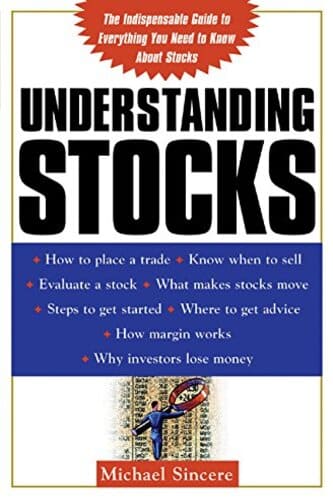
Understanding Stocks
$15.65
Understanding Stocks is an introductory guide to the stock market designed to establish a practical foundation in how stocks work, how investors and traders participate in the market, and how securities can be evaluated before capital is committed. Michael Sincere structures the book as a progression from basic market mechanics into investment and trading strategies, analytical methods, market psychology, and common mistakes that contribute to losses.
The first part establishes the operating framework of the market. It explains shares and corporate ownership, stock exchanges and market participants, major market indexes, risk, alternative investments, stock classifications, diversification, asset allocation, stock prices, and brokerage choices. The book distinguishes long-term investors from short-term traders and places stocks within the broader context of bonds, mutual funds, cash, and real estate rather than treating equities as an isolated asset class.
The methodology then shifts from market foundations to decision-making. Sincere introduces longer-term investment approaches alongside aggressive short-term trading strategies, followed by dedicated sections on fundamental, technical, and sentiment analysis. Fundamental analysis is used to examine the underlying corporation through financial information, earnings, valuation ratios, and business quality, while technical analysis focuses on price behavior, charts, trends, volume, and indicators. The book also demonstrates that these analytical disciplines do not have to be treated as mutually exclusive.
Risk and behavior remain important throughout the book. Diversification, asset allocation, risk tolerance, protective practices, discipline, flexibility, and learning from losing decisions are presented as integral parts of participating in the market. The final chapters broaden this framework by examining what influences stock prices, why investors lose money, and the author’s conclusions about market behavior.
Because Understanding Stocks was published in 2004, examples involving brokerage practices, market infrastructure, specific companies, regulations, trading technology, and market statistics reflect the period in which the book was written. Its strongest continuing value is as a structured introduction to stock-market concepts, analytical frameworks, investment versus trading approaches, and risk awareness.
✅ What You’ll Learn
- Understand what stocks represent and how investors, traders, corporations, brokers, exchanges, and other market participants interact.
- Distinguish stocks from bonds, mutual funds, cash, real estate, and other investment alternatives discussed in the book.
- Classify stocks by sector and by income, value, and growth characteristics.
- Apply foundational portfolio concepts including diversification, asset allocation, compounding, and risk tolerance.
- Differentiate longer-term investment strategies from short-term approaches such as day trading and swing trading.
- Use fundamental analysis to examine company quality, earnings, financial statements, valuation, and ratios such as P/E.
- Interpret technical concepts including charts, price trends, volume, indicators, and market direction.
- Understand sentiment analysis and the influence investor psychology can exert on stock-market behavior.
- Recognize common investor mistakes and the importance of combining discipline with flexibility when market conditions change.
- Integrate fundamental and technical perspectives rather than assuming that stock selection must rely exclusively on one analytical method.
💡 Key Benefits
- Builds stock-market knowledge progressively, beginning with foundational terminology and mechanics before introducing analytical tools and strategies.
- Provides coverage relevant to both long-term investors and active traders, clearly distinguishing their objectives, time horizons, and methods.
- Connects company analysis with price-based analysis, giving readers a broader framework for evaluating potential stock decisions.
- Places risk management within portfolio construction through diversification, asset allocation, risk tolerance, and disciplined decision-making.
- Examines behavioral errors alongside analytical techniques, helping readers understand why knowledge alone does not eliminate poor investment decisions.
- Provides a single introductory framework spanning market structure, investment strategies, trading strategies, fundamental analysis, technical analysis, sentiment, and investor psychology.
👤 Who This Book Is For
- Beginner to intermediate investors who need a structured introduction to stocks, market terminology, brokerage mechanics, and portfolio concepts.
- Self-directed investors seeking foundational methods for evaluating companies through fundamental analysis.
- Newer traders who want an introduction to technical analysis, price trends, short-term strategies, and market psychology before progressing to specialized trading material.
- Investors and traders seeking a broad reference that connects stock selection, portfolio construction, analytical methods, behavioral discipline, and risk awareness.
📚 Table of Contents
- Welcome to the Stock Market
- Stocks: Not Your Only Investment
- How to Classify Stocks
- Fun Things You Can Do (with Stocks)
- Understanding Stock Prices
- Where to Buy Stocks
- Want to Make Money Slowly? Try These Investment Strategies
- Want to Make Money Fast? Try These Trading Strategies
- It’s Really Fundamental: Introduction to Fundamental Analysis
- Fundamental Analysis: Tools and Tactics
- Let’s Get Technical: Introduction to Technical Analysis
- Technical Analysis: Tools and Tactics
- The Psychology of Stocks: Introduction to Sentiment Analysis
- What Makes Stocks Go Up or Down
- Why Investors Lose Money
- What I Really Think about the Stock Market
Understanding Stocks By Michael Sincere
| Author(s) | |
|---|---|
| Product Type | Ebook |
| Format | |
| Skill Level | Beginner to Intermediate |
| Pages | 206 |
| Publication Year | 2004 |
| Delivery | Instant Download |
7 reviews for Understanding Stocks
Only logged in customers who have purchased this product may leave a review.
Related products








Mercy McDowell (verified owner) –
I like books that are not written with an intent to impress.
I like straight forward talk and that is what this book delivers. I am halfway through and have learned a lot.
Anais Love (verified owner) –
I read this book when I first became interested in stocks. It was very informative and easy to read.
Lachlan Wilkins (verified owner) –
Basic information
Amalia Stout (verified owner) –
it was an enjoyable read for someone clueless like me
Natalia Wu (verified owner) –
Good advice but hard for a first timer to understand.
Kyson Benton (verified owner) –
Excellent book to read
Callahan Wood (verified owner) –
Very easy to read and remains engaged. It encourages me to look up other books written by the author. I would definitely recommend reading this book for anyone considering joining the stock market.