
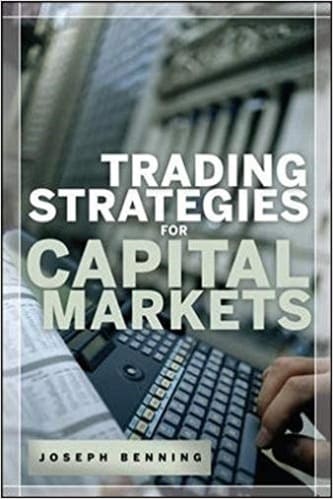
Trading Strategies for Capital Markets by Joseph Benning
$21.76
Trading Strategies for Capital Markets examines how market history, institutions, economic policy, and financial instruments shape trading opportunities. Benning begins with a framework for interpreting market behavior, then moves from market structure to specific strategies and risk management.
The book devotes substantial attention to fixed-income markets. It explains federal funds, government bonds, the yield curve, carry trades, Treasury basis trading, contract rolls, and intermarket spreads. It also covers equity instruments and index futures, including their pricing and use in trading strategies.
Benning places these methods in a broader context that includes the credit cycle, behavioral finance, pairs trading, technical analysis, and position risk. Examples connect market views to instruments and implementation.
The book is suited to traders and market professionals who want to understand how strategies work across asset classes and why institutional and policy conditions matter to their use.
✅ What You’ll Learn
- Analyze market behavior in its historical, political, and institutional context.
- Distinguish the roles of major capital market instruments and derivatives.
- Examine how Federal Reserve policy and the yield curve affect trading decisions.
- Assess carry trades, Treasury basis trades, and intermarket spreads.
- Understand equity indexes, exchange-traded funds, and index futures.
- Compare pairs trading, technical analysis, and cross-asset approaches.
- Consider behavioral factors in market interpretation.
- Identify and manage trading and position risk.
💡 Key Benefits
- Connects trading strategies to the institutions and instruments that make them possible.
- Provides detailed coverage of fixed-income market mechanics.
- Extends the discussion from bonds to equities and derivatives.
- Uses a common framework to examine opportunities across asset classes.
- Integrates risk management with strategy selection and implementation.
👤 Who This Book Is For
- Intermediate to advanced traders working across capital markets.
- Fixed-income traders studying policy, yield curves, and Treasury strategies.
- Equity and derivatives traders seeking a broader understanding of market structure.
- Finance professionals evaluating cross-asset strategies and position risk.
📚 Table of Contents
- Mapping the Market
- The Politics of Finance
- Going Mobile: Globalization and the Bond Market
- Electronic Markets
- Are Markets Really Efficient, Mr. Markowitz?
- What Drives the Market?
- Instruments of the Capital Markets
- Swaps and Listed Derivatives
- Fed Funds: The Price of Policy
- Government Bonds: A Toolbox
- The Carry Trade
- Tactical Trading and the Yield Curve
- Strategy and the Yield Curve
- Trading the Treasury Basis
- Synthetics, Contract Rolls, and Intermarket Spreads
- The Credit Cycle
- Trading Equities: An Overview
- Equity Instruments: Indexes and Exchange-Traded Funds
- Equity Index Futures, Basis Trading, and Market Timing
- Pairs Trading
- Technical Analysis
- Psychology and Markets: Behavioral Finance
- Breaking Up Is Easy to Do: Portable Alpha
- Managing Trading and Position Risk
Trading Stategies for Capital Markets By Joseph Benning
| Author(s) | |
|---|---|
| Product Type | Ebook |
| Format | |
| Skill Level | Intermediate to Advanced |
| Pages | 479 |
| Publication Year | 2007 |
| Delivery | Instant Download |
1 review for Trading Strategies for Capital Markets by Joseph Benning
Only logged in customers who have purchased this product may leave a review.


Ricky Howe (verified owner) –
Benning assumes a mathematically sophisticated reader, who know little about how markets work. So he provides an education. Centred in no small way on the Efficient Market Hypothesis by Markowitz. This is the dominant theoretical framework for modelling financial markets, and whether you subscribe to it or not, you need to be well aware of it. The book suggests, based on plausible reasoning, that markets are weakly efficient. But that volatility can be greater than theoretically assumed.
Another key portion of the book covers the Capital Asset Pricing Model.
Black-Scholes option pricing is derived, showing the assumptions on which it was originally based. Other financial instruments are also covered. Like Collateralised Mortgage Obligation (CMO). Alas, no mention of its close relative, the Collateralised Debt Obligation, which has been much in the news in 2007. A curious omission. But the book is still well worth reading.