
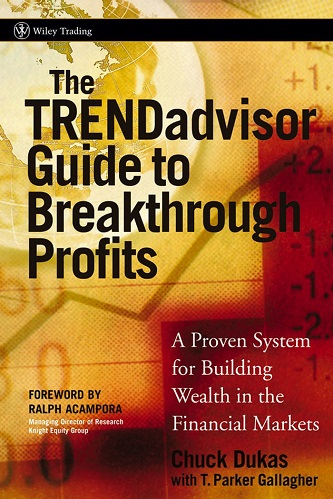
The TRENDadvisor Guide to Breakthrough Profits: A Proven System for Building Wealth in the Financial Markets
$17.80
The TRENDadvisor Guide to Breakthrough Profits presents a structured method for classifying price trends and connecting that classification with trading decisions. Chuck Dukas, with T. Parker Gallagher, explains how traders and investors can use observable price relationships to organize entries, exits, profit-taking, and capital allocation.
The central framework, the TRENDadvisor Diamond, divides market behavior into six phases: Recovery, Accumulation, Bullish, Warning, Distribution, and Bearish. Each phase is defined by the relationship between closing price and the 50-period and 200-period simple moving averages, together with the relationship between those averages. The book examines the buying and selling dynamics associated with each phase.
Supporting tools include a 60-period high/low channel, its midpoint retracement line, rate of change, stochastics, and a volume oscillator. Rather than interpreting these indicators identically in every market condition, the authors explain how their meaning changes with the phase. Chart examples illustrate developing trends, pullbacks, rallies, failed transitions, and potential trading candidates.
The framework extends into trading-plan development, including position limits, stop placement, staged exposure, and profit-taking rules. A concluding historical study compares instruments through time spent in different phases and the occurrence of new channel highs and lows. Published in 2006, the book offers a practical introduction to phase-based technical analysis while acknowledging the ambiguity traders encounter in live markets.
✅ What You’ll Learn
- Classify price behavior into the six phases of the TRENDadvisor Diamond.
- Interpret closing-price relationships with the 50-period and 200-period moving averages.
- Use moving-average slopes to assess developing or weakening trends.
- Identify new highs, new lows, and potential trend deterioration with a 60-period price channel.
- Evaluate momentum, range position, and volume within the context of each phase.
- Distinguish potential trend-following opportunities from failed phase transitions.
- Apply phase analysis to long positions and the book’s short-selling examples.
- Define entries, stops, profit-taking rules, and capital exposure within a trading plan.
- Compare instruments using historical phase occupancy and channel-breakout activity.
💡 Key Benefits
- Consistent market classification: Provides explicit criteria for organizing trend analysis.
- Contextual indicator interpretation: Explains why the same indicator reading can have different implications across phases.
- Integrated trade management: Connects chart analysis with entry, exit, and exposure decisions.
- Accessible analytical toolkit: Builds the methodology around commonly available technical indicators.
- Practical chart instruction: Uses examples to illustrate both orderly phase progressions and less straightforward transitions.
👤 Who This Book Is For
- Beginning to intermediate technical traders seeking a structured approach to trend identification.
- Swing and position traders studying phase-dependent entries, pullbacks, rallies, and exits.
- Self-directed investors interested in using price trends to guide market exposure and selling decisions.
- Developing traders building a written plan for position sizing, loss limits, profit-taking, and consistent execution.
📚 Table of Contents
- The Ins and Outs of Trends with a Toolkit for Analysis
- The Six Phases of the advisor Diamond
- The Recovery Phase
- The Accumulation Phase
- The Bullish Phase
- The Warning Phase
- The Distribution Phase
- The Bearish Phase
- Pulling It Together
- Discipline and Money Management Come from Your Trading Plan
- A Lens on the Past
The TRENDadvisor Guide to Breakthrough Profits: A Proven System for Building Wealth in the Financial Markets By Chuck Dukas, T. Parker Gallagher
| Author(s) | |
|---|---|
| Product Type | Ebook |
| Format | |
| Skill Level | Beginner to Intermediate |
| Pages | 209 |
| Publication Year | 2006 |
| Delivery | Instant Download |
11 reviews for The TRENDadvisor Guide to Breakthrough Profits: A Proven System for Building Wealth in the Financial Markets
Only logged in customers who have purchased this product may leave a review.


Jianna Castaneda (verified owner) –
The reason I have read numerous books, attended many seminars & spent thousands of dollars is because none of them could fully explain the intricacies of how the market worked. Not until I read “TRENDadvisor Guide to Breakthrough Profits” did it all make sense. Chuck did a phenomenal job in explaining the dynamics of the 6 market phases and how to trade them. In addition, Chuck educates the reader on the importance of money management and having a Disciplined Trading Plan.
This is a must have book for every trader who is serious about making money.
Reese Copeland (verified owner) –
After reading a lot of trading books, this one made me come back to this essential truth I forget : any stocks can always be classified in one phase, the position of price related to 50 and 200 moving average is a fundamental information. Chuck Dukas give us the synthetic view about trend and phases, his book is the natural continuation of the book of Stan Weinstein, these two are foundation for trading knowledge.
Axton Moody (verified owner) –
This is a book that explains that markets move by phases and how markets can be traded depending on the phase they are.
The books starts showing how to setup a template to analyze a stock. This is done by means of some very well known oscillators. This could appear very simple yet the author explains how this setup translates into market phases and how these oscillators behave during each phase.
Taking these concepts into account, the author complements the overall strategy to follow by applying money management rules and even shows examples of how all of this is done.
The book contains many charts and follows a certain rythm. All of this is done in order to achieve the objective of “training the eye” in order to detect how to apply all of this whenever trading for real.
I really like the strategy of simplifying the different scenarios and timeframes that can be found and going step by step in order to decide what to do next.
I have read many trading books. I highly recommend this book for both the novice as well as the advanced trader and I think this one of the best trading books that is that is available.
Maliyah Bridges (verified owner) –
Want to be upfront and honest; I am a student of Chuck Dukas since December of 2005. I have been a day trader for about a year now and have taken extensive courses through professional company where I’ve learned how trade level 5 options. These classes were very expensive, running into the thousands of dollars. My results have been less than stellar and for additional guidance it would cost me thousands more.
Under Chuck’s guidance we have covered most of what is in this book. I say most, because Chuck has been taking me one step at a time. My biggest problem has I’ve been trading without a plan. One cannot develop a plan until one knows what the market is doing at any given time, how to trade it, based on what we see, not what we think, feel or hear. In addition, you need to know what type of trader you are, long term, short term (months) or investment (years).
Chuck’s book “TRENDadvisor Guide to Breakthrough Profits” takes you from the beginning of how to look at the market, and equities in any stage, how to trade them, long or short, and close the trade with what we all want, and a profit. This is all based on a plan, which is laid out in his book.
The book is easy to read, in-depth, tons of charts, and tools, which, when put together with a trading plan will lead to profits. Since using Chuck’s methods I trade with confidence and finally make a profit month-to-month.
If your a trader, not seeing the results you want, I would suggest purchasing this book, study it, develop your own trading plan to fit your style of trading. The results just might astound you.
Korbyn Benjamin (verified owner) –
This is an interesting book. This book gives definitions of bull and bear markets and their phasis in exchanges, and suggests certain trading methods in each phase. You may take it or leave it, but in any case, this book is an anjoyable read.
Julieta Hendrix (verified owner) –
Martin Pring wrote “the book” on Market Momentum. Chuck Dukas has written “the book” on Market Trends, and how to analyze them. Chuck’s Diamond framework is elegant and useful. It provides specific criteria for classifying any market from recovery through bullish and bearish phases. His supporting indicators are valuable as well. After reading this excellent book, short-term traders and longer-term investors alike will no longer be clueless as to what stage a market is in, or where to enter and exit positions.
Collin Price (verified owner) –
It ain’t sexy and, fundamentally, it’s not especially new. But it is profitable (see below). The words “neural network,” “doji” and “impulse wave” are nowhere to be found. But the words “trend,” “accumulation,” and “distribution” are (a lot). So what do you want to do? Make money or pretend that those fretful, indecisive, and painful hours staring at the screen are just as much fun. If it’s the former and if you’re willing to abandon your search for the “next best thing” (you know, the one that’s finally going to turn it around for you) and to revisit some time-honored market wisdom presented in a freshly drawn framework, I encourage you to pick up this book.
The title, TRENDadvisor Guide to Breakthrough Profits, succinctly gives away the message inside: the trend is indeed your friend. Why read beyond that? Because Dukas presents this essential market truth, first among equals, as the organizing principle around which he creates an elegantly simple, though no less comprehensive or powerful for being so, model of market behavior. Based on the recurring, and so predictable, patterns of human behavior around issues of risk and money, this model is universal and enduring. Analyzed with a just few indicators, robust in their simplicity, the model spits out clearly defined trade parameters: entry points, protective stop levels and profit targets. Failures are quickly identified. Probabilities are left to unfold. Discretion is unwelcomed and taken at one’s peril.
The heart of the model is an understanding of market behavior as a series of six recurring stages, each with a distinct pattern of price activity. These stages continually repeat and form the familiar rising-and-falling cycles of market action (though Dukas has curiously chosen to represent it as a six-segmented diamond). Each stage is given its own chapter in the book. Each one’s characteristic price pattern is thoroughly analyzed according to the relative forces of supply and demand being evidenced. Pattern evolution is explained. Finally trading rules, both long and short, where appropriate are suggested. Chart examples are numerous and varied across markets and timeframes.
Basic money management concepts are integrated into the individual discussions of trading each market stage. Along with a brief review of trading plans, money management is also given a cursory chapter of its own. The book ends with a brief review of statistical analyses of the major market indexes and Dow stocks relative to the six stages during the past one, ten and twenty years.
If you are intrigued, as I was, with the power and elegance of a simple concept made comprehensive in its extension, not in more complexity, you might check out Dukas’ web site. There, under Performance, he publishes the returns of his system since 2000. They are impressive. Although most of the site is proprietary, from what can be deduced as a non-member these results, for example 36% in the first quarter of this year, are derived from trades setup identically to those he describes in his book.
I’m sure there are those sufficiently enamored of novelty and fond of complication who will remain unconvinced. And some of them are no doubt good and profitable traders; there are many ways to make money in the markets. Some, perhaps, but only a few I think. It is from the others that those who have the discipline to follow a simple plan, grounded in the truths of human behavior, will fatten their wallets.
Mohammed Jefferson (verified owner) –
I’m a day trader and trade stocks, ETF’s, and options. I always looking for new ideas to help me screen for “buy candidates.” I thought this book might have some new twist on technical indicators. When I opened it up, I was disappointed. I literally read the book, cover to cover in 10 minutes. I went though it quickly because the material was so simple. Basically the theory in the book is as follows: 6 phases of a stock. Recovery Phase (50SMA 50SMA), Accumulation phase (Close > 50SMA, Close > 200SMA, 50SMA < 200 SMA),etc…. same simple concept for the other four phases. Then for the grand finale,the last chapter "Putting it all together"…drum roll…. Was a review of the previous six chapters.. happy holidays.
Ryan Glass (verified owner) –
I have read over 100 books on investing and trading, and this book ranks on top. The concepts are thoroughly explained, and many charts are provided as examples. The book will benefit experienced as well as beginning traders and investors. Chuck takes some standard indicators which are available in most charting programs and interprets their positions to show where the stock, commodity, or mutual fund is in the price cycle. The book is invaluable in helping a trader or investor determine the safety or risk in entering a trade, because the book is such a good guide to determine what trend the stock, commodity, mutual fund, index, etc. is in and where it is likely to go in its next stage. Chuck also gives very good suggestions about when to take profits or exit trades. This book will greatly improve your market timing. If you want to trade with the trend, control risk, and help you time your trades so that you will be profitable, then this book will show you how to do all of that. Five stars all the way!
Piper Cruz (verified owner) –
It’s a sign of a novice trader when they bash books that present core concepts of trading/investing rather than fluff such as “revolutionary” indicators, or “new concepts in trading.” Yes, this book is short and simple, but it presents a concept that most wannabe traders totally miss. Dukas shows you an elegant but simple strategy of providing a framework to price action (similar to Stan Weinstein) that, if anything, serves as a guide post for your trading decisions. This was what I have been missing. Does Dukas illustrate specific trading setups in the book? No. He provides the framework and then leaves it up to you to design a approach that fits you. If you don’t want to do the work to design your own strategy then you shouldn’t be in this game. The more years that I get behind my belt, the more I realize that 99% of the trading books out there are useless. Sure, they are packed full of pretty graphs or trading setups, but they don’t get you to think for yourself and help you truly understand what drives price movement. In summary, if you’re looking for a framework to guide your trading decisions, then this is the book for you. Highly recommended!
Edward Woods (verified owner) –
Solid trading information look at this book to see a detailed system on how the dow theory could work