
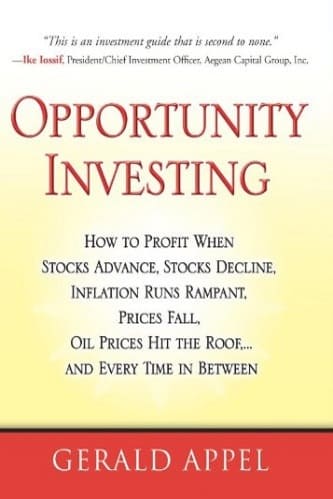
Opportunity Investing: How To Profit When Stocks Advance, Stocks Decline, Inflation Runs Rampant, Prices Fall, Oil Prices Hit the Roof and Every Time in Between
$10.48
Opportunity Investing presents a comprehensive framework for active portfolio management across multiple investment climates, including bull markets, bear markets, inflationary periods, deflationary cycles, and shifting global economic conditions. Gerald Appel combines tactical asset allocation, market timing, diversification, and sector rotation principles into a structured methodology designed for adaptable investors.
The book moves beyond traditional buy-and-hold investing by emphasizing flexibility, risk control, and opportunistic capital allocation. Appel explains how investors can dynamically adjust exposure to stocks, bonds, commodities, REITs, international markets, and sector-based investments depending on prevailing market conditions. Throughout the book, he focuses heavily on balancing growth opportunities with defensive positioning and capital preservation.
A significant portion of the material is dedicated to practical implementation. Readers are introduced to ETF and mutual fund selection systems, relative strength analysis, market breadth indicators, bond laddering, closed-end fund opportunities, inflation hedging techniques, and portfolio rebalancing procedures. The book also examines historical market cycles, presidential cycle analysis, sentiment indicators, and valuation-based timing frameworks.
In addition to tactical strategies, the book explores broader wealth-building concepts such as long-term financial planning, diversification by geography and asset class, and managing investment risk through disciplined portfolio construction. The result is a detailed investment manual that integrates technical analysis, macroeconomic awareness, and active portfolio management into a cohesive investment process.
✅ What You’ll Learn:
- How to structure diversified portfolios across multiple asset classes
- ETF and mutual fund rotation strategies using relative strength analysis
- Market timing techniques based on sentiment, breadth, and valuation indicators
- How to manage portfolios during inflationary and deflationary environments
- Bond laddering and income investing methodologies
- Tactical approaches to international and emerging market investing
- REIT investment strategies and real estate cycle analysis
- Closed-end fund discount and premium trading opportunities
- Risk reduction through diversification and active portfolio rebalancing
- Methods for identifying favorable and unfavorable investment climates
💡 Key Benefits:
- Provides a flexible framework adaptable to changing market conditions
- Combines technical analysis with macroeconomic investment themes
- Emphasizes risk management alongside return generation
- Covers a broad range of asset classes and global investment opportunities
- Introduces actionable portfolio timing and allocation models
- Helps investors develop structured, self-directed investment discipline
👤 Who This Book Is For:
- Intermediate to advanced investors seeking active portfolio management techniques
- Traders and investors interested in tactical asset allocation strategies
- ETF and mutual fund investors looking for systematic investment models
- Long-term investors seeking diversified approaches across global markets and economic cycles
📚 Table of Contents:
- The Myth of Buy and Hold
- Putting Together a Winning Portfolio
- Selecting Mutual Funds Most Likely to Succeed
- Income Investing—Safer and Steady . . . But Watch Out for the Pitfalls
- Securing Junk Bond Yields at Treasury Bond Risk
- The Wonderful World of Exchange-Traded Funds
- A Three-Pronged Approach to Timing the Markets
- Time Cycles, Market Breadth, and Bottom-Finding Strategies
- Cashing In on the Real Estate Boom— Investing in REITs
- Opportunities Abroad— Investing from Brazil to Britain
- How to Get the Most from Closed-End Mutual Funds
- Inflation—Coexisting and Even Profiting with Inflation
- Reviewing Our Array of Opportunity Strategies
Opportunity Investing: How To Profit When Stocks Advance, Stocks Decline, Inflation Runs Rampant, Prices Fall, Oil Prices Hit the Roof and Every Time in Between By Gerald Appel
| Author(s) | |
|---|---|
| Product Type | Ebook |
| Format | |
| Skill Level | Beginner to Intermediate |
| Pages | 370 |
| Publication Year | 2007 |
| Delivery | Instant Download |
6 reviews for Opportunity Investing: How To Profit When Stocks Advance, Stocks Decline, Inflation Runs Rampant, Prices Fall, Oil Prices Hit the Roof and Every Time in Between
Only logged in customers who have purchased this product may leave a review.
Related products



Veda Barnett (verified owner) –
Really like this book. Covers sector rotation, etf’s, how to position yourself to profit regardless of the market. Good, usable information. Yes it is backtested info. Use at your own risk. I like it!
Rosalee Flynn (verified owner) –
For all of us that are interested in taking a more active role in our investments, the processes in this book are a good next step. There is a rare balance of acceptance of risk and potential gain in the author’s suggested quarterly re-allocation method. The method is not a “read the market” approach, which virtually no one can do consistently, if at all. It is rather a method to use recent fund performance as a purchase / reallocation guideline for short periods of time (as in quarterly). It is definitely not for everyone, because of the quarterly attention required. A very good incremental step in a maturing investor’s education.
Ricky Roberts (verified owner) –
Being a financial advisor, I’ve come across books that range from the very basic to the ridiculous.
Appel’s book, although more conventional then his previous titles, lays out a comprehensive, although extremely practical and relevant strategy for 1) understanding how the markets both stocks and bonds work and 2) giving the investor various options to use that although do involve time and some monitoring, provide a solid blue-print step by step guide that will allow them to more intelligently invest with their hard-earned assets while reducing risk where possible.
Moreover, the combination of fundamental and technical analysis in security selection allows the investor to capitalize on both areas of the market that are affected by emotional factors (external events) but also takes advantage of proven technical and analytical strategies that in the long-haul will give the investor above market gains.
Highly recommended.
Avah Beltran (verified owner) –
good book
Kannon Horn (verified owner) –
Gerald Appel is a well-known author, technical analyst (and developer of the Moving Average Convergence Divergence (MACD) indicator) who has written a practical guide to investing while dispelling a number of Wall Street myths on along the way. His book’s purpose is to help readers who have limited time on their hands become active intelligent investors, as well as to help those individuals who are willing to put in more time and effort.
In the book, Appel covers specifically which vehicles to invest in, the timing of the buys and sells, and how to construct a portfolio that is diversified and balanced based on the individual’s age and financial situation. Throughout the book, he stresses the importance of active, informed, self-directed investing instead of the out-of-date and risky buy and hold approach which “may or may not service investors purposes in the future.”
The author suggests that investors focus not only on the U.S. stock market, but also on the overseas markets. He recommends investing in U.S. stocks, bonds, and money market instruments, as well as the more unfamiliar foreign bonds and stocks, real estate, and investments in foreign countries.
Appel kicks off the book covering the myth of why buy and hold is not a risk-free investment strategy compared to active management. He shows that by using a few indicators such as the NASDAQ/NYSE ratio, direction of interest rates, public sentiment, and the Best Six Months Strategy (buy at end of October and sell in May and go into cash until next October) that investors can reduce their risk and obtain decent investment performance. For example, by using the NASDAQ/NYSE relative strength ratio with a 10 dma crossover signal, according to Appel it is possible to beat the market’s performance with about half the risk.
In another chapter, the author compares three diversified mutual fund portfolios showing how different market segments work well together to reduce risk and improve returns. He covers the basics of how to select the best mutual funds by providing the most important characteristics to consider for the long run. Furthermore, he illustrates how to pick funds that are in the top decile of performance.
Appel devotes a separate chapter to income investing suggesting short-term bonds with high credit ratings, and current interest flow. In a section on maximizing safety he mentions T-bills, money market accounts, and setting up a bond ladder with wide diversification. He also reviews what to focus on for maximum potential returns, as well as balancing risk and return. A follow-on chapter reviews the keys to securing junk bond yields at Treasury bond risk levels. Another chapter reviews investing in REITs while another covers investing abroad using open-end and closed-end funds as well as ETFs.
Appel favors ETFs as a new way to invest replacing the typical mutual funds. He contrasts the pros and cons of ETFs, the different ETF categories, and how to create and maintain a diversified portfolio. He provides three specific sample portfolios for different types of investors.
The author’s market timing approach encompasses both fundamental and technical analysis. On the fundamental side he reviews the P/E ratio, bond yields, earnings yields and provides guidance on how to interpret the readings. On the technical side, he discusses the four year and presidential election market cycles, advance decline line, and new high new low breadth indicator.
Overall, Appel provides readers with a time-tested practical approach to take control of their investments. For those readers that prefer investing using their own skills this book will provide and excellent plan for moving ahead and succeeding.
Stephen Blankenship (verified owner) –
This book does an outstanding job explaining how to use different investment vehicles at the right time to find opportunities and achieve results. The author advises to only take on appropriate risk for your situation, diversify, buy your investments for a good value, and stick with your winners. He explains the proper use of open and close ended mutual funds, REITs, ETFs, commodity mutual funds, gold, stocks and bonds. High inflation? Invest in commodity and natural resource mutual funds. Moderate inflation? Stay in the stock market. Deflation? Go to investment grade intermediate and long-term bonds. This book is packed with strategies so you can become your own investment advisor by seeing opportunities no matter what the economic environment. I highly recommend.