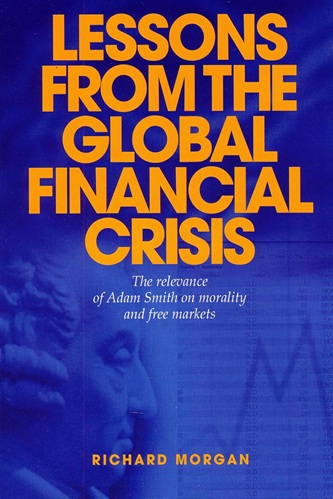
Lessons from the Global Financial Crisis: The Relevance of Adam Smith on Morality and Free Markets
$9.97
Lessons From the Global Financial Crisis is a reflective and intellectually grounded analysis of the 2008 financial collapse through the moral and economic philosophy of Adam Smith. Richard M. Morgan challenges the widespread assumption that the crisis represented a failure of free markets. Instead, he argues that it reflected a breakdown in ethical foundations, institutional discipline, and moral responsibility within financial systems.
The book revisits Adam Smith not merely as the author of The Wealth of Nations, but as a moral philosopher deeply concerned with justice, prudence, and social responsibility. Morgan emphasizes that Smith’s framework for free markets was never divorced from ethical conduct. According to this interpretation, markets function efficiently only when supported by moral norms and institutional accountability.
Morgan carefully analyzes the structural causes of the financial crisis—excessive leverage, distorted incentives, regulatory failures, and misaligned risk assumptions. He contends that modern financial institutions deviated from classical free-market principles by socializing losses while privatizing gains. The result was systemic fragility rather than competitive discipline.
The discussion extends beyond crisis diagnosis. The book examines the broader philosophical tension between state intervention and market autonomy. It argues that proper regulation should reinforce, not replace, market morality. The reader is encouraged to reconsider common narratives about capitalism, greed, and deregulation in light of Smith’s integrated moral-economic framework.
This is not a trading manual. It is a macro-level exploration of financial ethics, policy design, and systemic stability. For serious investors and analysts, the book provides deeper structural insight into how moral philosophy intersects with financial architecture.
✅ What You’ll Learn:
- How Adam Smith’s moral philosophy relates to modern financial markets
- Structural causes behind the 2008 global financial crisis
- How incentive misalignment contributed to systemic instability
- The distinction between free markets and regulatory distortion
- How ethical frameworks influence financial system resilience
- The relationship between public policy and market discipline
💡 Key Benefits:
- Provides historical and philosophical context for financial crises
- Clarifies misconceptions about capitalism and free markets
- Enhances macroeconomic awareness for investors
- Deepens understanding of systemic risk drivers
- Strengthens long-term strategic thinking about financial stability
👤 Who This Book Is For:
- Macro-focused investors and financial analysts
- Economics and finance students
- Institutional professionals studying systemic risk
- Readers interested in political economy and market philosophy
- Not suitable for short-term technical traders seeking chart-based strategies
📚 Table of Contents:
- Smith’s Life and Career
- The Philosopher Economist
- Smith and Social Cohesion
- Moral Judgments
- How Living Standards Are Improved
- Smith and Self Interest
- The Importance of Benevolence
- Self Interest Does Not Mean Selfish
- Self Interest, Saving, Investment and Prosperity
- Self Interest and the Banking Sector
- Smith, the Critic of Exploitation
- The Proponent of a Well Governed Society
- The Threat of Government Intervention
Lessons from the Global Financial Crisis: The Relevance of Adam Smith on Morality and Free Markets By Richard M. Morgan
| Author(s) | |
|---|---|
| Product Type | Ebook |
| Format | |
| Skill Level | Intermediate to Advanced |
| Pages | 110 |
| Publication Year | 2009 |
| Delivery | Instant Download |
Related products