
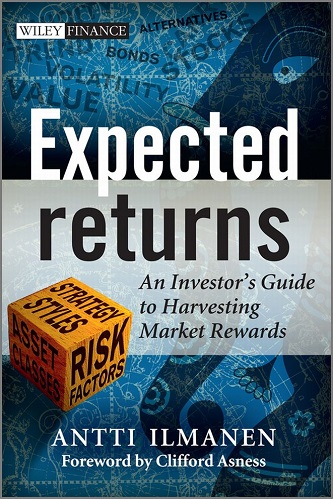
Expected Returns: An Investor’s Guide to Harvesting Market Rewards
$21.79
Expected Returns examines how investors can assess prospective investment rewards across asset classes, systematic strategies, and underlying risk factors. Antti Ilmanen broadens the traditional focus on asset allocation by studying equities, bonds, credit, alternative assets, value, carry, momentum, and volatility selling within a shared analytical framework.
The book combines historical performance, financial and behavioral theories, and forward-looking indicators. It distinguishes realized returns from expected returns and examines competing explanations for investment performance: compensation for risk, persistent behavioral effects, and statistical artifacts. Valuations, yields, spreads, and return-building-block analysis provide tools for evaluating opportunities beyond historical averages.
Twelve case studies connect these ideas to specific return sources. They cover asset and strategy premia alongside exposure to growth, inflation, liquidity, and tail risks. Throughout, Ilmanen emphasizes that the timing and economic context of losses matter when assessing whether an investment offers adequate compensation.
The final section addresses forecasting, economic regimes, investment horizons, diversification, leverage, skill, and costs. Written for readers with an established understanding of financial markets, the book provides an institutional framework for evaluating investment opportunities and improving portfolio decisions while recognizing the uncertainty of return estimates.
✅ What You’ll Learn
- Assess expected returns using historical evidence, theory, and forward-looking indicators.
- Distinguish asset class exposures, systematic strategy returns, and underlying risk factors.
- Evaluate equity, bond, credit, and alternative asset premia using their specific return drivers.
- Analyze value, currency carry, commodity momentum, and volatility-selling strategies.
- Separate risk-based and behavioral explanations from data mining and measurement bias.
- Compare investments through carry, expected cash flow growth, and expected valuation changes.
- Evaluate sensitivity to growth, inflation, liquidity shocks, and adverse market conditions.
- Assess forecasting models, seasonal patterns, and business-cycle evidence with appropriate caution.
- Incorporate investment horizon, diversification, leverage, trading costs, and manager fees into portfolio analysis.
💡 Key Benefits
- A consistent framework for comparing opportunities across different markets and investment styles.
- More disciplined return assumptions for strategic allocation and investment planning.
- Clearer identification of shared exposures that conventional asset class labels can obscure.
- A stronger basis for evaluating whether active management fees reflect skill or systematic exposures.
- Greater awareness of the constraints that affect the practical capture of investment premia.
👤 Who This Book Is For
- Intermediate to advanced investors developing a more rigorous approach to multi-asset portfolio allocation.
- Institutional allocators and investment consultants evaluating return assumptions, alternative investments, and portfolio construction.
- Quantitative researchers and systematic traders studying value, carry, momentum, volatility premia, and forecasting methods.
- Portfolio managers and investment analysts connecting valuation, macroeconomic conditions, and risk exposures to prospective returns.
📚 Table of Contents
- Whetting the appetite: Historical averages and forward-looking returns
- The historical record: The past 20 years in a longer perspective
- Road map to terminology
- Rational theories on expected return determination
- Behavioral finance
- Alternative interpretations for return predictability
- Equity risk premium
- Bond risk premium
- Credit risk premium
- Alternative asset premia
- Value-oriented equity selection
- Currency carry
- Commodity momentum and trend following
- Volatility selling (on equity indices)
- Growth factor and growth premium
- Inflation factor and inflation premium
- Liquidity factor and illiquidity premium
- Tail risks (volatility, correlation, skewness)
- Endogenous return and risk: Feedback effects on expected returns
- Forward-looking measures of asset returns
- Interpreting carry or non-zero yield spreads
- Survey-based subjective expected returns
- Tactical return forecasting models
- Seasonal regularities
- Cyclical variation in asset returns
- Secular trends and the next 20 years
- Enhancing returns through managing risks, horizon, skill, and costs
- Takeaways for long-horizon investors
Expected Returns: An Investor's Guide to Harvesting Market Rewards By Antti Ilmanen
| Author(s) | |
|---|---|
| Product Type | Ebook |
| Format | |
| Skill Level | Intermediate to Advanced |
| Pages | 593 |
| Publication Year | 2011 |
| Delivery | Instant Download |
Only logged in customers who have purchased this product may leave a review.
Related products








Reviews
There are no reviews yet.