
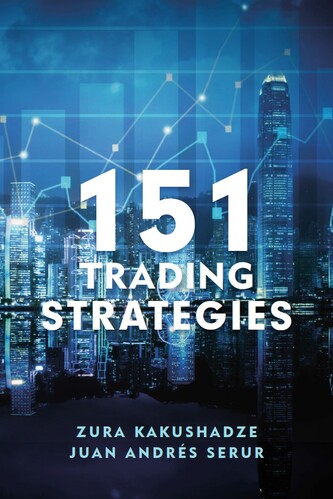
151 Trading Strategies by Zura Kakushadze & Juan Andrés Serur
$26.48
151 Trading Strategies is a technically oriented survey of systematic trading methods across a broad range of financial markets and asset classes. Kakushadze and Serur define a trading strategy as a set of instructions for establishing specified asset holdings at predefined times, noting that strategies may pursue outright profit, hedging, risk transfer, arbitrage, or other portfolio objectives. The book therefore extends well beyond conventional directional trading and includes relative-value, market-neutral, hedging, volatility, factor, arbitrage, and machine-learning approaches.
The authors organize the material across options, equities, ETFs, fixed income, indexes, volatility, foreign exchange, commodities, futures, structured assets, convertibles, tax arbitrage, distressed assets, real estate, cash, cryptocurrencies, global macro, and infrastructure. Many strategies are presented mathematically, with formulas defining portfolio construction, payoffs, break-even points, maximum profits or losses, hedging relationships, factor exposures, or optimization procedures. The resulting framework is closer to a quantitative strategy reference than to a discretionary trading manual.
The stock chapter illustrates the breadth of the methodology through price and earnings momentum, value, low-volatility and implied-volatility factors, multifactor portfolios, residual momentum, pairs trading, several forms of mean reversion, moving-average systems, support and resistance, event-driven trading, machine learning, statistical arbitrage, market making, and alpha combinations. Similar treatment is applied to other markets, including volatility carry, FX carry, futures trend following, fixed-income relative value, convertible arbitrage, commodity factors, cryptocurrency models, and global macro strategies.
The authors also emphasize that financial markets are adaptive rather than static. Strategies that once worked can weaken or disappear as market structure, technology, competition, transaction costs, and participant behavior change. Accordingly, the book is positioned as a structured survey of strategies practitioners have considered rather than a claim that all 151 methods will remain profitable indefinitely.
An appendix extends the framework into implementation by providing R source code for illustrating out-of-sample backtesting. The authors explicitly distinguish legitimate historical testing from look-ahead bias and discuss expected returns, universe construction, risk models, portfolio optimization, trading costs, dollar neutrality, and performance measurement. The book itself does not provide empirical backtests for all strategies; its purpose is to describe the methods and direct readers toward the underlying literature.
✅ What You’ll Learn
- How trading strategies can be structured for directional profit, hedging, arbitrage, relative value, income, volatility exposure, and market neutrality.
- How common option structures are constructed and how their payoff, break-even, maximum-profit, and maximum-loss characteristics are calculated.
- How quantitative equity strategies use momentum, value, volatility, mean reversion, pairs relationships, moving averages, statistical arbitrage, and multifactor signals.
- How sector rotation, trend following, mean reversion, and leveraged-product techniques can be applied to ETFs.
- How fixed-income strategies use duration, convexity, yield-curve positioning, butterfly structures, carry, value, and spread arbitrage.
- How volatility, FX, commodity, and futures strategies incorporate carry, momentum, term structure, hedging pressure, relative value, and risk premia.
- How machine-learning approaches are applied to stocks and cryptocurrencies.
- How arbitrage concepts extend to indexes, convertibles, structured products, tax relationships, and other specialized markets.
- How global macro strategies can incorporate economic fundamentals, inflation, fixed income, and scheduled economic announcements.
- How out-of-sample backtesting, risk models, portfolio constraints, transaction costs, and optimization fit into quantitative strategy research.
💡 Key Benefits
- Provides a single structured reference covering a wide cross-section of systematic trading methods and asset classes.
- Connects trading concepts with mathematical definitions instead of relying solely on qualitative descriptions.
- Helps readers compare directional, market-neutral, arbitrage, factor, hedging, and volatility-based approaches within one framework.
- Provides extensive references for readers who want to investigate the empirical and academic literature behind individual strategies.
- Introduces practical quantitative-research issues including backtest design, look-ahead bias, portfolio optimization, risk modeling, and trading costs.
- Supports strategy research across both traditional markets and newer areas such as machine learning and cryptocurrencies.
👤 Who This Book Is For
- Intermediate to advanced traders with familiarity with financial markets, derivatives, portfolio concepts, and quantitative reasoning.
- Quantitative traders and researchers looking for a broad catalogue of systematic strategies across multiple asset classes.
- Finance students, academics, analysts, and practitioners seeking mathematically specified examples of trading and hedging methodologies.
- Algorithmic traders who want a reference spanning factor models, arbitrage, machine learning, portfolio optimization, and out-of-sample testing.
📚 Table of Contents
- Options
- Stocks
- Exchange-Traded Funds (ETFs)
- Fixed Income
- Indexes
- Volatility
- Foreign Exchange (FX)
- Commodities
- Futures
- Structured Assets
- Convertibles
- Tax Arbitrage
- Miscellaneous Assets
- Distressed Assets
- Real Estate
- Cash
- Cryptocurrencies
- Global Macro
- Infrastructure
151 Trading Strategies By Zura Kakushadze, Juan Andrés Serur
| Author(s) | |
|---|---|
| Product Type | Ebook |
| Format | |
| Skill Level | Intermediate to Advanced |
| Pages | 480 |
| Publication Year | 2018 |
| Delivery | Instant Download |
5 reviews for 151 Trading Strategies by Zura Kakushadze & Juan Andrés Serur
Only logged in customers who have purchased this product may leave a review.
Stephanie Hayden (verified owner) –
This is exactly what I expected it to be, a concise formulation of the strategy described and all the necessary references to document them and to be able to begin to do a rigorous investigation of each of them.
P.S.: For readers who are looking for gifted work, it’s better to turn around.
Morgan Howell (verified owner) –
No deapth or detailed expalanation of the strategies, only a high level overiew
Rory Ryan (verified owner) –
Content I’ve seen from this author in the past usually included a useful amount of R source code. Was not expecting this book to just be equations with very little description of the strategy, and mostly useless code at the end for a couple strategies.
Bradley McLaughlin (verified owner) –
If there was an option to rate this book zero, I would.
This book only provides 5 to 10 lines summaries of the strategies, you are better off searching the strategies on google for free. Most the pages are just filled with references to other books, he writes a few lines describing a strategy with no actual examples. For example, in Fixed income, there are about 2 pages describing fixed income strategies, then about 25 pages of references. That’s pure nonsense.
DO NOT BUY!
Leroy Calderon (verified owner) –
This book is a complete rip off. There is close to 500 pages in the book. Yet there is only a tiny paragraph (no more than 10 lines), very general, on each strategy and then close to 10 pages of book references after each strategy. And then, as if it were not enough, at the end of the book the author recaps all the references one more time. All in all that’s over 300 pages of references on a 480 pages book.
As for the actual content, you’ll be better of searching the strategies on the internet. There is basically no content in this book. A 10 line description of a very general strategy, no math, no backrest, no optimization.
I would not buy this book for even $5, let alone $20 !!!!