
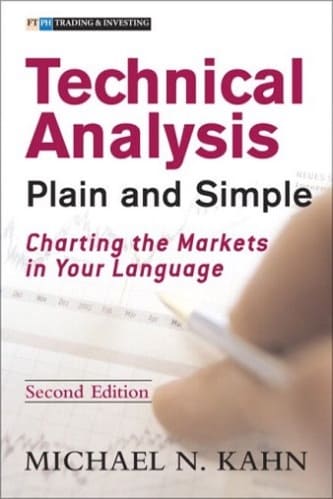
Technical Analysis Plain and Simple: Charting the Markets in Your Language
$12.78
Technical Analysis Plain and Simple by Michael N. Kahn is a structured introduction to technical market analysis designed for investors and traders seeking a practical understanding of chart-based decision-making. The book explains how price action, market psychology, supply and demand, trend behavior, and investor sentiment interact to shape market movements across stocks, bonds, commodities, and currencies.
Rather than presenting technical analysis as a highly mathematical discipline, Kahn positions it as a practical framework for interpreting market behavior through charts and recurring price structures. The material emphasizes how trends develop, how crowd psychology influences prices, and why technical analysis can enhance timing and risk management alongside fundamental research. The author repeatedly reinforces the distinction between evaluating companies and evaluating stock behavior in the marketplace.
The book covers core technical analysis concepts including trendlines, support and resistance, chart patterns, momentum, volume analysis, sentiment indicators, market cycles, candlestick analysis, Elliott Wave concepts, and risk-versus-reward evaluation. It also includes practical case studies that demonstrate how technical tools can be integrated into real-world investment decisions.
A key strength of the book is its educational structure. The material is organized progressively, beginning with foundational concepts and terminology before moving into advanced chart interpretation and practical portfolio application. The writing style focuses on simplifying technical concepts for investors who may not have prior experience with chart analysis while still introducing institutional-level analytical principles.
✅ What You’ll Learn:
- How to read and interpret market charts effectively
- The role of supply and demand in price movement
- How trendlines, support, and resistance levels function
- Methods for identifying continuation and reversal patterns
- How volume and momentum confirm market direction
- Techniques for evaluating risk versus reward before entering trades
- How sentiment and crowd psychology impact markets
- The basics of candlestick analysis and Elliott Wave concepts
- How to combine technical and fundamental analysis
- Methods for improving market timing and trade selection
💡 Key Benefits:
- Simplifies technical analysis into practical market concepts
- Provides a structured framework for chart interpretation
- Helps investors improve entry and exit timing
- Explains market psychology through observable price behavior
- Covers multiple technical tools without excessive complexity
- Includes real-world case studies and practical applications
👤 Who This Book Is For:
- Beginner to intermediate investors learning technical analysis
- Traders seeking a practical introduction to chart reading
- Fundamental investors wanting to improve market timing
- Market participants interested in price action and trend analysis
📚 Table of Contents:
Part I — A Few Things You’ll Need to Know Before You Begin
- Chapter 1: Required Background
- Chapter 2: What Is Technical Analysis?
- Chapter 3: What Is a Chart?
- Chapter 4: Jargon You Cannot Avoid
Part II — The Core of Chart Analysis
- Chapter 5: Concepts
- Chapter 6: What Are Supply and Demand in the Markets?
- Chapter 7: The Trend Is Your Friend and So Are Trendlines
- Chapter 8: See the Forest and the Trees
- Chapter 9: Chart Patterns—When the Market Needs a Rest
- Chapter 10: Chart Patterns—When the Market Is Changing Its Mind
- Chapter 11: Chart Patterns—Explosions
- Chapter 12: Corrections in Perspective
Part III — Technical Analysis in the Real World
- Chapter 13: What Is There Other Than Price?
- Chapter 14: Volume
- Chapter 15: Time
- Chapter 16: Sentiment
- Chapter 17: Fundamental Analysis Really Is Technical Analysis
- Chapter 18: Just What Makes a Stock (Bond, Commodity) Look Good?
- Chapter 19: Risk Versus Reward—Is This Stock Really Worth It?
- Chapter 20: This Isn’t Brain Surgery
Part IV — The Actual Process of Investing
- Chapter 21: OK, Now Do It!
- Chapter 22: How to Know If You Are Wrong
- Chapter 23: Sometimes Being Wrong Is Good
- Chapter 24: When to Sell
- Chapter 25: Bear Markets
- Chapter 26: A Word About Your Ego
Part V — Tools and Case Studies
- Chapter 27: What Do I Really Need to Get Started?
- Chapter 28: Building Your Technical Toolbox
- Chapter 29: Final Advice
- Chapter 30: Case Study—The Perfect World
- Chapter 31: Case Study—The Real World
- Chapter 32: How Good Is Your Broker’s Stock?
Part VI — Further On Down the Road
- Chapter 33: Introduction to Candlesticks
- Chapter 34: Cycles
- Chapter 35: Elliott Waves
- Chapter 36: Technical Terms You May Have Heard
- Chapter 37: Debunking the TV Analyst
Technical Analysis Plain and Simple: Charting the Markets in Your Language By Michael N. Kahn
| Author(s) | |
|---|---|
| Product Type | Ebook |
| Format | |
| Skill Level | Beginner to Intermediate |
| Pages | 347 |
| Publication Year | 2006 |
| Delivery | Instant Download |
23 reviews for Technical Analysis Plain and Simple: Charting the Markets in Your Language
Only logged in customers who have purchased this product may leave a review.
Related products








Mason Pace (verified owner) –
GOOD BOOK FOR BASICS OF TECHNICAL ANALYSIS
Serena Dorsey (verified owner) –
As someone who has never done any technical analysis, and had no idea where to begin this book has so far provided a very good introduction. If you’re looking for detailed analysis, look elsewhere but for beginners this is perfect.
Reese Dixon (verified owner) –
Great intro into topic and principles of why charts tell a story which can guide investment decisions. Does not get into nature of individual measures.
Enoch Decker (verified owner) –
An excellent book! Starting with a background to charting, explaining the different chart patterns, through to the various things that accompany price on the charts (such as, momentum, accumulation/distribution, RSI, sentiment etc.). I bought it as an introduction to technical analysis & found it well written & easy to understand. I still use it for reference today.
Jaxtyn Schmitt (verified owner) –
I like this book. It has given me a straightforward no nonsense description of a complicated subject matter. I have yet to fully read and take in the full contents of this book but so far it is excellent. I would recommend.
Rafael Decker (verified owner) –
If you are a brand new trader/investor and your intention is to learn more about Bollinger Bands, Fibonacci Retracements, MACD, Stochastics, then this book is NOT for you. Only in the second last chapter the author mentions these analyses and it is an extremely quick reference to them.
I was a bit disappointed as I wanted to learn more about the above mentioned subjects and I did not get from the other reviews that this book would not cover them.
Another downside: I think that some of the graphs were difficult to understand based on the author’s explanation and other graphs were so small that made it very hard to see the details in it. These bar charts looked somewhat cluttered.
On the other hand I wouldn’t say reading it was a complete waste of time. I think it provides some valuable information about Bear Markets, risk/reward evaluation, divergence, reversal, momentum, sentiment, gaps, moving averages and volume.
All in all it is an OK book.
Aleena Park (verified owner) –
This book is really plain and simple. Very good for beginners. It explains what technical analysis is all about but does not go into a lot of detail.
Sierra Hernandez (verified owner) –
happy with the book, I enjoyed learning about how to trade
Daxton Trujillo (verified owner) –
This is a great book for people who are fairly sophisticated about the market but don’t have a clue about technical analysis (that would be me). It cuts the jargon to a minimum and treats each facet of technical analysis as a tool, explaining its use and its limitations. It gives the careful reader insight into the market, and is useful both as an introduction and as a reference. If you want to be a serious investor, I’d say this is a very useful book, perhaps even an essential one.
Egypt Calhoun (verified owner) –
This review is probably a little bias as it was my first book on TA.
Has helped me make a lot more and still keep it for good reference.
There probably are a lot better intro TA books, but once again this is pretty good for an intro.
Emmie Meadows (verified owner) –
I like the writer’s creative analogies and down to earth approach.
This is a terrific intro book to get a “taste” of what TA is comprised of.
It covers the elements that make up TA in a topical manner
It will give a solid foundation to start your TA education. I would recommend “Technical Analysis Explained” or “Technical Analyis of the Financial markets” to deepen your undertanding after reading this book.
Hope to see a follow up book from this author getting more detailed since he has a knack for conveying.
Alexander Harrell (verified owner) –
I am very skeptical of technical analysis but was interested in learning more about it. This book is clear but mostly definitional. You will learn about various tools technicians use and different chart patterns but there is very little on how to actually profit from these tools. For example, is the trader supposed to anticipate “head and shoulders” chart pattern before it happens or trade after it happens? Perhaps that is because you can’t profit consistently from these tools but of course many successful traders would disagree with me. Whether it is useful or not, the fact remains that investors and speculators see these terms used widely and this book will get you familiar with the terms.
Now a challenge for all fans of technical analysis … Take a random stock and look at its chart for a random period of time. It is important that you don’t know what ultimately happened to the stock. Can you predict what will happen to the stock? You can instantly see if you are right. I would be curious to see how successful technicians are with this exercise.
Kyle Zamora (verified owner) –
Mr. Kahn has done a great job of taking a subject that could be made to appear difficult and he demystifies and truly makes it Plain and Simple to read and understand.
Ryleigh Hood (verified owner) –
It was exactly as described.
Oscar Rocha (verified owner) –
Great intro book and I also love the Technician app.
Brixton Hardy (verified owner) –
It is a very fundamental and good book for beginner and intermediate traders. I like the simple explanation the author writes.
Aleena McClure (verified owner) –
Easy way introduction to a theory that explain behaviour in the marketplace.
Kara Clark (verified owner) –
This book is good if you have no clue about the role that intangibles (investor sentiment, momentum, etc.) play on a security’s price fluctuations. There are plenty of good cliches about how a stock is priced. But other than that, I gained nothing in terms of actual technical analysis skill. The author spent too much time arguing the validity of using technical data with fundamentals which I would assume anyone who purchased the book, already knew there is value in technical analysis.
Danielle Bryan (verified owner) –
Kahn’s book on technical analysis ‘simplified’ attempts to fill a niche that sorely needs to be met– explaining technical analysis in ‘layman’s’ terms. Unfortunately, this book fails at that. Kahn defines a lot of terms associated with technical analysis, but somehow all the concepts that he presents do not cohere in any rational manner. As another reviewer noted, it’s not clear, after reading Kahn’s book, how one should trade the information presented.
Most of the charts presented in the Kahn book are from the 1990s, with a few from around 2004-05.
As with any text on technical analysis, one wonders how much ‘data fitting’ is going on behind the scenes. Kahn can present a chart that purports to show an upside breakout from, say, a head & shoulders formation, but there is no indication how often this type of signal actually works in live trading. Ten percent? Fifty percent? The answer is not here.
The best introductory book that I have read on technical analysis is, ironically, ‘Technical Analysis for Dummies,’ by Barbara Rockefeller. I would not waste my money on the Kahn book.
Darian Cano (verified owner) –
Great book for anyone interested in understanding the basics of technical analysis.
Gary Spencer (verified owner) –
This book is a “must read” if you’ve wanted to learn more about this sometimes intimidating subject. You’ll certainly learn to incorporate a few concepts of Technical Analysis (analyzing stock prices and volume trends over time) as an important part of your investing decision making. This book takes a very complex subject and breaks it down into some solid, easy-to-understand explanations for those of us who simply want to know “the basics”. For example, one of the chapters is entitled, “This Isn’t Brain Surgery”. The author seems to be writing toward those of us who are thinking in a broader sense and want to utilize technical analysis as an additional validation to confirm our buy, hold, and sell decisions. The author’s chapter on “When to Sell” is worth the price of this book alone. Yes, this book does cover some of the more intricate technical analysis tools, but, thankfully, the author provides a decent explanation, spends a little time on it, and then moves on (before we nod-off, that is!). If you’ve always wanted to know more about Technical Analysis (but were afraid to ask your “geek” friends), you’ll enjoy this author’s method of sharing these concepts along with some of his own investing wisdom. If you are willing to spend some of your own time every week incorporating a few of these tools into your investing decisions (just like Jim Cramer on CNBC advises every night on his TV show), then this book is definitely for you!
Giana Carroll (verified owner) –
I am more interested in books that marry financial and technical analysis. Kahn does a reasonable attempt at that. Some reviewers mention this book is a bit on the basic side. I would have them look at the title and what it suggests the book is trying to accomplish, i.e. a simple and plain review of technical analysis. That it does quite well.
Chris Douglas (verified owner) –
The true introduction to technical analysis. This isn’t as much of a “how to” book, than an explanation of how the market determines the price of securities. I have read numerous books on technical analysis and if I could re-choose what order to read them in, this would be among the first. I won’t give it away, but this book does have a happy ending.