
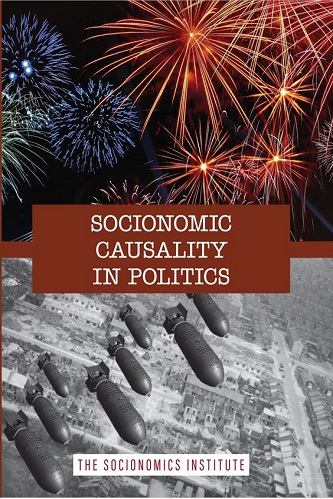
Socionomic Causality in Politics: How Social Mood Influences Everything from Elections to Geopolitics
$14.20
Socionomic Causality in Politics gives you the tools to be at the forefront of the most promising work in the field of behavioral studies. Suppose you had a single framework that allowed you to understand why certain candidates win elections and why nations go to war. And why a country’s internal politics can be peaceful one minute and beset with strikes, protests and terrorism the next. Such is the value of Socionomic Causality in Politics. In a paradigm-shifting work that trumps conventional wisdom, Robert Prechter and fellow contributors unveil why politics frequently confound even the most brilliant pollsters, historians, politicians, social scientists and the media—and how you can understand and sometimes even anticipate political changes with one simple shift in your perspective.
Contents:
- Social Mood and Election Outcomes
- Fundamental Observations of Political Causality
- Social Mood and Authoritarianism
- Europe
- Russia
- Middle East and Africa
- Far East
- Pot, Pottery, Punishment and ‘Pologies
Socionomic Causality in Politics: How Social Mood Influences Everything from Elections to Geopolitics By Robert R. Prechter pdf
| Author(s) | |
|---|---|
| Format | |
| Pages | 360 |
| Publication Year | 2017 |
5 reviews for Socionomic Causality in Politics: How Social Mood Influences Everything from Elections to Geopolitics
Only logged in customers who have purchased this product may leave a review.
Related products








Lacey Whitehead (verified owner) –
I read this book and it offered intriguing insights for anyone not familiar with the science. A book of original ideas and explorations with lots of clarity in regards to thinking and theory. Book helps to make you measure your own theories as to what might be lurking around the corner in political events – in yet to be written pages. It is not only a cerebral read with fun and exciting vernacular, but is a visual journey with lots of charts which bring clarity to correlating text.This book is easy to read and mind-expanding in regards to sociology and economics; social mood and social events. Never a dull moment with the book. Food for thought on every page. Highly recommend for all people!
Houston Hobbs (verified owner) –
This is certainly the most iconoclastic work on the subject of politics since Machiavelli’s The Prince. Like Marx said of Hegel, Robert Prechter can say, “I found political causality standing on its head, so I placed it on its feet.”
Even the word, “Socionomics”, elicits a misspelling underline on my word processor. To put it briefly, the central concept of the theory is that events do not determine moods; instead, shared social mood determines events. This mood is unconscious and pervasive. Like the lower life forms act collectively as hives, herds and packs, so do humans. This idea is presented and developed in a companion books recently out: Socionomic Studies of Society and Culture (also reviewed by this writer.)
The book is actually a collection of eighty essays on the topic. They were written by seven members of the Socionomics Institute founation and edited by the founder, Robert R. Prechter.
The subject of politics is fascinating, especially when properly understood from the socionomic point of view. The topics range all over the globe, covering current and recent history in the U.S., Russia, Europe, Asia, Australia, the Middle East, Africa, and the far East. The issues range from voter behavior to how to become a revered historical figure.
If you have never liked the subject of politics, this book could change your mind. If you think of yourself as a political wonk, then you really should look into the contents and spare yourself further embarrassment from faulty thinking.
No matter what your personal politics, these essays contain more truth than any dozen learned books on the topic. As a former elected local government official myself, I can say that this book really cuts through the usual c*** to give you the real reasons that determine elections and policy positions world-wide. Most of all, I think you will really enjoy reading the diverse essays that fill out this excellent collection.
Dean Wade (verified owner) –
As a neuroscience, I was astonished at the parallels between Robert Prechter’s Socionomic Causality in Politics, and his Socionomic Studies of Society and Culture and what I have learned about the brain over the last three decades. All I can say is, WOW!
Here are three strong reasons this book should be read by anyone with an interest in the social sciences, and particularly what these sciences can become:
Number 1: The brain and Socionomics. The brain’s small cerebellum contains 69 billion neurons compared to a mere 16 billion in the entire rest of the brain. My recent brain research has shown how the 69 billion neurons of the cerebellum essentially tells us what to do in novel and uncharted situations, and how they influence ourselves and others below the level of our conscious awareness.
Number 2: Mood and Social Events. This massive unconscious brain sensitivity of the cerebellum constantly monitors social interactions of our neighbors, friends, associates, television news commenters and so forth. In times of uncertainty (which, over the last million years, the human social cerebellum evolved to detect) literally runs the moods of society in unconsciously shared patterns and thus causes social events to occur which deal with any uncertainty at hand, including that of the markets.
Yes, It’s Fractal
Number 3: Fractals. I have argued that one of key beauties of the cerebellum is that it predicts social events (and all other events) using fractal prediction trajectories. These fractal trajectories can be used by the conscious rational portion of the brain (the mere 16 billion neurons) to both predict and anticipate (get ready for) what is about to occur. Thus, cerebellum research provides solid support for the extraordinarily diverse selection of chapters found in both Socionomic Causality in Politics, and Socionomic Studies of Society and Culture.
Strong Recommendation
In addition to those with an interest in the social sciences, I strongly recommend that both of these books be used by colleges and universities in all courses related to the social sciences. This would help students understand (1) the sources of the fractal dynamics of society (which is actually the basis of social movements, see Vandervert, in-press) and (2) the psychology of their own socionomically-driven minds. The many powerful chapters of the two books will provide students with highly memorable guideposts in this more recently understood and critically important process.
Zayd Welch (verified owner) –
Great insight
Evie Snow (verified owner) –
I like the subject very much and it is fun to read. Sometimes confusing and repetitive but that may be me. Since I am also a follower of the Elliott Wave Principle the information contained in this book was familiar. If you are an investor the information can be used although it takes an open mind. The main subject of mood and it’s correlation with the stock market is easy to understand and in most cases see. The subject is very apropos for this time in history.