
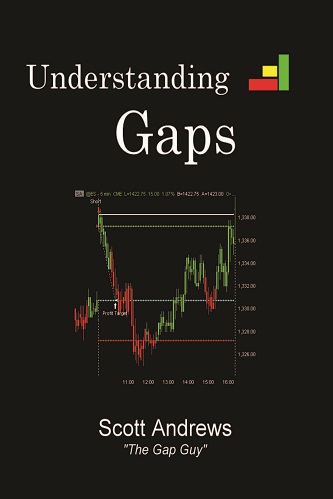
Understanding Gaps: Profiting from the Opening Gap
$9.99
Understanding Gaps: Profiting from the Opening Gap examines how opening price gaps can be analyzed and incorporated into a structured trading approach. Scott Andrews introduces common, breakaway, continuation, and exhaustion gaps, explaining the distinction between trading toward the previous session’s close and trading in the direction of the opening move.
The book’s central framework combines gap size, gap location, prior-day price action, and seasonality. Andrews introduces “gap zones” defined by the opening price’s relationship to previous-session levels, including the open, high, low, and close. Historical studies, primarily using E-mini S&P 500 futures, illustrate how these characteristics affected trading outcomes in the periods examined.
A key theme is the difference between a high winning percentage and a profitable strategy. The book compares stop sizes and target distances, including partial gap fills and targets beyond the previous close. These discussions connect setup selection with profit expectancy, average gains and losses, and drawdown.
Annotated trade examples show how Andrews applies his framework to gap fades, continuation trades, and reversals after a gap fill. Published in 2008, the book combines introductory explanations with historical research and practical observations, providing a foundation for readers developing or evaluating their own gap-trading methods.
✅ What You’ll Learn
- Distinguish common, breakaway, continuation, and exhaustion gaps.
- Identify gap zones using previous-session price levels and direction.
- Evaluate gap size alongside historical fill tendencies and potential payoff.
- Incorporate day-of-week and monthly seasonality into setup research.
- Compare fixed-point stops with stops based on a percentage of gap size.
- Assess partial-fill, full-fill, and extended profit targets.
- Interpret win rate, profit factor, and profit expectancy together.
- Recognize the differences between fading a gap, trading with it, and fading the fill.
- Account for sample size and over-optimization when evaluating historical patterns.
💡 Key Benefits
- A structured selection process: Organizes opening-gap analysis around identifiable price relationships.
- Clearer performance evaluation: Explains why frequent winning trades can still produce weak overall results.
- Integrated trade planning: Connects entry selection, stop placement, targets, and position management.
- Practical illustrations: Includes winning, losing, and avoided setups to show how the framework is applied.
- A focused research foundation: Provides concepts readers can investigate when refining an existing strategy or developing a new one.
👤 Who This Book Is For
- Beginner to intermediate day traders learning to evaluate opening-gap setups.
- Stock-index futures traders interested in the book’s E-mini S&P 500 examples.
- Swing traders seeking additional context for entry timing around gaps.
- Traders familiar with basic charts who want a more systematic approach to testing gap patterns.
📚 Table of Contents
- Introduction
- Why I Love Trading Gaps
- What Are Gaps?
- The Basics
- How To Use & Profit from Gaps
- The Promise of Gaps
- The Paradox
- Creating a Profitable Strategy
- Gap Size
- Gap Zone
- Seasonality
- Stop Size
- Target Optimization
- Real World Examples
- How I Trade Gaps
- Gap Fade Examples
- “Go With” Example
- “Fade the Fill” Example
- Gap Trading Tips
Understanding Gaps: Profiting from the Opening Gap By Scott Andrews
| Author(s) | |
|---|---|
| Product Type | Ebook |
| Format | |
| Skill Level | Beginner to Intermediate |
| Pages | 61 |
| Publication Year | 2008 |
| Delivery | Instant Download |
1 review for Understanding Gaps: Profiting from the Opening Gap
Only logged in customers who have purchased this product may leave a review.
Related products



Mack Liu (verified owner) –
Scott Andrews is the “Gap Guy”. He is the quintessential expert on gaps. This thin, paperback guide offers fundamental definitions about the different kinds of gaps and how to trade them. No one offers a clearer description about gaps than Scott but to really take advantage of his insights one has to subscribe to his paid on-line service with daily gap alerts and recommendations.