
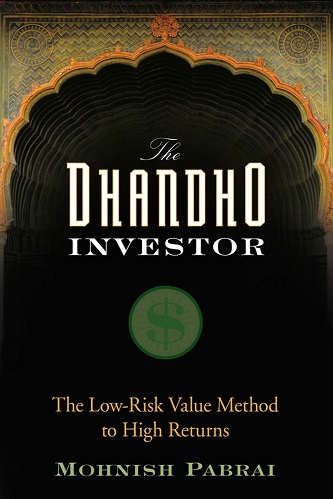
The Dhandho Investor: The Low-Risk Value Method to High Returns by Mohnish Pabrai
$17.01
The Dhandho Investor presents a value-investing framework centred on purchasing understandable businesses at prices that leave room for adverse outcomes. Mohnish Pabrai develops this approach through entrepreneurial examples, including Patel motel owners, Richard Branson and Lakshmi Mittal, before applying the underlying principles to publicly traded equities.
The book organises its methodology around nine principles: existing businesses, simplicity, distress, durable competitive advantages, selective capital allocation, arbitrage, margin of safety, the distinction between risk and uncertainty, and replication of proven business models. Its central concern is the relationship between purchase price, business value and the potential for permanent capital loss.
Pabrai connects these principles to practical analysis through cash-flow valuation examples, investment case studies and probability-based position sizing. His discussion of the Kelly Formula examines both the rationale for concentrated investments and the consequences of overbetting, uncertain probability estimates and portfolio volatility.
Later chapters address selling decisions, the choice between indexing and active stock selection, and focused research within an investor’s circle of competence. The book is particularly relevant to readers developing a disciplined approach to fundamental stock analysis and concentrated value portfolios. Its historical examples illustrate the author’s reasoning rather than establish expected investment returns.
✅ What You’ll Learn
- Analyse shares as ownership interests in existing businesses.
- Estimate intrinsic value using conservative assumptions about future cash flows.
- Evaluate distressed businesses without treating a depressed price as sufficient evidence of value.
- Identify competitive advantages and assess their durability.
- Distinguish uncertainty about future outcomes from the risk of permanent capital loss.
- Use margin of safety to account for valuation errors and adverse scenarios.
- Examine probability-based position sizing through the Kelly Formula and fractional allocations.
- Understand Pabrai’s treatment of arbitrage and repeatable business advantages.
- Assess holding and selling decisions against updated business value.
- Compare indexing with the research demands of active value investing.
💡 Key Benefits
- Provides a coherent framework linking business selection, valuation and capital allocation.
- Makes investment reasoning concrete through entrepreneurial and public-market case studies.
- Encourages selective decisions by defining conditions under which an opportunity should be rejected.
- Connects entry analysis with an explicit approach to reassessment and exit.
- Helps readers organize research around a limited set of understandable businesses.
👤 Who This Book Is For
- Intermediate equity investors developing a fundamental value-investing process.
- Advanced investors examining concentrated portfolios and probability-based capital allocation.
- Long-term stock investors studying distressed opportunities, competitive advantages and intrinsic value.
- Business-minded investors who want to connect entrepreneurial economics with public-market investment analysis.
📚 Table of Contents
- Patel Motel Dhandho
- Manilal Dhandho
- Virgin Dhandho
- Mittal Dhandho
- The Dhandho Framework
- Dhandho 101: Invest in Existing Businesses
- Dhandho 102: Invest in Simple Businesses
- Dhandho 201: Invest in Distressed Businesses in Distressed Industries
- Dhandho 202: Invest in Businesses with Durable Moats
- Dhandho 301: Few Bets, Big Bets, Infrequent Bets
- Dhandho 302: Fixate on Arbitrage
- Dhandho 401: Margin of Safety—Always!
- Dhandho 402: Invest in Low-Risk, High-Uncertainty Businesses
- Dhandho 403: Invest in the Copycats rather than the Innovators
- Abhimanyu’s Dilemma—The Art of Selling
- To Index or Not to Index—That Is the Question
- Arjuna’s Focus: Investing Lessons from a Great Warrior
The Dhandho Investor: The Low-Risk Value Method to High Returns By Mohnish Pabrai
| Author(s) | |
|---|---|
| Product Type | Ebook |
| Format | |
| Skill Level | Intermediate to Advanced |
| Pages | 209 |
| Publication Year | 2007 |
| Delivery | Instant Download |
Only logged in customers who have purchased this product may leave a review.
Related products






Reviews
There are no reviews yet.