
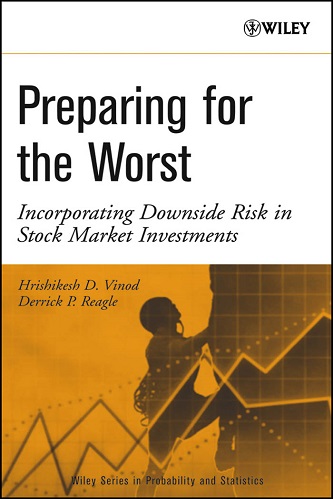
Preparing for the Worst: Incorporating Downside Risk in Stock Market Investments
$23.68
Preparing for the Worst examines how investors can measure and incorporate the risk of adverse stock-market outcomes. Hrishikesh D. Vinod and Derrick P. Reagle develop a quantitative framework that moves from conventional return and volatility measures to downside-focused analysis, alternative return distributions, and investor preferences.
The book combines financial theory, statistical methods, and computational techniques. Coverage includes Value at Risk, lower partial moments, downside performance measures, utility theory, stochastic dominance, and derivatives-based hedging. The authors examine how skewness, heavy tails, changing volatility, and departures from normality affect the interpretation of investment risk.
The analysis also considers risks that extend beyond standard price models. Investor reactions, optimistic forecasts, currency movements, fraud, corruption, and international contagion are examined alongside diversification and portfolio valuation. This connects statistical estimates with the economic and institutional conditions that can influence losses.
Published in 2005, the book provides a technical foundation for analysts, portfolio managers, and advanced students. Its mathematical and computational chapters address matrix methods, option-pricing derivations, simulation, bootstrapping, and numerical accuracy, helping readers assess both risk estimates and the procedures used to produce them.
✅ What You’ll Learn
- Distinguish downside risk from volatility measured across both gains and losses.
- Examine parametric and nonparametric approaches to Value at Risk.
- Apply lower partial moments to downside-focused risk and performance analysis.
- Evaluate how skewness, heavy tails, and time-varying variance affect return models.
- Compare alternative distributions and assess whether normality assumptions fit observed data.
- Connect utility theory and stochastic dominance with investment preferences and portfolio comparisons.
- Understand derivatives-based hedging, option valuation, and sensitivity measures.
- Assess how investor behavior, currency exposure, fraud, and contagion contribute to downside risk.
- Examine simulation and bootstrap methods for financial analysis.
- Identify data, sampling, rounding, and algorithmic issues that can undermine risk calculations.
💡 Key Benefits
- Provides an organised framework for studying potential investment losses.
- Connects risk measurement with investor preferences and portfolio decisions.
- Broadens analysis beyond normal-distribution and constant-volatility assumptions.
- Integrates statistical modelling with economic and institutional risk factors.
- Strengthens scrutiny of the data and computational procedures behind financial estimates.
👤 Who This Book Is For
- Intermediate to advanced investment analysts developing quantitative approaches to equity risk.
- Portfolio and risk managers evaluating downside exposure and diversification limitations.
- Quantitative researchers studying return distributions, simulation, and financial modelling.
- Advanced finance and economics students with a foundation in probability, statistics, and mathematics.
📚 Table of Contents
- Quantitative Measures of the Stock Market
- A Short Review of the Theory of Risk Measurement
- Hedging to Avoid Market Risk
- Monkey Wrench in the Works: When the Theory Fails
- Downside Risk
- Portfolio Valuation and Utility Theory
- Incorporating Downside Risk
- Mathematical Techniques
- Computational Issues
- What Does It All Mean?
Preparing for the Worst: Incorporating Downside Risk in Stock Market Investments By Hrishikesh (Rick) D. Vinod, Derrick Reagle
| Author(s) | |
|---|---|
| Product Type | Ebook |
| Format | |
| Skill Level | Intermediate to Advanced |
| Pages | 315 |
| Publication Year | 2005 |
| Delivery | Instant Download |
2 reviews for Preparing for the Worst: Incorporating Downside Risk in Stock Market Investments
Only logged in customers who have purchased this product may leave a review.
Related products




Zachariah Park (verified owner) –
This book presents the latest ideas in the field from the ground up.
Lia Strong (verified owner) –
Most students in market finance would benefit from using it as an introduction to downside risks.