
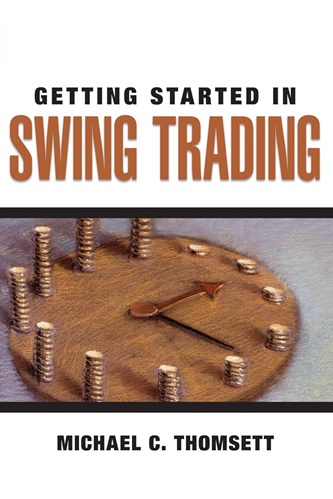
Getting Started in Swing Trading
$14.20
Getting Started in Swing Trading is a structured introduction to short- to intermediate-term trading designed for individuals who want to capture price swings without engaging in full-time day trading. Michael C. Thomsett presents swing trading as a disciplined strategy that balances opportunity with risk control, emphasizing preparation over impulsive execution.
The book begins by defining swing trading within the broader spectrum of market participation. Unlike long-term investing or intraday scalping, swing trading focuses on multi-day to multi-week price movements driven by momentum shifts, earnings reactions, sector rotation, and technical breakouts. Thomsett explains how identifying these intermediate trends allows traders to participate in directional moves while avoiding constant market monitoring.
Technical analysis plays a central role. The author discusses chart patterns, trendlines, moving averages, support and resistance zones, and volume behavior as tools for identifying high-probability setups. Rather than relying on isolated signals, he emphasizes confirmation, entry planning, and structured exit criteria. Risk control is integrated directly into the strategy through disciplined stop-loss placement and position sizing logic.
A defining strength of the book is its practical tone. Thomsett addresses common mistakes such as overtrading, chasing breakouts without confirmation, and ignoring market context. He also explains how broader market conditions influence swing trade outcomes, reinforcing the importance of aligning trades with overall trend direction.
Overall, Getting Started in Swing Trading provides a balanced framework for traders transitioning from passive investing toward active market participation. It blends technical structure, disciplined risk management, and strategic planning into a coherent approach suitable for developing consistent swing trading habits.
✅ What You’ll Learn:
- How swing trading differs from investing and day trading
- How to identify multi-day trend opportunities
- How to use moving averages and support/resistance effectively
- How to time entries using confirmation signals
- How to set stop-loss levels and manage position size
- How market context affects swing trade performance
💡 Key Benefits:
- Provides a clear entry-level framework for swing trading
- Emphasizes structured planning over reactive decisions
- Encourages disciplined capital management
- Helps avoid common short-term trading mistakes
- Builds foundation for intermediate-term strategy development
👤 Who This Book Is For:
- Beginner traders entering active market participation
- Investors transitioning into swing trading
- Part-time traders seeking structured short-term strategies
- Traders wanting defined entry and exit discipline
- Not suitable for high-frequency scalpers or quantitative system developers
📚 Table of Contents:
- The Big Picture: How Swing Trading Works
- The Basic Technical Rules
- Candlestick Charting for Swing Trading
- Reaction Swings and the Reaction Cycle
- Brokerage Rules and the Pattern Day Trader
- Picking Stocks for Swing Trading
- Selling Short: Entering a Swing Trade with a Short Order
- Options for Swing Trading: the Basics
- Option Strategies for Swing Trading
- Swing Trading in Your Investment Portfolio
Getting Started in Swing Trading By Michael C. Thomsett
| Author(s) | |
|---|---|
| Product Type | Ebook |
| Format | |
| Skill Level | Beginner to Intermediate |
| Pages | 225 |
| Publication Year | 2007 |
| Delivery | Instant Download |
7 reviews for Getting Started in Swing Trading
Only logged in customers who have purchased this product may leave a review.
Related products



Kannon Melton (verified owner) –
If it were not for the very meaningful front cover, I might have just rated this a one star. As a professional trader I can tell the book is too shallow (and in lack of passion, insight and substance from the author) to be of any help at all. Some may argue that I am too demanding to require a book of less than 200 content page to be compleat but I assure you “the market” is a killing field arguably with a casualty rate of over 70% that forgives no mistake nor ignorance. Of course, if you think a lukewarm mix of Candlestick, patterns, FA and options is good enough, please simply neglect this review. Otherwise,…………..
p.s. If I had read the backcover which said, “the author has written more than sixty books on investing, real estate, business and management”, I would certainly have given this book a pass.
Crystal Flynn (verified owner) –
I’m new in stock trading. I found this book give a very good overview of swing trading and using an easy understand approach to introduce technical terms such as candlestick chart, sell short and option etc.
I’d recommend this book for newbie of stock trading.
James Watkins (verified owner) –
This book is for beginners only, and if that’s you, you will not be disappointed.
It also touches on subjects such as technical analysis, money management and options.
I’m an experience trader, and I got value out of this book.
Beau Vasquez (verified owner) –
After attending a workshop with “The Market Guys” in June, I was on the hunt for good info to help me start my expedition of options trading. I was finishing up on “Technical Analysis – Plain and Simple” by Michael Kahn when I came across the “Swing Trading” book. It is a great compliment: easy to read, but hits many key points like “trading against the box” (that I applied in a recent Starbucks’ trade in combination with Put options).
The book worked really well for me because it starts off with Support and Resistance, and how to establish trend setup points. I especially like how it emphasizes that traditional investors are missing out on 50% of trading opportunities because they only play up hill.
Surprisingly, the book gives a good intro to Technical Analysis. Like most “Getting Started …” books, there’s a certain amount of general stuff but I found this book to be very useful and has lead to several conversations with my broker.
If you’re a beginner like me and are considering options, I’m currently reading “Options Strategies” 6th Printing by Guy Cohen. If you decide to read this book …
1) Don’t try to make sense of the strategy icon system (very confusing)
2) It has a number of typos and missed edits that will throw you off a little
3) Descriptions often don’t make sense until you’ve SEEN the example so
a) review the example first
b) then go back and read the description
PS: Always, do paper trades for at least a week before trading with real money.
Best wishes
Lola Henderson (verified owner) –
I tried explaining to somebody what swing trading is by detailing the short-term “buy low sell high” idea and failed. I was cut short and confronted by a “isn’t that what all trading is about?” Very true – fancy words make us feel better about what we do don’t they?
Getting Started in Swing Trading is exactly what the title suggests – a getting started book that runs you through the works without insulting your intelligence. You need not to fall exactly into the swing trader category to benefit from reading it. In fact it is a very good book for beginners in trading. I mean who as a keen beginner in the trading business really settles well into the idea of long-term trading straight out?
The book runs through trading emotions, support and resistance, technical and fundamental analysis, chart patterns, candle stick reversals, how to pick stocks and a good section on options. A few times I wondered to myself “haven’t I already read this?” You will find the book regurgitating important concepts throughout – and this is not a bad thing. This book has good information for beginners and I wish I had come across it when I was starting out.
I was however disappointed in the lack of in depth swing trading content; I guess I wouldn’t hold grudges about it considering it does say “Getting Started in” on the cover. If you are a swing trader looking for something to reinforce your trading – this is not the one for you.
Books I’ve read in the “Getting Started in” series so far has been decent.
Marcelo Daniels (verified owner) –
Michael’s book is excellent from the perspective of getting started as one expects; however, the editor and/or typesetter did it a complete injustice. Throughout the book there are places where the words are broken into parts because of full justification and the aforementioned people not paying attention to the detail. Consequently, it makes the reading broken and tedious instead of serving its intended purpose.
While I consider Michael wrote a number of books serving as a good source for introduction to a subject, I would not recommend brothering with this book until the responsible people correct their mistakes.
Kamiyah Garcia (verified owner) –
All good. Many thanks.