
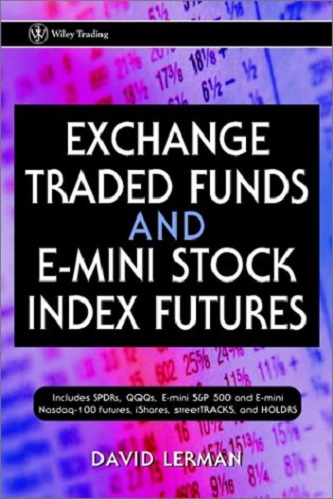
Exchange Traded Funds and E-Mini Stock Index Futures
$17.24
Exchange Traded Funds and E-mini Stock Index Futures examines how index-based instruments serve both active trading and long-term investment management. David Lerman connects the rationale for indexing with the mechanics of exchange traded funds and E-mini futures, explaining how these products provide market exposure, support hedging, and facilitate portfolio adjustments.
The book progresses from indexing fundamentals and benchmark selection to ETF structures, the creation-redemption process, and practical investment applications. Its futures coverage introduces performance bond margins, daily settlement, contract specifications, basis, and theoretical fair value before applying these concepts through trading examples and case studies.
Practical applications include portfolio hedging, cash equitization, spread strategies, sector exposure, and asset allocation. Lerman also explores the core-satellite approach, showing how indexed holdings can be combined with actively managed investments. Worked examples, exhibits, and quizzes help readers connect product mechanics with investment decisions.
Written for beginning to intermediate investors, the book also offers useful context for traders and investment advisers seeking a clearer understanding of index instruments. Published in 2001, it presents the early development of ETFs and E-mini futures through period-specific products, market data, and institutional practices.
✅ What You’ll Learn
- Evaluate the author’s case for indexing through costs, turnover, taxes, and cash drag.
- Distinguish major equity benchmarks and their implications for market exposure.
- Compare ETF structures and explain the creation-redemption process.
- Assess ETF liquidity using bid-offer spreads, market depth, and underlying holdings.
- Interpret futures contract specifications, performance bond margins, and daily settlement.
- Explain the relationship between cash indexes, futures basis, and theoretical fair value.
- Follow worked examples of portfolio hedging, cash equitization, and spread strategies.
- Construct asset allocation and core-satellite approaches using ETFs alongside other investments.
- Evaluate leverage, capital adequacy, and the trade-off between risk and return.
💡 Key Benefits
- Integrated product understanding: Connects ETFs and index futures within a shared framework for managing equity exposure.
- Progressive learning structure: Builds from foundational concepts toward applications and more demanding market mechanics.
- Decision context: Explains why investors choose different instruments for trading, hedging, and portfolio construction.
- Applied study material: Uses numerical examples, case studies, exhibits, and quizzes to reinforce understanding.
- Historical perspective: Documents the formative development of ETF markets and electronically traded E-mini contracts.
👤 Who This Book Is For
- Beginning to intermediate investors seeking a structured introduction to indexing, ETFs, and equity index futures.
- Developing ETF and futures traders studying contract mechanics, pricing relationships, and short-term applications.
- Long-term portfolio investors exploring diversification, asset allocation, and core-satellite investing.
- Investment advisers and portfolio-management learners examining institutional uses of hedging and cash equitization.
📚 Table of Contents
- From Random Walk to a Trillion-Dollar Phenomenon: Why Indexing Works So Well
- The Players
- The Indexes
- ETFs: Beginnings, Advantages, Attributes
- Details: ETF Structures and the Creation-Redemption Process
- General Strategies Using ETFs
- ETF Highlights
- E-Mini Stock Index Futures: The History and Basic Nomenclature
- E-Mini Stock Index Futures: Contract Highlights, Trading Fundamentals, Basis, and Fair Value
- Short-Term Strategies Using E-Mini Stock Index Futures and ETFs
- Longer-Term Strategies: Asset Allocation with ETFs
- Risk: The Most Ignored Four-Letter Word
- ETFs Beyond the United States
- The Future of ETFs and E-Mini Stock Index Futures: The Road Ahead
- Frequently Asked Questions (and Answers) about ETFs and E-mini Stock Index Futures
Exchange Traded Funds and E-Mini Stock Index Futures By David Lerman
| Author(s) | |
|---|---|
| Product Type | Ebook |
| Format | |
| Skill Level | Beginner to Intermediate |
| Pages | 336 |
| Publication Year | 2001 |
| Delivery | Instant Download |
9 reviews for Exchange Traded Funds and E-Mini Stock Index Futures
Only logged in customers who have purchased this product may leave a review.
Related products
Adelyn Atkinson (verified owner) –
I was disappointed because there was very little information on futures, and I was hoping for a lot more. It was also out-dated.
Kane Heath (verified owner) –
Gives you the basic information you need about Index Futures and ETFs.
Duke Schultz (verified owner) –
good book for beginner who wants to know about ETFs (like me). helped me in reviewing my holdings.
Royce Estrada (verified owner) –
I’ve attended several of Mr. Lerman’s stock index seminars that he has done for the Chicago Mercantile Exchange–I agree with one of the endorsers that stated that he is a powerful communicator. He has translated his gift for teaching investment/trading principles into written form. Exchange Traded Funds and E-mini Stock Index futures was not only highly educational, it will help boost my investment returns and help save thousands of dollars in annual fees/expenses as well. I particularly liked the asset allocation section and appreciated how easy it is to construct portfolios with Spiders, QQQs and other ETFs. The best parts though were the multitude of strategies for basic investors all the way up to the more advanced trader. The sections on hedging portfolios against a bear market and spreading small/midcaps vs. large caps were easy to comprehend and implement. With small and mid-sized stocks outperforming the large caps YTD 2001, and in 2000, these types of strategies are very germaine. There are also tons of great statistics, graphs and an excellent section on Risk–the most ignored factor in investing. For the advanced investor he also explains fair value and index arbitrage in very easy to comprehend language. Overall, great job…well worth the time and money spent!
Madalyn Holloway (verified owner) –
I happened to read this wonderful book while in Chicago recently. In browsing through the introductory pages, I smiled at the references to both Warren Buffett and Jack Bogle. Now here, I thought, is someone who “gets it”. Buy this book and read it. It is worth every penny. Amidst today’s cacaphony of financial marketing, Lerman’s voice emerges from these pages with refreshing honesty, simplicity, and reason.
Those trying to educate themselves in the area of personal finance and investment should read this book carefully. For conservative investors as well as for those inclined to a bit of speculation on occasion, this book is very well written and informative.
Following up on the themes that, in the long run (emphasis), economic fundamentals drive returns; that larger, well-established, actively traded markets are, over time (emphasis), highly efficient; and that costs matter greatly when assessing net performance over extended periods; Lerman does an excellent job of explaining the rapidly developing role of ultra low-cost, exchange traded funds (ETFs) as part of any core indexing program. At the same time, he carefully exposes the many hidden (and, unfortunately, rising) costs lurking in most mutual funds today.
Still, Lerman wisely acknowledges, in the short term things can and do happen. While over long periods of time certain markets may be extremely efficient, the difference between that and what may happen in the near term is, as Buffett points out, the difference between day and night. After all, we are inescapably human, and fear and greed will never be completely expunged from our collective psyche. Sudden, unexpected events can result in major market and/or sector security specific swings, and it is during those times that patient investors as well as prudent speculators can occasionally reap outsized returns. Here again, ETFs (as well as the related E-Mini Stock Index Futures for more enterprising individuals) can help.
In short, by building a long-term, broadly-based core portfolio around low-cost ETFs and perhaps a few well-chosen securities and/or money managers (particularly in less efficient markets), and by then (for the enterprising investor) complementing such a portfolio with the occasional, more speculative foray, whether by utilizing ETFs, E-Mini Stock Index Futures, or other means, an intelligent individual should be able to navigate successfully today’s choppy financial waters.
Sutton George (verified owner) –
You will learn all of the basics of ETFs and E-Mini stock futures from this book. The author explains the history of both products and different strategies to trade each one. His experience working for CME helps as well.
Amani Sharp (verified owner) –
I won’t complain about this book at all. It has very good basic information on trading the futures market. Experience traders may not need this but this is a very good starting point and think that is essential for all beginners to own this book.
Sawyer Griffin (verified owner) –
This book at this point in time is obsolete. It is mostly a historical record now…
Ayden Middleton (verified owner) –
This is a well written book and easy to read about the history of ETFs and Emini futures. The author describes the creation of the likes of SPY, QQQ, SMH. Why is it important to know about these instruments, how they get created, who manages them, their cost effective investing over regular mutual funds. He goes in great detail by listing all EFTs available today with their tickers as well, till the point I don’t need to keep going to the internet. I started trading the EFTs for profit and for hedging in particular after reading this book. The introduction about the Emini futures is useful and gave me a good start in this subject.