
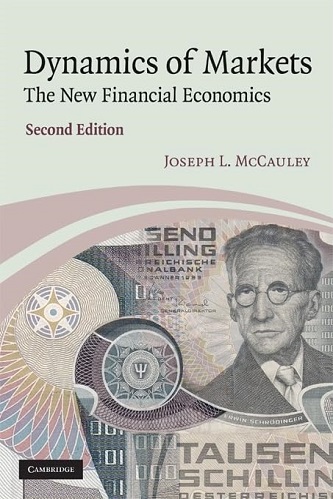
Dynamics of Markets: The New Financial Economics
$28.65
Dynamics of Markets examines financial markets through econophysics, probability theory, and empirical time-series analysis. In this second edition, Joseph L. McCauley develops an alternative to equilibrium-centered economic models, emphasizing nonstationary market behavior and the statistical evidence needed to support a mathematical description of prices.
The book builds from probability and stochastic calculus to Ito processes, martingales, portfolio selection, and option pricing. Its central methodological distinction concerns what different measurements can establish: return distributions and scaling exponents alone are insufficient to identify underlying dynamics, while pair correlations and conditional probabilities provide deeper information.
A detailed analysis of historical Euro/Dollar exchange rates illustrates how approximate statistical ensembles can be constructed from a single market record. McCauley examines detrending, intraday variation, volatility measures, and the misleading results that sliding-window analysis can produce when increments are nonstationary. He also critically evaluates rational expectations, cointegration, and ARCH/GARCH models.
The discussion extends to the Dollar’s development as a worldwide reserve currency, the gold standard, deregulation, shadow banking, and the financial crisis of 2008. For quantitatively experienced readers, the book provides a framework for evaluating market models, understanding pricing assumptions, and connecting statistical analysis with the institutional conditions under which markets operate.
✅ What You’ll Learn
- Distinguish stationary processes, stationary increments, and nonstationary market behavior.
- Use probability distributions, conditional densities, and pair correlations to assess stochastic models.
- Follow the application of Ito calculus and diffusion equations to financial prices and returns.
- Examine market efficiency through McCauley’s martingale framework.
- Understand why Hurst exponent scaling alone does not establish long-term dependence.
- Construct approximate statistical ensembles from recurring features of historical market data.
- Identify potential distortions caused by sliding-window averages on nonstationary increments.
- Analyze CAPM, Black–Scholes pricing, and generalized martingale option pricing.
- Evaluate McCauley’s critiques of rational expectations, cointegration, and ARCH/GARCH assumptions.
- Examine how monetary arrangements, regulation, and credit creation affect market stability.
💡 Key Benefits
- Provides a mathematical foundation for assessing whether a model’s assumptions fit observed market behavior.
- Strengthens research judgment by distinguishing empirical evidence from imposed statistical assumptions.
- Connects portfolio and derivative theory with the liquidity and stability conditions their applications require.
- Integrates quantitative analysis with monetary history and institutional market structure.
- Offers a structured progression from foundational finance concepts to research-level questions in market dynamics.
👤 Who This Book Is For
- Intermediate to advanced quantitative traders and market researchers studying stochastic price dynamics.
- Options traders and derivatives analysts seeking a deeper understanding of pricing and hedging assumptions.
- Economists and finance students examining empirical alternatives to equilibrium-based models.
- Physicists, engineers, and mathematically experienced investors entering econophysics and financial time-series research.
📚 Table of Contents
- Econophysics: why and what
- Neo-classical economic theory
- Probability and stochastic processes
- Introduction to financial economics
- Introduction to portfolio selection theory
- Scaling, pair correlations, and conditional densities
- Statistical ensembles: deducing dynamics from time series
- Martingale option pricing
- FX market globalization: evolution of the Dollar to worldwide reserve currency
- Macroeconomics and econometrics: regression models vs empirically based modeling
- Complexity
Dynamics of Markets: The New Financial Economics By Joseph L. McCauley
| Author(s) | |
|---|---|
| Product Type | Ebook |
| Format | |
| Skill Level | Intermediate to Advanced |
| Pages | 286 |
| Publication Year | 2009 |
| Delivery | Instant Download |
3 reviews for Dynamics of Markets: The New Financial Economics
Only logged in customers who have purchased this product may leave a review.
Related products




Alejandro Morse (verified owner) –
good book
Brian Stewart (verified owner) –
So, I am an economist. I have sympathies with the econophysics literature and community. However, this book is guilty of the worst vices of that community. There are two I wish to point out.
The book’s treatment of neoclassical economics is awful! Truly awful. The author concedes that his understanding of neoclassical economics is based on Hal Varian’s Intermediate Microeconomics textbook. There is no admission that this is the textbook economists use to introduce the formalism of neoclassical economics. It is the first textbook students will see that treats utility and profit maximization. Varian’s book spends almost all its time on static consumer and producer problems, which are not realistic. But, you don’t introduce students to the cutting edge research that attempts to handle all the realistic details that we currently can. You simplify the crap out of everything so that students can develop aptitude and sophistication. Yet, our author accuses economists of believing that Varian’s Intermediate Micro represents what we believe.
He makes some glaring claims that are categorically false. For instance, neoclassical economics can’t handle capital accumulation. If one looked at Acemoglu’s Intro to Modern Economic Growth Theory, Aghion and Howitt’s Endogenous Growth Theory, Romer’s Advanced Macro or any other graduate textbook, you would see that neoclassical economics does handle capital accumulation. Our Author is ignorant of the Solow model, which handled capital accumulation in the 1950s. He also claims that neoclassical econ can handle money. This is also disingenuous at best. Walsh’s textbook on Monetary policy and theory is definitely in the neoclassical tradition. It handles money.
The summary here is that readers should skip chapter 2. There are some tidbits that I agree with (the existence of equilibrium is not enough; how we get there from where we are is important too), but there are lots of just sloppy statements (economists assume equilibrium exists; no we prove equilibrium exists when certain conditions are satisfied. We assume that the market is in that equilibrium), ignorant claims (We can’t empirically construct utility functions; economists have known this since the 1950s), or downright falsehoods (see the above paragraph). So, skip chapter 2. It is not worth reading.
My second point of contention is that econophysicists don’t realize that their notation is different from what everyone else uses. They also have very sloppy derivations of many mathematical statements. Economists learned stochastic calculus from mathematicians. Mathematicians are marvelously pedantic when it comes to notation. Physicists are not; they are actually somewhat infamous for sloppy notation. This book is no exception to that trend. Econophysicists could go a long way to remedy this situation by just putting a glossary of notations they use and explaining their derivations a lot better.
I personally think the econophysics research program should be more influential in economics and finance. The issues outlined above keep economists from trying to learn any of what the econophysicists are putting out. It is a shame. There is value in the collaboration. But, physicists, much like economists, are arrogant and stubborn and refuse to actually learn any of the economics that is done.
Maya Cunningham (verified owner) –
Awesome! The technical portions of the book are non-trivial and really require advanced training in mathematics and / or physics. However, the implications are clear and their exposition relatively approachable give the technical content. More economists should read this!