
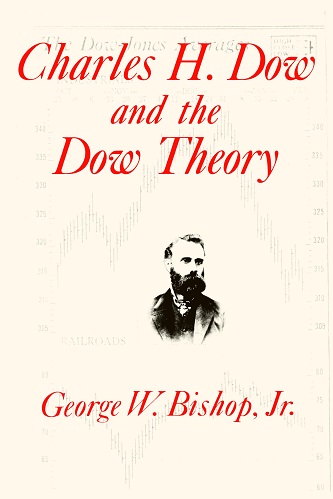
Charles H. Dow and the Dow Theory
$29.66
Charles H. Dow and the Dow Theory combines a biography of Charles H. Dow with a critical examination of how his market observations developed into Dow Theory. George W. Bishop, Jr. traces Dow’s early newspaper career, financial journalism, and stock market writings before examining the contributions of S. A. Nelson, William Peter Hamilton, and Robert Rhea.
Originally prepared as a doctoral dissertation, the book uses documentary research and close analysis of published writings to distinguish Dow’s original ideas from later interpretations. Bishop examines the relationship between prices and underlying values, the classification of market movements, and the role of stock averages. He also compares treatments of confirmation, secondary reactions, volume, and trading ranges.
A central contribution is its explanation that the established Dow Theory represents an evolving synthesis rather than a single, unchanged doctrine authored by Dow. Bishop identifies differences and inconsistencies among its interpreters, including their treatment of chart formations and the independence of market averages from other information. The discussion also examines Dow’s broader principles concerning speculation, losses, overtrading, and security valuation.
For traders, investors, and researchers, the book provides historical grounding for evaluating classical trend analysis. Its substantial appendix reproduces Dow’s “Leadville Letters,” documenting his reporting on the Colorado mining boom and adding context to his development as a financial journalist.
✅ What You’ll Learn
- Distinguish Dow’s original market observations from the later interpretations of Hamilton and Rhea.
- Compare primary movements, secondary reactions, and daily fluctuations within the historical development of Dow Theory.
- Examine how stock averages became tools for interpreting broad market direction.
- Assess the reasoning behind confirmation between industrial and railroad averages.
- Compare differing interpretations of volume, trading ranges, and double-top and double-bottom formations.
- Understand the importance Dow assigned to earnings, underlying values, and market conditions.
- Evaluate Dow’s principles concerning stop orders, limiting losses, and avoiding overtrading.
- Recognize the interpretive limitations and inconsistencies within classical market forecasting doctrines.
💡 Key Benefits
- A documented foundation for understanding the origins of classical technical analysis.
- Greater precision when attributing particular Dow Theory concepts to their historical authors.
- A stronger basis for critically evaluating simplified presentations of trend analysis.
- Broader perspective on the relationship between market movements, valuation, and business conditions.
- Historical context that connects financial journalism with the development of market analysis.
👤 Who This Book Is For
- Intermediate to advanced technical traders seeking a deeper understanding of Dow Theory and trend interpretation.
- Equity investors and market analysts examining the relationship between broad market direction, security values, and economic conditions.
- Students and researchers of financial history studying Dow, early financial journalism, and the evolution of market analysis.
- Trading educators and experienced practitioners who need to distinguish original observations from later formulations of the theory.
📚 Table of Contents
- THE EARLY LIFE OF CHARLES H. DOW
- A NEWSPAPERMAN IN PROVIDENCE
- LETTERS FROM THE MAGIC CITY
- DOW IN NEW YORK CITY
- THE S. A. NELSON VERSION OF THE DOW THEORY
- THE EDITORIALS OF CHARLES H. DOW
- THE INTERPRETATION OF WILLIAM PETER HAMILTON
- THE WORK OF ROBERT RHEA
- THE EVOLUTION OF THE DOW THEORY
Charles H. Dow and the Dow Theory By George W. Bishop
| Author(s) | |
|---|---|
| Product Type | Ebook |
| Format | |
| Skill Level | Intermediate to Advanced |
| Pages | 377 |
| Publication Year | 1960 |
| Delivery | Instant Download |
1 review for Charles H. Dow and the Dow Theory
Only logged in customers who have purchased this product may leave a review.
Related products






Walker Russo (verified owner) –
Good Book