
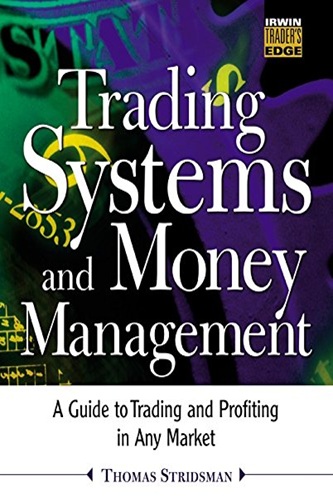
Trading Systems and Money Management
$22.71
Trading Systems and Money Management is a rigorous, technically grounded examination of systematic trading and the mathematical principles that govern long-term profitability. Thomas Stridsman approaches trading not as discretionary speculation, but as a structured engineering problem—where edge, risk control, and position sizing determine survival and growth.
The book is divided into two essential domains: system development and capital management. In the first section, Stridsman explores how trading systems are constructed, evaluated, and optimized. Rather than promoting curve-fitted strategies, he emphasizes robustness, statistical validation, and realistic performance expectations. Readers are guided through key system metrics, including expectancy, drawdown behavior, risk-to-reward structure, and performance stability across varying market conditions.
The second major focus—money management—is where the book delivers its deepest insight. Stridsman explains why position sizing, not entry logic, is the primary driver of equity curve behavior. Concepts such as fixed fractional sizing, volatility-based sizing, and risk-of-ruin calculations are presented in a mathematically coherent yet practical framework. The interaction between leverage, drawdown tolerance, and compounding is carefully examined, reinforcing the idea that capital preservation is a strategic discipline.
Importantly, the book bridges theory and execution. It does not merely present formulas; it explains how money management decisions alter psychological pressure, recovery speed, and long-term equity trajectory. Readers gain a structural understanding of how aggressive sizing accelerates growth but exponentially increases drawdown risk.
This work is not about finding the “perfect system.” It is about building sustainable trading operations rooted in statistical thinking, disciplined sizing, and structural robustness. For serious traders and system developers, this book provides a quantitative foundation for professional-level trading design.
✅ What You’ll Learn:
- How to design and evaluate systematic trading strategies
- How expectancy and risk metrics shape long-term performance
- How position sizing models impact equity curve stability
- How to calculate and manage drawdown exposure
- How leverage and compounding influence capital growth
- How to reduce risk of ruin through disciplined money management
💡 Key Benefits:
- Strengthens quantitative understanding of system performance
- Improves capital allocation and risk control decisions
- Reduces reliance on emotional or discretionary sizing
- Provides structured framework for long-term sustainability
- Enhances robustness of algorithmic and rule-based systems
👤 Who This Book Is For:
- Traders developing or refining systematic strategies
- Algorithmic and quantitative traders
- Swing or position traders seeking advanced capital management insight
- Professionals focused on performance optimization and drawdown control
- Not suitable for beginner traders without foundational trading knowledge
📚 Table of Contents:
- Foundations of Systematic Trading
- Performance Metrics and Evaluation
- Expectancy and Risk Modeling
- Drawdowns and Risk of Ruin
- System Optimization and Robustness
- Fixed Fractional and Alternative Position Sizing Models
- Volatility-Based Position Sizing
- Leverage and Compounding Effects
- Equity Curve Analysis
- Integrating Systems with Money Management
Trading Systems and Money Management By Thomas Stridsman
| Author(s) | |
|---|---|
| Product Type | Ebook |
| Format | |
| Skill Level | Intermediate to Advanced |
| Pages | 415 |
| Publication Year | 2003 |
| Delivery | Instant Download |
4 reviews for Trading Systems and Money Management
Only logged in customers who have purchased this product may leave a review.
Leilany Wright (verified owner) –
It doesn’t matter how great your system is if you don’t have a relevant money management strategy that will sustain you for the long run. Mr.Stridsman does just that. He does not pull punches in showing the relevance of trading systems and how useless they are if there is no money management component.
He then goes on to show you how to combine these two seemingly disparate concepts into concrete solution for trading jus about any market.
Where he falters is in the mechanics of the actual items that you can trade. Especially with single stock futures now on the scene I would have like to have seen some examples of single stock futures in the book. In this instance I would combine Mr.Stridsman concepts with the book “Single Stock Futures For Small Speculators” or “Futures For Small Speculators”.
Otherwise I was thoroughly impressed.
Grayson Sosa (verified owner) –
From the content to the writing style this book scores a zero. The book is more of a sales piece for another book Stridsman wrote. I have never heard of someone being so stuck on percentages. Stridsman should be a middle school math teacher. Of course percentages are important, but I don’t think we need to pay nearly 40 dollars for a magazine columnist to tell us that. I guess if you happen to want to buy his code for tradestation you might find the book more interesting, but you can get that stuff for free off of many sites. Don’t waist your money.
Alec Stein (verified owner) –
Wow, what can I say? This is a huge disappointment. I don’t think you really need this book because Stridsman’s first book is good enough and better. The problem with this book is that the systems are rehashes of articles that the author has already written for Active Trader magazine, and the systems are not even that good. This book is “been there, done that” — it does not advance the technical analysis literature with any new concepts or ideas. I had a strange feeling of deja vu only a few pages into the book. Again, I am really surprised that this book was released – cannot recommend it at all.
Cassandra Baxter (verified owner) –
Excellent Seller! This is a great book. It is a little hard to follow b/c the author (IMO) is a brilliant code writer, but the book is a bit disjointed. My opinion is it would be better to tell us JUST what works and not lots of info and methods that don’t. That’s just me though. Mr. Stridsman goes into great detail regarding the methods that DO NOT work and why. Interesting, but I would rather him just say, “I’ve tested this, and it doesn’t work”.
For a “coder”, I imagine this book would be fabulous. The book is still excellent- you just have to VERY carefully sift through lots of his thoughts and ideas to pick out the real “brass tacks”. The code is written for TradeStation, and will have to be “tweaked” due to the age of the book. That can be a difficult task unless you are very good with “coding”.