
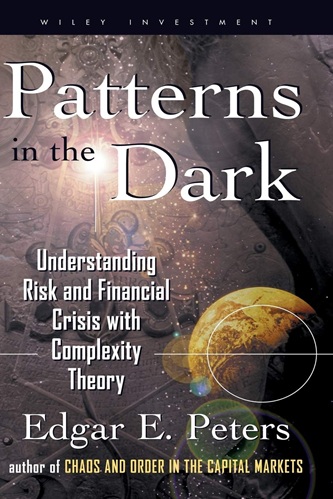
Patterns in the Dark: Understanding Risk and Financial Crisis with Complexity Theory
$22.31
Patterns in the Dark is a rigorous, intellectually demanding exploration of financial markets through the lens of complexity theory, nonlinear dynamics, and chaos. Edgar E. Peters challenges traditional financial models that assume equilibrium, normal distributions, and rational behavior, arguing instead that markets behave as complex adaptive systems prone to instability, regime shifts, and extreme events.
Rather than offering trading setups or tactical strategies, this book provides a conceptual framework for understanding risk, market crashes, and systemic fragility. Peters explains why conventional risk metrics—such as variance, beta, and Gaussian assumptions—fail during periods of financial stress, and how complexity-driven behavior leads to fat tails, clustering of volatility, and unpredictable cascades.
The book draws from physics, mathematics, and systems theory to explain how order and disorder coexist in markets. Peters shows how seemingly random price behavior can contain hidden structures, and how crises emerge not from single causes but from interacting feedback loops within the financial system. This perspective fundamentally reframes how investors, risk managers, and policymakers should think about uncertainty and stability.
Patterns in the Dark is not a how-to trading manual. It is a foundational work for readers who want to understand why markets break, why risk is inherently nonlinear, and why financial crises are not anomalies but natural outcomes of complex systems. The insights presented here are essential for advanced practitioners seeking a deeper, more realistic view of financial risk.
✅ What You’ll Learn:
- Why traditional financial models fail to explain market crises.
- How complexity theory applies to financial markets and risk behavior.
- The role of nonlinear dynamics and feedback loops in market instability.
- Why volatility clusters and extreme events occur more frequently than expected.
- How chaos and order coexist within market price behavior.
- The limitations of equilibrium-based risk management frameworks.
- A new way to conceptualize systemic risk and financial fragility.
💡 Key Benefits:
- A deeper, more realistic understanding of financial risk and crises.
- Replaces oversimplified models with complexity-based market thinking.
- Enhances strategic insight for risk management and portfolio design.
- Provides intellectual tools for interpreting extreme market behavior.
- Serves as a foundational reference for advanced financial theory.
👤 Who This Book Is For:
- Advanced investors and analysts interested in systemic risk.
- Risk managers seeking alternatives to traditional volatility-based models.
- Academics and practitioners studying financial crises and instability.
- Readers with a strong interest in complexity theory and market dynamics.
📚 Table of Contents:
- Imposing Order: Conspiracies and the Mathematics of Ignorance
- Uncertainty, Vagueness, and Ambiguity: The Need for Information
- Complexity and Time: The Dynamics of Uncertainty
- Subjectivism: “The Economics of Time and Ignorance”
- Diversity and Knowledge
- Crisis and Competition: Creative Destruction in Free Markets
- Economic Evolution: Change in Real Time
- Creativity: Uncertainty, Innovation, and Entrepreneurs
- Rules and Law: Limits in Complexity
- Degrees of Order: Balancing Rules, Freedom, and Uncertainty
- The Need for Uncertainty
Patterns in the Dark: Understanding Risk and Financial Crisis with Complexity Theory By Edgar E. Peters
| Author(s) | |
|---|---|
| Product Type | Ebook |
| Format | |
| Skill Level | Intermediate to Advanced |
| Pages | 241 |
| Publication Year | 1999 |
| Delivery | Instant Download |
3 reviews for Patterns in the Dark: Understanding Risk and Financial Crisis with Complexity Theory
Only logged in customers who have purchased this product may leave a review.
Related products


Trent Curry (verified owner) –
Ever the standard bearer for the rational approach in the complacent and often hide-bound practices of most people to the world of financial-economics, Peters makes a compelling and ultimately convincing case for the paradigm of complexity to supplant that of equilibrium.
Lest the rank-and-file practitioner forget, the most humble methods one has for interpreting any information in the market have their conceptual grounding from the 1930’s application of equilibrium in physics to economics. These humble methods include the Portfolio Theory of the 1970s and Graham & Dodd of the 1930s. What most practitioners fail to appreciate is that once that conceptual foundation is changed from equilibrium to complexity, every metric and every conclusion drawn from those metrics change also.
The changes Peters highlights, while based on solid science, challenge much of the convetional wisdom. It is the millenium and age of enlightenment. Investors should treat themselves to some of the same and read this book.
Cade Lawrence (verified owner) –
I found the discussions of complexity and risk as applied to financial crisis to be superficial and somewhat platitudinous. There are no in depth discussions of the factors involved in any recent financial crisis. There are various discussions of risk, complexity, evolution and Keynesian vs. Austrian schools of economics but no real depth or new perspectives on any of these issues are presented. The discussion of the pros and cons of socialism(collectivism) vs. capitalism(free market) societies was not much more substantive than an article you might see in the Business Section of USA Today. A graph showing(arguing) that the US is higher in on the scale of economic “uncertainty” than China or Russia is highly suspect. One of the defining features and advantages of the US capitalistic system is the relative sanctity of private property and enforceable contracts which provide a foundation of “certainty” upon which vibrant commerce can be enabled. Such institutions are completely lacking in communist states which is one of the major reasons for their collapse. I have to question the scholarship behind the presentation of such a comparison. This book is not worth your time or money.
Alison Cabrera (verified owner) –
This seems to be the author’s own loose ideas about Austrian economics vis a vis complexity in markets. It is not complexity theory in any formal or quantitative sense. It was a pleasant enough read, but in terms of boosting any “understanding” of risk, etc., it might only have sharpened a bit of my skepticism about various other schools and methods purporting to do so.