
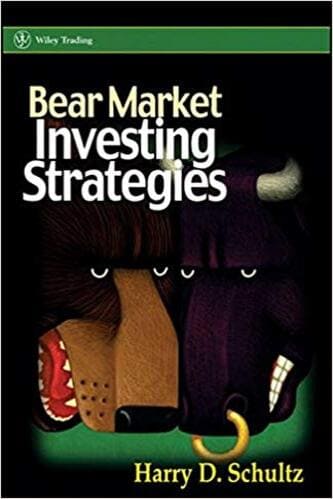
Bear Market Investing Strategies by Harry D. Schultz
$22.09
Bear Market Investing Strategies is a structured guide to recognizing, navigating, and managing capital during prolonged market declines, recessions, and major corrections. Harry D. Schultz approaches bear markets as distinct investment environments that require different assumptions from sustained bull markets. The book combines historical market study, economic interpretation, technical analysis, capital-preservation principles, tactical positioning, and investor psychology.
The methodology begins by examining the history and structure of bear markets. Schultz distinguishes between different degrees of bear markets, studies secondary rallies and declining market legs, and argues that historical comparisons should be used as contextual models rather than mechanical forecasts. Economic conditions, monetary developments, globalization, political events, and market data are considered together to form an evolving assessment of the broader market environment.
The practical framework then moves into market measurement and portfolio management. The book examines technical indicators, chart interpretation, cycles, trend behavior, short selling, stop-loss protection, defensive investments, and strategies designed to reduce the consequences of incorrect market forecasts. Capital preservation is treated as the primary objective during adverse conditions, with investment returns considered in relation to the amount of risk being assumed.
The final sections address flexibility and psychology. Schultz emphasizes adjusting positions as evidence changes rather than remaining permanently bullish or bearish, while also examining crowd behavior and contrary opinion. The result is a bear-market investment framework built around historical perspective, technical evidence, risk control, adaptable positioning, and disciplined decision-making.
✅ What You’ll Learn
- Distinguish major bear markets from ordinary corrections and secondary reactions.
- Study historical bear markets to develop context for evaluating changing market conditions.
- Recognize economic and market guideposts associated with deteriorating or recovering conditions.
- Differentiate bear-market rallies from the beginning of a sustainable new bull market.
- Analyze bear-market legs, trend changes, technical indicators, cycles, and chart structures.
- Apply capital-preservation principles when downside risk becomes more important than aggressive return seeking.
- Understand short selling, covering positions, stop protection, and the risks associated with trading declining markets.
- Develop contingency strategies for situations in which your market-direction forecast proves incorrect.
- Evaluate defensive investments according to the type and stage of the bear market.
- Manage fear, optimism, crowd psychology, and contrary opinion as components of investment decision-making.
💡 Key Benefits
- Provides a complete framework for approaching markets when conventional buy-and-hold assumptions become less dependable.
- Places capital preservation and predetermined risk ahead of maximizing short-term returns.
- Combines technical market tools with economic, historical, and behavioral analysis rather than relying on a single forecasting method.
- Explains how investment tactics can change between early, middle, and late stages of a bear market.
- Develops a flexible decision process that allows investors to hold, sell, remain in cash, hedge, or take bearish positions according to changing evidence.
- Connects portfolio strategy with investor psychology, recognizing that execution and emotional discipline can materially affect results.
👤 Who This Book Is For
- Beginner to intermediate investors seeking a structured understanding of bear markets and capital-preservation methods.
- Long-term investors who want alternatives to simply holding positions through prolonged market declines.
- Active investors and traders interested in short selling, market timing, technical indicators, and defensive positioning.
- Market participants who want to integrate historical analysis, market psychology, and risk management into investment decisions.
📚 Table of Contents
- THE BEAR BACKGROUND
- ECONOMIC SETTING FOR BEAR MARKETS
- STRUCTURE OF BEAR MARKETS
- TOOLS FOR MEASURING BEAR MARKETS
- MONEY-MAKING TACTICS
- THE EMOTIONAL ASPECT
- PREDICTIONS AND CONCLUSIONS
Bear Market Investing Strategies By Harry D. Schultz
| Author(s) | |
|---|---|
| Product Type | Ebook |
| Format | |
| Skill Level | Beginner to Intermediate |
| Pages | 181 |
| Publication Year | 2002 |
| Delivery | Instant Download |
6 reviews for Bear Market Investing Strategies by Harry D. Schultz
Only logged in customers who have purchased this product may leave a review.
Related products






Piper Herrera (verified owner) –
The book was very straight forward and very interesting,. I have found alot of the information was true.
Kyla Reed (verified owner) –
Save your money for something more useful. There is nothing in this book that makes it worth the price. A far better book on bear market investing is “Riding the Bear” by Sy Harding. And for concepts about timing the market and investing both long and short, see Les Masonson’s “All About Market Timing” and Deborah Wair’s “Timing the Market.”
Dax Price (verified owner) –
Good tips such as to invest in gold and using shorting. I would recommend “After Shock” and ” “Random Walk Down Wall Street.”
Arlo Maxwell (verified owner) –
If you had acted on the advice in this book 3 years ago you would be rich, but don’t let that stop you from reading it now. By most historical models the stock market remains wildly overvalued and the information in this book retains its validity today. This book is a joy to read and offers balance to the talking heads at CNBC and the other mainstream media outlets that could never call a top to the market, but issue new prognostications about a bottom every week. The information on short selling alone is worth the price of the book.
Leslie Valencia (verified owner) –
In the late ’90s, when the market was going up almost every day, investing was easy and everybody was a genius. Things have changed, and those who haven’t changed their strategies have gotten clobbered. Mr. Schultz gives good ideas for preserving your account in rough times. I subscribe to several great sites, among them thestreet.com and tradingmarkets.com, and this, combined with some strategies in Mr. Schultz’s book, have helped me to keep most of my account intact through this market.
Easton Zuniga (verified owner) –
Of course, the author is well known for his financial writings, having experienced the Great Depression, WW2, the stagflation of the ’70s, etc. yet finding profit during these periods. “Bear Market Investing Strategies” is the summation of the author’s methods of preserving, even gaining wealth during financial disasters.