
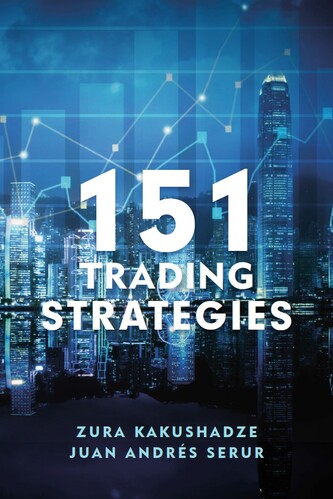
151 Trading Strategies
$22.80
151 Trading Strategies provides detailed descriptions, including more than 550 mathematical formulas, for more than 150 trading strategies across a host of asset classes and trading styles. These include stocks, options, fixed income, futures, ETFs, indexes, commodities, foreign exchange, convertibles, structured assets, volatility, real estate, distressed assets, cash, cryptocurrencies, weather, energy, inflation, global macro, infrastructure, and tax arbitrage.
Introduction:
A trading strategy can be defined as a set of instructions to achieve certain asset holdings by some predefined times t1, t2,… , which holdings can (but need not) be null at one or more of these times. In many cases, the main objective of a trading strategy is to make a profit, i.e., to generate a positive return on its investment. However, some viable trading strategies are not always outright profitable as stand-alone strategies. E.g., a hedging strategy can be a part of a bigger plan, which itself can but need not be a trading strategy. Thus, an airline hedging against rising fuel costs with commodity futures is a trading strategy, which is a risk management step in executing the airline’s business strategy of generating profits through its services.
In the case of trading strategies that are intended to be outright profitable as stand-alone strategies, one may argue that the phrase “buy low, sell high” captures their essence. However, this viewpoint is somewhat superfluous and, while it applies to trading strategies that buy and sell a single asset (e.g., a single stock), it would exclude a whole host of viable strategies that do not work quite like that. E.g., a trading strategy that uses a hedging sub-strategy for risk management may not always “buy low, sell high” when it comes to a particular asset in its portfolio. This is because hedging risk—or, essentially, transferring some risk to other market participants—is not free, and often a trader will pay a premium for hedging some risks in a trading strategy to achieve its objectives. Another example would be the so-called statistical arbitrage, wherein the trading portfolio can consist of, e.g., thousands of stocks and profitability is typically not achieved by buying low and selling high each stock or even any discernable groups of stocks, but statistically, across all stocks, with some trades making money and some losing it. It gets complicated quickly.
The purpose of these notes is to collect a variety of trading strategies in the context of finance (as opposed to trading baseball cards, classic cars, etc.) across essentially all (or at least most frequently encountered) asset classes. Here we deliberately use the term “asset class” somewhat loosely and include what can be referred to as “asset sub-classes”. Thus, a narrower definition would include stocks, bonds, cash, currencies, real estate, commodities, and infrastructure. However, this definition would be too narrow for our purposes here. We also consider: derivatives such as options and futures; exchange-traded funds (ETFs); indexes (which are usually traded through vehicles such as ETFs and futures); volatility, which can be treated as an asset class (and traded via, among other things, exchange-traded notes); structured assets (such as collateralized debt obligations and mortgage-backed securities); convertible bonds (which represent a hybrid between bonds and stocks); distressed assets (which are not a separate asset class per se, but the corresponding trading strategies are rather distinct); cryptocurrencies; miscellaneous assets such as weather and energy (derivatives); and also trading strategies such as tax arbitrage and global macro (which use some assets mentioned above as tradables). Some strategies are relatively simple and can be described in words, while many (in fact, most) require a much more detailed mathematical description, which we provide formulaically.
It is important to bear in mind that, unlike the laws of nature (physics), which (apparently) are set in stone and do not change in time, financial markets are man-made and change essentially continuously, and at times quite dramatically. One of the consequences of this transiency is that trading strategies that may have worked well for some time, may die, sometimes quite abruptly. E.g., when the New York Stock Exchange (NYSE) started switching away from its human-operated “specialist” system to electronic trading beginning late 2006, many statistical arbitrage strategies that were profitable for years prior to that, pretty much died overnight as volatility increased and what used to do the trick before no longer did. Eventually, the market was flooded with high-frequency trading (HFT) strategies further diminishing profit margins of many “good old” trading strategies and killing them.
However, technological advances gave rise to new types of trading, including ubiquitous trading strategies based on data mining and machine learning, which seek to identify—typically quite ephemeral—signals or trends by analyzing large volumes of diverse types of data. Many of these trading signals are so faint that they cannot be traded on their own, so one combines thousands, in fact, tens or even hundreds of thousands if not millions of such signals with nontrivial weights to amplify and enhance the overall signal such that it becomes tradable on its own and profitable after trading costs and slippage, including that inflicted by HFT.
Contents:
- Options
- Stocks
- Exchange-Traded Funds (ETFs)
- Fixed Income
- Indexes
- Volatility
- Foreign Exchange (FX)
- Commodities
- Futures
- Structured Assets
- Convertibles
- Tax Arbitrage
- Miscellaneous Assets
- Distressed Assets
- Real Estate
- Cash
- Cryptocurrencies
- Global Macro
- Infrastructure
151 Trading Strategies By Zura Kakushadze, Juan Andrés Serur pdf
| Author(s) | |
|---|---|
| Format | |
| Pages | 480 |
| Publication Year | 2018 |
5 reviews for 151 Trading Strategies
Only logged in customers who have purchased this product may leave a review.
Related products



Stephanie Hayden (verified owner) –
This is exactly what I expected it to be, a concise formulation of the strategy described and all the necessary references to document them and to be able to begin to do a rigorous investigation of each of them.
P.S.: For readers who are looking for gifted work, it’s better to turn around.
Morgan Howell (verified owner) –
No deapth or detailed expalanation of the strategies, only a high level overiew
Rory Ryan (verified owner) –
Content I’ve seen from this author in the past usually included a useful amount of R source code. Was not expecting this book to just be equations with very little description of the strategy, and mostly useless code at the end for a couple strategies.
Bradley McLaughlin (verified owner) –
If there was an option to rate this book zero, I would.
This book only provides 5 to 10 lines summaries of the strategies, you are better off searching the strategies on google for free. Most the pages are just filled with references to other books, he writes a few lines describing a strategy with no actual examples. For example, in Fixed income, there are about 2 pages describing fixed income strategies, then about 25 pages of references. That’s pure nonsense.
DO NOT BUY!
Leroy Calderon (verified owner) –
This book is a complete rip off. There is close to 500 pages in the book. Yet there is only a tiny paragraph (no more than 10 lines), very general, on each strategy and then close to 10 pages of book references after each strategy. And then, as if it were not enough, at the end of the book the author recaps all the references one more time. All in all that’s over 300 pages of references on a 480 pages book.
As for the actual content, you’ll be better of searching the strategies on the internet. There is basically no content in this book. A 10 line description of a very general strategy, no math, no backrest, no optimization.
I would not buy this book for even $5, let alone $20 !!!!