
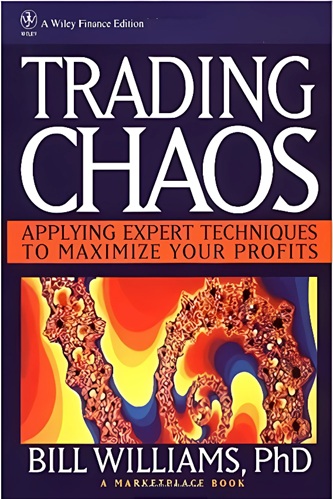
Trading Chaos: Applying Expert Techniques to Maximize Your Profits
$16.58
Trading Chaos: Applying Expert Techniques to Maximize Your Profits by Bill M. Williams is a transformative guide that challenges traditional approaches to trading by introducing a fresh perspective rooted in chaos theory and behavioral science. Williams, a legendary trader and educator, redefines how market structure should be understood, moving beyond conventional indicators to reveal how markets are driven by psychology, nonlinearity, and patterns that most traders overlook.
The book provides a comprehensive framework that integrates technical tools with a deep understanding of human behavior. Williams introduces unique concepts such as the Alligator Indicator, the Awesome Oscillator, and fractal patterns—not as isolated tools but as part of a unified system that reflects how markets truly operate. By blending technical analysis with insights into trader psychology, he demonstrates how to align with the natural rhythms of the market rather than fight against them.
One of the core strengths of Trading Chaos lies in its ability to teach traders how to navigate uncertainty with clarity. Williams shows that markets, like all complex systems, are inherently chaotic but not random. By recognizing order within apparent disorder, traders can identify high-probability setups and exploit them with confidence. The text is filled with real-life examples, charts, and practical techniques that bridge theory with application, making it both intellectually stimulating and directly actionable.
This book is also a roadmap for personal transformation. Williams emphasizes that mastering trading is as much about mastering oneself as it is about mastering charts. He addresses common psychological pitfalls, emotional traps, and decision-making errors that often sabotage traders. By developing awareness and discipline, traders can move from inconsistent results to sustainable profitability.
For both aspiring and experienced traders, Trading Chaos offers more than strategies—it provides a philosophy of trading that empowers readers to embrace complexity, think differently, and achieve long-term success. It stands as a classic in trading literature, inspiring countless traders to adopt a more holistic and adaptive approach to the markets.
Contents:
- A Look at the Current Reality of Trading
- Understanding the Markets
- Chaos Theory: A New Paradigm for Trading
- Defining Your Underlying Structure-and How That Affects Winning and Losing
- Navigating the Markets: The Need for Good Maps
- Level One: Novice Trader
- Level Two: The Advanced Beginner
- Using Fractals and Leverage
- Level Three: The Competent Trader
- Profitunity Trading Partner
- Level Four: The Proficient Trader
- Level Five: The Expert Trader
Trading Chaos: Applying Expert Techniques to Maximize Your Profits By Bill M. Williams pdf
| Author(s) | |
|---|---|
| Format | |
| Pages | 285 |
| Publication Year | 1995 |
20 reviews for Trading Chaos: Applying Expert Techniques to Maximize Your Profits
Only logged in customers who have purchased this product may leave a review.
Related products
Keira Portillo (verified owner) –
a lot of the phD academic comes through in the philosophy and style of writing but the technical portion is excellent to build your knowledge base and incorporate in ones market analysis and tools for trading
Gracelyn Fuentes (verified owner) –
Excellent book ; very well application of the abstract concept into real world trading. Precisely written.
Kohen Farrell (verified owner) –
It is different and telling what I have experienced. Chaos is the main structure of the market and without understandig that structure you will not be the true winners.
Noor Griffith (verified owner) –
As an avid student of Chaos Theory and Fractals, I found this book to be similar to his other one. Williams eludes to using fractals in his analysis but makes no reference to fractal dimensions, Koch curves, monsters or any of the original theories as proposed by Mandelbrot. He does present some scaling principles and their application to Elliot Waves, but this is under the assumption that the Elliot Wave is correct or that you believe in it. I do agree with some of the money flow theories Williams proposes, which is probably the most clearly explained and substantiated part of his trading theoriey. I recommend “Fractals and Scaling in Finance” by Mandelbrot and for software, “Fractal Finance” by Tetrahex. Both of these follow a similar system, although Fractal Finance does use a MACD which appears similar to Williams.
Karter Hopkins (verified owner) –
After buying this book, I realize that I had to read over and over again. Dr. Williams are sound, just hard to grasp. Although his method for detecting waves in sequence is an objective way to measure them.
In order to understand his second(The New Trading Dimensions) book more clearly though, I believe you should read this one to grasp his overall objective. It also set a firm way to measure elliot waves in a totally objective manner.
As other reviewers stated, it is not real strong on chaos theory, which the title is misleading. If your purchasing this book for scientific reasons, then don’t buy it. But if your objective is learning how to make money, then do yourself a favor and get it.
Although his method here(which is different than the 2nd book)is based more on the general overview of the markets, it is a good
starting point to learn his methodology, even though you may have to read 2 or 3 times(like I did).
Harley Rich (verified owner) –
This book really is mistitled. Chaos theory for markets is not presented, so look elsewhere for that. The book does present a good theory for the psychology of trading such as “traders differ on value but agree on price” as motivation and explains the development of traders from novice, intermediate, and advanced (skip master and expert level)and the goals for each level. Unfortunately, the methodology for trading with a Chaos background is not touched upon.
Good filler read for background on trading and personal development. Poor on methodology for trading with Chaos. Perhaps Mr. Williams had an epiphany and contends all trades are done in Chaos, so traders should relax. To borrow a line from another author, “some trades will, some trades won’t, so what, next trade please.”
Ambrose Shepard (verified owner) –
Even though much of what is taught in this book is not used as much due to the more recent book by Bill Williams and his daughter, it is still a great read. Gives all the basic principles of Chaos, the Alligator, Fractals, etc. You can’t go wrong reading this book if you are using Chaos as a method for trading.
Franklin Castaneda (verified owner) –
One of my traders made me revisit the fractal systems in Bill’s book after I pitched the book his way years ago. I always find it funny that the traders in retail land always seem to be on the hunt for a holy grail of trading and a lot of the reviews reflect that.
As a futures trader and asset manager, I can attest to the utility of several components of Bill’s book as having relevance to technical and integrated trading methods on several time frames, including but not limited to intraday. Is it the sole source of our operations? Heavens no. That’s like thinking the basic gross anatomy book from med school will carry you through the entirety of a medical career.
There are few books like Williams’ that have zero utility in trading IF you have the requisite time and culture to make learning. If you want a study in fractals, go get a math degree. If you want to take a loosely conceptual look at how fractals can help zero in on inflections and timinf, read this one in detail. But please pair it with other books regarding practical Elliott Wave and or pattern recognition concepts. It’s beautiful once you piecemeal it together but just remember, this isn’t a PhD study; trading is art and science.
If you’re looking to copycat a solution in public space to make profits in the market, please don’t quit your day job… you’ll need it soon. Take the concepts herein and make them your own. You’ll see the difference… or you’ll quit and complain like 95% of everyone else.
Bowen Berg (verified owner) –
This is a good book which makes you rethink about your current trading system if you are still using RSI, moving averages or market profile. But this is not too much about “Chaos”.
The author spent tremendous amount of time explaining why the technical indicators used nowadays are useless. He also quoted a very good example classifying the errors that typical traders usually commit : the swinging bell theory — We cut losses and later found our original prediction being correct. Then we try to “solve the problem” by allowing a larger cut-loss. However, next time when we make a large loss by using the larger cut-loss, we again try to “solve the problem” by reducing the allowed cut-loss again. This pattern is recurring and just like a swinging bell. The writer did a very good job explaining the drawbacks of technical indicators nowadays and why traders lose.
After reading the first half of the book, I was almost persuaded not to use any technical indicators with linear parameters again. Yet, disappointingly, the author goes on to advertise his first and ever introduced indicator: Market Facilitation Index (MFI), together with other LINEAR-PARAMETIZED indicators. He claimed that the first stage of trading should use these indicators and should target at break-even. Since it is highly recommended by the author and is claimed to be able to win consistently, I have spent 8 hours programming his trading system in my computer, and tested with 2 years Hong Kong Hang Seng Index Futures trading data. Guess the results? The max. gain approximates the max. loss! Well, at least it proves that writer is right — the target of this stage is break-even ONLY! Yet it makes no difference between other technical indicators. This is a disappointing section of the book.
In later part, the author used MACD to clarify the confusion of using Elliot Wave Theory to count the waves. This is nice. Yet the fact that MACD being a linear-parameter indicator seems to be contradictory to what the author is asserting. Besides, after almost half of the book describing the fantasy of Chaos and Fractals, when it comes to the part for its application to the stock market, the author surprisingly concluded that Elliot Wave Theory is the fractal for stock market. If this is the case, I wonder why the author did not put a better title for the book as “Wave Theory”, since there seems nothing related to “chaos” in his trading system.
The author did point out a “fractal” pattern in the book after his 35 years of analysis and sorting process by the computer. The result, unfortunately, was disappointing. I found it useless in the historical data of HSI futures. If the fractal pattern proposed by the author is Fractal A, I may say I have found another Fractal B, which is — in the past 30 years, for every turning points, there was 99.9% that you could found a “HIGH” or a “LOW”. It is true, right? But it’s not useful.
For the section 11 and 12, it seems that the author wants to teach us how to put ourselves in an environment that better controls our psychology. This part is so far so good. I didn’t benefit much from this part as I don’t know how I could control to switch between left brain and right brain during trading. The only thing I want to ensure is my brain still works.
Overall, the book is thought-stimlulating. I benefited from knowing the “scientific reasons” why the popular technical indicators do not work, although I never thought they will work in the past. I also benefited from learning to use MACD to clarify the confusion of Elliot wave counting. Yet the book could be better if the author rewrite it in more concise way. My last word, this book is a good-buy if you don’t take it too serious about “Chaos”.
Jessie Mosley (verified owner) –
Cool book. He kind of rambles at times, but overall it has a lot of valuable info.
Frederick Barajas (verified owner) –
Great price, great book!
Keilani Abbott (verified owner) –
The auther has too much difficulty staying on the subject. It is a strange way of approaching commedities markets.The examples given are confusing.It is an insult to Elliott wave principle followers. Waste of time in my openion.
Aubree Moody (verified owner) –
Easily the worst trading book I’ve ever read. The book is nothing short of complete nonsense with no practical usage for those trading any market. If you’re looking for someone that brags about how many profitable traders they’ve taught then look no further. Bill mentions that fact about 4 different times before chapter 4. Oh, and the number is 450.
Abigail Gordon (verified owner) –
Funny Bill Williams manged to take the complicated theories away and apply a simple method to trading the markets.
Eliseo Gonzalez (verified owner) –
Williams has many good ideas. I’m sure that many of them work. Unfortunately, he presents an idea, tells a story about it, and moves on. Later, he refers to the idea, but he’s not very good at connecting references back and forth. Sometimes he cites a previous chapter, without a page number, and several of his key ideas are not found in the index. A professional technical editor might have been able to help with that.
Other people may disagree, but I found the proliferation of anecdotes and analogies to be so much filler. JMHO.
He makes a lot of claims, but doesn’t cite any studies or data to back them up. If you’re a skeptic, you might want to search on Profitunity trading reviews. A few people are not convinced.
Kade Villegas (verified owner) –
happy with the purchased
Ryland Campbell (verified owner) –
I was greatly disappointed with this book. One would think it is about chaos theory and its applications for the financial markets, but all it has on the subject is one page of text! When I read the book, I had a strong feeling that the author didn’t know what he was talking about when it came to chaos, and that’s why he had so little to say. If you really want to get familiar with chaos theory and how it can help analyze the markets, your best bet is Peters’ “Chaos and Order in the Financial Markets”. Better yet, if you have some mathematical background, “Chaos and Nonlinear Dynamics in the Financial Markets” by R.Trippi offers some serious discussion on the subject.
Gabriela Barker (verified owner) –
If you are looking for a different approach to the markets this is it.
Emmalyn Wise (verified owner) –
This book supports “New Trading Dimensions”. I use it for developing my understanding of ‘NTD’, but it has a useful presentation discussing Elliot waves and the relationship of volume with the day’s trading range.
Wallace Crawford (verified owner) –
This is the best place to read about the Bill Williams indicators and the rationale behind it. Great book.