
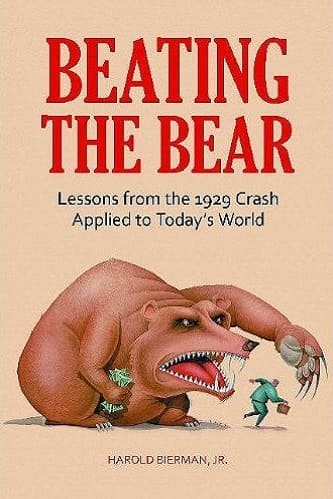
Beating the Bear: Lessons From the 1929 Crash Applied to Today’s World
$17.44
Beating the Bear reexamines the economic crash of 1929 and compares the event to the modern stock market crash of 2008-2009. Twice in the last century the usually stalwart economy of United States has crumbled―first in 1929, when the stock market crash that led to the Great Depression hit, and again with the financial market meltdown of 2008-2009 that is still crippling much of America. While it is still too soon to state unequivocally how this latest economic disaster came about, it is possible to theorize that much of what has happened could have been foreseen and even avoided―just as it could have been in 1929.
Author’s Note:
The year 1929 stands out as the most significant year of the decade of the 1920s. In the minds of most people, the year 1929 marks the crash of the stock market, the beginning of the Great Depression, and the end of a 10-year period of prosperity that exceeded anything the United States had ever known. In 1955, John Kenneth Galbraith published his very readable and enjoy-able classic The Great Crash, 1929. A reader of that popular book might well conclude that it would be foolhardy for someone to retrace the same path. And it would be; but I will follow a different path and arrive at a different set of conclusions.
What actually was the economic situation in 1929? How does it compare to the economic situation in 2008 – 2009? To better illuminate the current dark financial picture, I take a fresh look at the Crash of 1929 and then compare that period to the stock crash of 2008 – 2009. I challenge the facts „everyone knows‰ and overturn previously held assumptions concerning the catastrophic events that led to 10 years of economic depression.
Like-wise, todays news is filled with stories about what is happening and why. While its still too soon to come to rock-solid conclusions about the f inancial market meltdown of 2008 – 2009, much of what has happened could have been foreseen and even avoided · just as it could have been in 1929. By accurately assessing the causes behind the 1929 stock market crash that led to the Great Depression, and the causes that led to the decline of 2008 – 2009, readers can better grasp the present market situation and more wisely make financial decisions.
This book considers the economic situation in 1929 and the events leading up to the stock price declines in October of that year. It concludes that the 1920s were a wondrous period of economic prosperity for the United States, and that in 1929 it was far from obvious that the stock market was in trouble. But something very serious happened in 1929 to stock prices, and we should try to understand it.
There are many myths about 1929 that are incorrect. The myth that is most relevant to this book is „Stocks were obviously overpriced (the evidence suggests stocks were reasonably priced.)‰ While stocks were not obviously overpriced in general, there was one sector of the market, public utilities, that can be shown to have been overpriced. This book is an attempt to refute unjustified myths and to define the causes of the 1929 stock market crash. There were several factors that combined in October 1929 to bring about the crash.
Contents:
- How High Is High? The Stock Markets in 1929 and 2008
- The Events Prior to the 1929 and 2008 Crashes
- Market Myths in 1929 and 2008–2009
- The FedÊs Role in Good Times and Bad
- Practice for the October Crash: The Week of March 25, 1929
- The 1929 Market in Depth: The Ups and Downs of the 1929 Stock Market
- The Great Crash of 2008: The 2008–2009 Market in Depth
- Stopping the Speculators: Margin Buying, Pools, Trusts, Short Selling, and the 1929 Crash
- The Senate Hearings of 1931 Concerning 1929
- Dispelling the Myths of 1929
- The U.S. Government Accuses
- The Prime Cause of the 1929 Crash: The Public Utility Sector
- Lessons to Be Learned
Post-Crash Investment Strategies: Beating the Bear Market
Beating the Bear: Lessons From the 1929 Crash Applied to Today's World By Harold Bierman pdf
| Author(s) | |
|---|---|
| Format | |
| Pages | 221 |
| Publication Year | 2010 |
1 review for Beating the Bear: Lessons From the 1929 Crash Applied to Today’s World
Only logged in customers who have purchased this product may leave a review.
Related products







Thaddeus Small (verified owner) –
Philosopher and novelist George Santayana (1863-1952) once said “Those who cannot remember the past are condemned to repeat it”. For most of us, however, the stock market crash of 1929 and the Great Depression occurred before we were even born. What to do?
Many books and articles have been written on those two cataclysmic events by notable academics, market pundits, and news reporters and many films and documentaries have been produced since then. The underlying theme of the vast majority of such work is that rampant excess speculation on Wall Street during the late 1920s pushed the stock market up to unsustainable heights, making its crash inevitable. The greatest economic depression that followed in its aftermath brought widespread wealth and income devastation not only to the people in America but to the world at large. In heeding Santayana’s advice, there are many lessons to be derived from those dismal times that can be useful in coping with subsequent economic and market upheavals. The problem, however, is that the causes of the 1929 stock market crash that have been generally put forward belong to the realm of mythology. Frankly, if the topic at hand wasn’t as significant to one’s personal economic wellbeing, I wouldn’t mind reading all those exciting, but untrue or partially true, stories.
“Beating The Bear: Lessons from the 1929 Crash Applied to Today’s World” is a formidable and transcendental book which I highly recommend. In short, it is founded on comprehensive and well-researched analysis of the prevailing economic and market conditions in the 1920s and of all the relevant factors and key players (including: U.S. presidents and members of the Congress, Federal Reserve Bank, federal and state regulators, major financial institutions, and U.K government) that contributed to a greater or lesser extent to October 1929’s stock market collapse.
Where this particular book excels, however, is in the author’s synthesizing ability to look through a rather complex set of events and arrive at sound and sensible conclusions of what triggered the Great Crash of 1929, which, in the author’s words, “actually persisted for four years, during which time the stock market lost approximately 72 percent of its value. The largest losses occurred in 1930 and 1931. It is a myth that the market ‘crashed’ in 1929. The crash only began in 1929.”
This is by no means all the book has to offer. In fact, the author draws various parallels between the 1929 crash and the 2008-09 crash that help explain the causes of the latter and why it ended up being so severe. Indeed, in less than a year, after a high of 13,058 in the spring of 2008, the DJIA fell to 6,470 on March 29, 2009, a drop of over 50%!
“Beating The Bear” is not an easy read, but is a fascinating one. If you really want to understand who and what lay behind the worst U.S. stock market declines of the past and how you can be better positioned to confront the next major downturn, please do yourself a favor: read Prof. Harold Bierman, Jr.’s book.